

With the world’s attention focused on the spiraling U.S.-Israeli war on Iran, it’s easy to forget that Latin America was a top priority in the Trump administration’s National Security Strategy published in December. Even as Trump has failed to achieve a quick end to his latest intervention in the Middle East, he has continued to advance his agenda in a region long regarded as U.S. imperialism’s backyard.
The expansion of U.S. influence in Latin America and the Caribbean was evident at the recent “Shield of the Americas” summit, where Trump convened far-right allies from across the region to announce a military coalition aimed at combating cartels. This renewed war on drugs will serve as a pretext for U.S.-trained repressive forces to crack down not only on cartels but also on left-wing opponents, social movements, and marginalized communities that threaten U.S. economic dominance in the region. This was, after all, the true purpose of the war on drugs in the 1980s.
The role of these far-right governments is to attack labor laws and environmental protections, privatize state-run companies and social services, and open Latin America’s resources and workforces to privileged extraction and exploitation by imperialist countries, particularly the United States. But from Chile to Bolivia, the regional Far Right is enjoying increasingly short honeymoons as class struggles flare up to challenge its austerity measures and repressive violence.
The Growing U.S. Bootprint in Latin America
Trump achieved a significant win for the Donroe Doctrine agenda with his kidnapping of Venezuelan president Nicolás Maduro. Since then, the regime now led by Delcy Rodríguez has been moving toward establishing the country as a U.S. protectorate. While there were some initial protests in the United States against Trump’s intervention, that opposition has largely died down, even as Maduro is held in a city governed by a self-described “democratic socialist” mayor.
Meanwhile, the United States continues to strangle Cuba by blockading oil to the island nation, an escalation of the embargo upheld for decades by both Republicans and Democrats. Currently, there is speculation that Cuba might receive some reprieve after Trump agreed not to intercept a Russian oil tanker en route to Cuba. Trump, however, insists that he is still maintaining the blockade, but this recent development has increased pressure on Mexico to send oil. Historically, Mexico has provided aid to Cuba, but in a drastic reversal of this policy, President Claudia Sheinbaum, while paying lip service to sovereignty, has been entirely complicit, halting oil shipments to Cuba even as Mexican workers and leftists demand that oil be sent there. President Lula in Brazil has been similarly complicit even as unionized workers in the country’s state-owned oil companies demand that Lula send oil.
Recently, the Nuestra América Convoy gathered activists from across the Americas and Europe to draw attention to the blockade and deliver aid. While solidarity efforts like this are important, as long as Cuba lacks oil — and an anti-imperialist movement that clearly articulates its demands — the United States will remain in a position of strength. This is especially so as the Cuban government enters talks which risk conceding the gains of the country’s revolution, a path President Diaz-Canel has already been taking the country down.
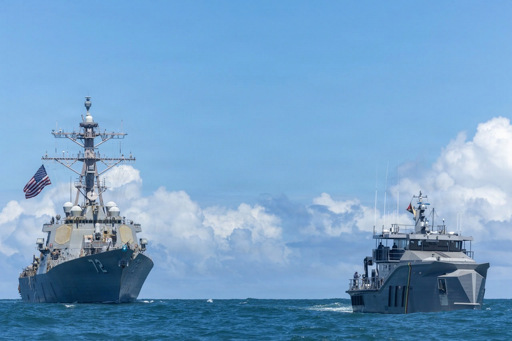
Gaining even less attention is the expansion of U.S. military operations in Latin America, particularly in Panama and Ecuador. In November, reports indicated that U.S. forces resumed operations at Fort Sherman, a Panamanian base that had been dormant since 1999. The U.S. Navy is now present in Panama’s waters for the first time in 50 years. In fact, U.S. troops operating in Panama have become a staple of U.S. Southern Command’s social media presence (see here, here, here, here, and here). Trump, after all, threatened at the start of his second term to take the Panama Canal by force, but he has instead found in President José Raúl Mulino a partner willing to subordinate the country’s sovereignty to Washington’s dictates, even brutally suppressing a rebellion last year that expressed outrage against U.S. imperialism. Now, Ecuadoran president Daniel Noboa is playing a similar role. Although the Ecuadoran people overwhelmingly rejected the establishment of a U.S. military base in a November referendum, U.S. troops have recently begun conducting joint military operations with Ecuadoran forces.
The expansion of U.S. operations in Latin America, dubbed “Operation Total Extermination” — a name that sounds as if it were conceived by a chronically online 12-year-old — poses a real threat to the region’s people, as evidenced by U.S. strikes on alleged cartels in Ecuador, which have already spilled over into Colombia and resulted in bombings of a dairy farm and villagers’ homes in the Amazon.
Class Struggle Can Force a Retreat of Imperialism
Trump’s aggression is taking place in the context of a rightward turn across the region. Since the start of his second term, he has leaned on far-right allies like Argentinean president Javier Milei and El Salvador’s Nayib Bukele. A wave of elections throughout Latin America has brought additional far-right administrations to power, from Bolivia to Chile to Costa Rica. Many of these governments have risen amid disillusionment with center-left administrations. Previous waves of “progressive” leaders campaigned on the aspirations of the region’s working class, students, and social movements, only to compromise with capital and maintain the underlying system of exploitation once in power.
But this rightward turn doesn’t signify a consolidation of the Far Right, because none of these administrations can resolve the various crises that the working and popular classes have endured. Even the Far Right’s repression, backed by U.S. imperialism, has been unable to snuff out class struggle, which has been evident in popular uprisings from Panama to Peru to Bolivia.
In Chile, for example, the new administration of José Antonio Kast lasted only three weeks before its approval ratings began to fall, and environmental activists as well as the country’s powerful student movement have begun taking to the streets. Bolivia’s new far-right president, Rodrigo Paz, has seen a similarly brief honeymoon, facing a powerful uprising. While this process in Bolivia was diverted — largely thanks to the Bolivian Workers’ Center (COB), which compromised with the government — the cycle of struggles in Bolivia could flare up again.
Meanwhile, in Argentina, where Milei has set much of the framework for the region’s new far-right leaders, the revolutionary socialist Left has been gaining popularity. Several political polls in Argentina indicate that Trotskyist congressional deputy Myriam Bregman is among the most popular political figures in the country. On March 24, Argentinians flooded the streets to commemorate the 50th anniversary of the coup that imposed a brutal military dictatorship. These mobilizations were a fierce rejection of Milei, who has denied the atrocities committed by the dictatorship. The mobilizations were championed by the country’s coalition of Trotskyist parties, including Left Voice’s sister group, the PTS, of which Bregman is a leading figure.
Clearly, even as Trump and his regional allies push forward with their agendas, they are not going unchallenged. It is urgent to strengthen resistance against Trump and his allies in Latin America, such as Milei, Kast, and the entire regional Far Right, who seek to hand over the continent’s resources to imperialism. In the United States the struggle against ICE and the war in Iran must fully embrace solidarity with our Latin American siblings, joining the region’s masses in their rejection of austerity plans. A united working class of the Americas, crossing borders around demands such as “Oil for Cuba now!” and “U.S. troops out of Latin America and the Caribbean!” is essential to confront the Donroe Doctrine. We can develop this force if we fight for its emergence.
The post With All Eyes on the Middle East, the Trump Administration Advances Its “Donroe Doctrine” in Latin America appeared first on Left Voice.
From Left Voice via This RSS Feed.