

Photographs by Joseph Bui
Article Summary
• Texas is a major producer of shrimp in the U.S., thanks in large part to Vietnamese immigrant fishermen.
• Fishing—and shrimping in particular—is very dangerous work, with a fatality rate 40 times the national average. The Trump administration has deregulated the industry and cut safety funding, creating an even more dangerous environment.
•Meanwhile, this community has long lacked access to medical care.
• The Docside Clinic, which started in 2021 and operates monthly, provides primary medical care, food, clothing, and social and legal services at no charge.
• Clinic practitioners are planning to expand to other locations in Texas, Louisiana, and Puerto Rico.
It’s a cool February morning in Galveston, Texas. Seagulls circle overhead, and dozens of docked shrimping boats bob in the water. Next to a wooden pier, nurse Martha Díaz crouches down to examine open sores on a shrimper’s heel.
He carefully rolls the cuff of his jeans to his knee and raises his foot so she can see it more clearly. Through a medical student translating her English to Vietnamese, Díaz asks about the cluster of yellow and pinkish-red sores and his history of diabetes as she wipes his foot with gauze and a cleansing solution.
The shrimper is one of a handful of men who’ve come out for UTHealth Houston School of Public Health’s Docside Clinic, monthly pop-up events where local commercial shrimp fishermen—many of them Vietnamese immigrants—can get primary medical care, food, clothing, and social and legal services at no charge. The clinics connect shrimpers to care they would not be able to otherwise access, given many are uninsured, unhoused, and have limited English proficiency and varying immigration statuses.
Traumatic work-related injuries make commercial fishing one of the most dangerous occupations in the U.S.
“It felt like it was a population that was quite literally invisible,” said Shannon Guillot-Wright, an associate professor in the department of environmental and occupational health sciences at the school. She launched the clinics in 2021 with a one-off event to research how to reduce “slips, trips and falls,” but after the shrimpers revealed deeper health disparities, the clinics turned into a monthly commitment.
“When we went out there, everyone basically was like, ‘You’ve got the wrong story,’” Guillot-Wright said. “Many of them would talk about, ‘I haven’t had access to a physician in 10 years. I don’t have access to food; I don’t have access to housing.’” Guillot-Wright changed her approach from specifically focusing on traumatic injuries to seeing them as part of a much bigger picture, one that centered on the fishermen’s basic needs.
Now, patrons gather for a few hours each month under a pop-up canopy to seek care—for everything from work-related injuries to chronic conditions like diabetes and hypertension—from a nurse, two community health workers, a volunteer lawyer, a handful of medical and MPH students, and researcher Guillot-Wright.

Shannon Guillot-Wright, an associate professor in environmental and occupational health sciences at UTHealth Houston. Guillot-Wright launched the Docside Clinics in 2020. (Photo credit: Joseph Bui)
Traumatic work-related injuries make commercial fishing one of the most dangerous occupations in the U.S., with a fatality rate over 40 times the national average, according to the National Institute for Occupational Safety and Health (NIOSH). Out in the open water, fishermen labor for long hours in all kinds of weather as they handle heavy equipment and pull in catches on wet surfaces, which can lead to falls overboard, slips, and severe injuries from machinery. On the docks, fishermen can fall or be struck by fishing gear at boatyards.
Shrimping has proven to be particularly dangerous. Compared with other commercial fishing fleets in the Gulf of Mexico, the shrimping fleet experienced the highest number of fatalities—about half the region’s total—from 2010 to 2014, according to a NIOSH report.
Despite this, the Trump administration has been working to deregulate commercial fishing and cut safety funding and resources for fishermen, creating an even more dangerous work environment—and making the work of the clinic even more vital. Additionally, healthcare costs are skyrocketing; Affordable Care Act (ACA) marketplace premiums are expected to more than double on average this year after Congress failed to extend the ACA’s enhanced premium tax credit.
Amidst this increased instability and need, the Docside Clinic is trying to fill the gap for fishermen who often risk their lives to put food on tables across the U.S. The clinic continues to care for its patrons while also figuring out how to ensure its long-term financial stability and expand the model to fishing communities elsewhere in the country.

The clinic pops up on the docks once a month. (Photo credit: Joseph Bui)
Establishing Care for a Marginalized Community
Since the 1950s, Texas has had one of the top-producing shrimping industries in the country, with catches of white, brown, and pink shrimp. However, in recent years, the industry has steeply declined due to a drop in prices spurred by imported shrimp, high gas prices, and other disruptions, including the COVID-19 pandemic.
Vietnamese fishermen arrived in Texas following the Vietnam War, in the 1970s and 80s, when many people fled Vietnam as refugees. They settled in Galveston and the Texas Gulf Coast, where they could use their fishing skills in a coastal environment similar to that of their home country. Many came with their families, establishing close-knit communities of Vietnamese immigrants here.
They faced intense discrimination from white fishermen, however. In 1981, after the Ku Klux Klan intimidated and harassed them by holding rallies, burning a boat, and hanging an effigy of a Vietnamese fisherman, the Vietnamese Fishermen’s Association successfully filed a lawsuit against the hate group that stopped their intimidation and dismantled their paramilitary militia.
Today, many of the shrimpers are Vietnamese men in their 60s accustomed to the grueling labor of shrimping. They are used to being at sea for four to six weeks at a time, trawling the water with thick green shrimping nets and hauling in 75-pound loads of shrimp—and only sporadically returning to shore.
Before the shrimpers had access to the clinic, many avoided seeking medical care. Guillot-Wright said her research revealed most deckhands reported that they hadn’t seen a primary healthcare provider for years—even decades—due to many barriers, such as the length of time they spent at sea, their tendency to lose important documents in the water or from boat accidents, and financial and language barriers.

A shrimper drags his nets down the dock, flanked by shrimp boats. (Photo credit: Joseph Bui)
To cope with aches and pains, fishermen are also especially prone to self-medicating with alcohol, cigarettes, and substances. Across the fishing industry, substance abuse—including a surge in opioid addiction—is a widely known issue that is intertwined with the high rate of fatal injuries.
One shrimper, who has been in the industry for 40 years, has become accustomed to hearing about and experiencing accidents. He describes his work with a dismissive wave: “No, no—it’s easy.” Yet the broken pinky finger of his leathery, tanned left hand juts out at a 90-degree angle from an accident years ago. While he initially went to the hospital, he missed followup appointments, so his finger didn’t heal properly. He also recalls slipping on the deck and hurting his ribcage, which he didn’t seek medical care for.
Still, he’s used to hearing about far worse. Offhandedly, he mentions a fatal accident that once happened on a nearby boat, when a cable came loose and hit a fisherman. “Somebody there, he [died] in the boat,” he said, pointing into the distance.
That’s why the Docside Clinic is so vital: It makes it easier for fishermen to address injuries and health issues they would otherwise be prone to brush off. “This is definitely a good opportunity to make sure that we’re trying to meet people where they are,” said Díaz, who’s worked at the clinics for over four years.
Kait Guild is the assistant director of Harvard Medical School’s Mobile Health Map, a network of mobile health clinics focused on health equity. She said the flexibility of mobile health can help rebuild trust with people the traditional healthcare system hasn’t been able to reach. “It’s providing care in accessible spaces, places where underserved and marginalized community members and patients of all backgrounds feel safe,” she said.

Sisters CucHuyen “Cecile” Roberts (left) and CucHoa Trieu, community health workers and translators at the clinic. (Photo credit: Joseph Bui)
Respecting Culture, Building Trust
The February clinic fell within Tết, the Vietnamese Lunar New Year, and the clinicians celebrated with a special themed clinic. While the fishermen take turns consulting with nurse Díaz, shrimpers lounge on camping chairs, chatting in Vietnamese as they munch on chả giò, fried eggrolls. Many hold lì xì, red envelopes stuffed with lucky $2 bills, given to them by the clinic team.
Though the dock is an unconventional spot for a health clinic, it’s where the fishermen feel most at home. Their presence permeates the space, from a note written in Vietnamese taped to a door window to a white marble Buddhist statue looking out on the water.
Given the long history of discrimination they have experienced, many of Galveston’s Vietnamese fishermen are wary of strangers, including reporters, and building trust can be complicated.
CucHuyen “Cecile” Roberts and her sister Cuc Hoa Trieu, who migrated from Vietnam to the U.S. in 1986, have worked for more than 20 years as community health workers and translators in Houston, which has the third-largest Vietnamese population in the U.S. The sisters have been pivotal in building trust with the shrimpers since the clinics launched over four years ago.
Their shared heritage with the shrimpers helps them understand the cultural stigma other health workers might miss, like the fishermen’s difficulty asking for help. “That’s culture because it’s embarrassing, it’s shameful, to say you need something. Like, ‘Oh you can’t take care of yourself,’ ” Roberts explains.
At just 4 feet 11 inches, Roberts is a ball of energy, with a magnetism that has helped her become one of the fishermen’s closest confidantes. During the February clinic, she boisterously greets a shrimper while waving him over to come closer. “I hug them. I don’t care if they’re dirty or stinky or whatever,” she said. Gesturing to images on her phone, she said, “You see we take pictures [with them] and stuff like that. Make them very welcome. Make them happy.”
Roberts said she knows how to speak with the fishermen because it’s like talking to people back home in Vietnam. “I know how to make them feel comfortable, because I’m like one of them,” she said.
While it took her and Trieu years to gain their trust, the fishermen now tell them nearly everything—and they reciprocate by picking up the phone and offering help at a moment’s notice. During a previous year’s winter freeze, for instance, Roberts helped the fishermen get blankets after they called in the middle of the night to say they were cold. “They trust us now because they know that we’re here to help them, not to hurt them,” she said.
In the last year or so, they’ve even been able to convince a few of the shrimpers to accept care at a traditional hospital. Roberts sees it as a stride forward: “These guys, they don’t go to the hospital—even [if their] skull splits open, they won’t go!”
Last year, the team noticed over many months that a fisherman in his 60s was in declining health, sweating during cold weather and experiencing high blood pressure. The Docside Clinic, along with its partners, helped the fisherman access medication and housing.
A small grant program at the free health clinic St. Vincent’s Hope Clinic, which covers the cost of Uber rides to and from the hospital, has made it even more possible for fishermen without cars to seek care if the Docside Clinic team notices they’re at risk.
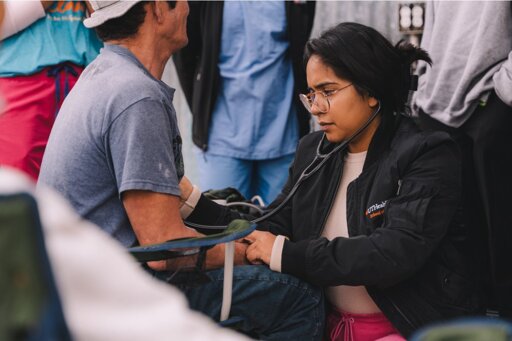
At the February clinic, Díaz advises a fisherman whose blood pressure is abnormally high to get checked out at the hospital. Around 6:30 p.m., hours after the clinic ended, the sisters hop on a call to translate for the fisherman as he tries to arrange an Uber ride.
For Guillot-Wright, it’s been rewarding to see the fishermen access followup care or testing because of their familiarity with the clinics. “That continuity of care exists in a totally different way than it would have if we hadn’t just come out to the docks, plopped down our Academy chairs, and just started meeting people where they are,” she said.

A shrimper rests for a moment on the docks. (Photo credit: Joseph Bui)
The Quest for Long-Term Sustainability
Currently, about half of the clinic’s funding comes from NIOSH, which has faced policy whiplash over the last year. In April 2025, the Trump administration made extensive budget and staffing cuts to the federal agency only for all the fired employees to be reinstated earlier this year after public outcry.
While there was some back and forth with NIOSH, Guillot-Wright said, so far they’ve been able to keep their funding for the Docside Clinic. Still, she’s looking to grow their funding sources to ensure the viability of the Galveston location, as well as maintain a second Texas location in Port Arthur and expand to Louisiana and Puerto Rico.
“We’ve started to diversify and work with foundations, state funding, and think about other sustainable ways that we can keep the work going,” she said.
One way Guillot-Wright has tried to sustain the clinics is by partnering with local nonprofits, as evidenced by a table of free supplies available to the fishermen: cans of sliced pears and tomatoes from the local food bank, packets of Tylenol and Ibuprofen, portable ice packs, hygiene kits—even some mini Old Spice deodorants from the local Seafarers Center.
The clinic has also partnered with lawyer Bill Rankin, who’s provided the fishermen with free legal services for the last two years. One shrimper, through a Vietnamese translator, spoke with Rankin at the February clinic about how to apply for a new green card after losing his.
The card is vital for the fisherman to remain safely in the U.S., and he needs it to return home to Vietnam, which he hasn’t done since leaving in 1977. As he talks about visiting the graves of his parents and grandmother and reuniting with his younger sister, his eyes moisten slightly and his face flushes a soft red. “I [want to] come back to my country,” he said in English.
“We don’t always do the work of thinking about where our food comes from, and I think doing that work as consumers goes a really long way.”
Because of the transient nature of the shrimpers’ lives, Rankin explains documents often go missing, falling overboard or getting lost as shrimpers move from place to place. “They’re here legally generally,” he said of the fishermen, “but they might have, in the course of their employment, lost a particular kind of documentation that they need to get a copy of, or they’re looking to take the next step from being a legal resident to a citizen.”
Given the current political climate in the U.S. and surge of deportations, Rankin worries for the shrimpers. Even for immigrants who are legal residents applying for citizenship or passports, he said “the risk level has increased.”
Ultimately, Guillot-Wright said she sees the clinics as an effort to care for the people who feed us but are often forgotten. “We don’t always do the work of thinking about where our food comes from,” she said, “and I think doing that work as consumers goes a really long way.”
At the clinic, nurse Martha Díaz carefully finishes wrapping the fisherman’s foot to cover his sores. “It may be better to clean your whole entire foot, not just the wound, every day because bacteria can get stuck on your skin,” she explains.
After an interpreter translates Díaz’s instructions, the fisherman nods in understanding—he can clean his foot daily. He rests his newly bandaged foot on the concrete floor as Díaz pulls off her latex gloves and starts to gather the supplies he’ll need when miles out at sea. Perhaps next month, he’ll be back.
The post A Mobile Clinic Delivers Critical Care for Texas Shrimpers appeared first on Civil Eats.
From Civil Eats via This RSS Feed.