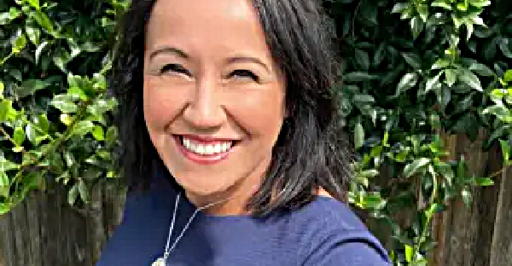
Janine Jackson interviewed Good Jobs First’s Arlene Martinez about Sunshine Week for the March 27, 2026, episode of CounterSpin*. This is a lightly edited transcript.*
https://media.blubrry.com/counterspin/content.blubrry.com/counterspin/CounterSpin260327Martinez.mp3

Janine Jackson: One mark of a democratic society is that we can have debates about how best to organize society. When a small group of powerful people, designated as representatives, can do things that majorities of people don’t want to happen, there’s a fundamental disconnect that we were all taught in school is the very problem that the United States was founded to address.
Talking about that, giving voice to those outside of power, is a fundamental tenet of journalism. It’s why we have a First Amendment that guards the ability to speak difficult truths to power.
OK, but the basics of that conversation would be that we all have access to information. If people want to change anything about our society and the ways we’re governed, transparency about what the powerful are doing is necessary, if not sufficient.
Talking about transparency—what it can mean, where it’s thwarted, and what that means—is the point of Sunshine Week, a project started in 2005 by the American Society of Newspaper (now just News) Editors. It’s a living project, and one of the groups keeping it alive is Good Jobs First. We’re joined now by the group’s deputy executive director and communications director, Arlene Martinez. Welcome back to CounterSpin, Arlene Martinez.
Arlene Martinez: Thanks, Janine. Glad to be here.
JJ: I think of Good Jobs First as the group that stays on top of federal, state and local subsidies that companies are given for what’s often called “economic development,” and how those play out. And that includes a lot of things: corporate malfeasance, tax dodging, how these subsidized entities respect workers’ rights…. My question is, where do you fit journalism in there, and why is Sunshine Week important to you?
AM: I was a journalist before I got to Good Jobs First, and our former research director, who is still on staff, was also a journalist for many years, and Greg LeRoy, executive director, was also trained as a journalist. So we offer these tools, these databases, that are heavily used by journalists.
A big hallmark and central tenet of our work has been transparency. People may not know, but we are filing hundreds of public records requests every year to try to get information on how much money private companies are receiving in the name of “economic development.” So journalism and newsrooms and the role of press is very near and dear to our heart, and very central to our mission. And, of course, it all starts with transparency.
JJ: Yeah, I mean, taxpayer dollars, we hear so much about “taxpayers” and our “dollars,” but they fund government operations. So we have a right, a legal and not just a moral right, to understand and to see how decisions are being made, and how our money is being spent.
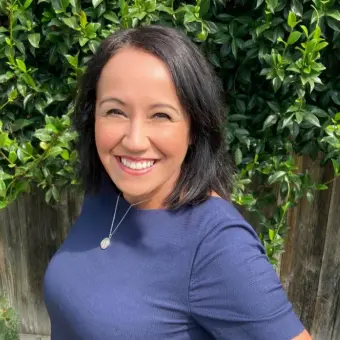
Arlene Martinez: “If we can’t see the money that’s going out, we can’t make any evaluation on whether it’s a good use of our money.”
AM: Yeah, we do. And if we can’t see the money that’s going out, we can’t make any evaluation on whether it’s a good use of our money.
So we know that companies get billions of dollars every year in the form of tax breaks, and discounted land, and all kinds of other goodies that they get. And then some places, you can’t even find out the company that’s getting it, or the total amount of dollars. We’ve come a long way from where there were just a handful of states disclosing online, and now we’re at 49 states that disclose at least some level of information online when it comes to what companies are getting from the public.
JJ: Well, let’s get into it. I often say “PR can pitch, but someone has to catch.” And a corollary to that is, information can be available, but if it isn’t being taken up and used, it’s hard to find the payoff. So that’s where I was so happy to see, not just “yay Sunshine Week” as a concept, but actual examples of where transparency or fought-for access mattered. So if I could, just talk about some of the cases that Good Jobs First researchers have been lifting up recently.
AM: There are a lot of places that we call out for having really good transparency, and part of the work, too, that we do is hoping to create better workplaces and better standards. And what we have seen is states and counties, and even at the city level, putting up their own portals for the public to be able to look to see what companies in their community are doing and how they’re behaving, and also holding them to higher standards.
Like, for example, San Diego County has its own database; it looks at companies that have stolen worker wages, and fights very hard to get them to pay workers back, but also, by putting them on this list that’s very public, also says, “By the way, we’re going to withhold permits from these companies until they pay what they owe workers.” And if there’s still a delay, they even have a mechanism where they can pay workers while those claims are being settled.
And then we have New York City, too, the comptroller’s office. They have what’s called an “Employer Wall of Shame.” There’s violation, penalty and settlement data. Suffolk County, also in New York, runs something similar. So it’s a great way to be able to say, “What are companies in our community doing? Should we be doing business with them”—like from a procurement point of view, for example?
JJ: And it names names. I think that’s what’s so wonderful about it, is that it takes away this sort of scrim of opacity. These are companies, they name their names when they sign up to get their checks, so why can’t we know their names when they are, for example, stealing wages from their workers? I think just naming the names is itself very important.
AM: Yes, it’s just critical. We have fought very hard in a lot of places to get states to release the names of companies, whether it’s how they are treating employers, or other types of regulatory violations that they have, or whether it’s getting an incentive. You have to know the name of the company getting the incentive to figure out what they’re doing with the money, what the community gets in return, and to hold them accountable for when they fall short.
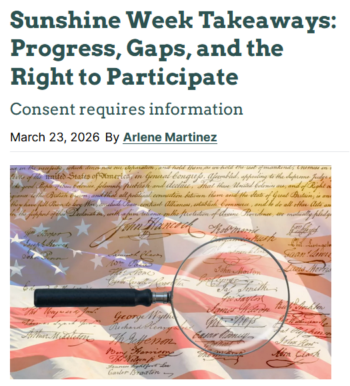
Good Jobs First (3/23/26)
JJ: And we often see journalists doing the story on the breaking of the ground of a new entity, or a new business that got an incentive. But then the follow-up is missing, the piece where we say, “What did we get? ” As you’ve just said, what do we get in return? Sometimes we just don’t see that story. So tracking it is important, and not just celebrating “public/private partnership,” as we so often see in media.
Well, your takeaway piece is called “Progress, Gaps and the Right to Participate.” So I do want to ask you, what are some of those gaps? What are the obstacles that FOIA (Freedom of Information Act) requesters, or people who are trying in other ways to access information from government entities, what are some of the obstacles that are thrown up to them? And then, also: You don’t have to be a reporter, do you, to file for access to information? You don’t have to be with a “accredited journalistic institution,” do you?
AM: No, and I’m glad you mentioned that, because Sunshine Week, if you look on their website, they offer 15 videos. They’re all 30 seconds or less, and they’re all tips for filing public information requests in your own communities. So we can all be doing a part to hold these governments accountable to release information.
And in fact, where we have some of the best transparency in the country, including Chicago, for example, that has come because of community opposition that really swelled in response to a lot of bad deals being done quietly, and we’ve seen that all over the country. The better the transparency is, there’s usually been some kind of a grassroots push behind it.
A lot of states will make a lot of claims for why they can’t release information: It’s proprietary information, or there’s taxpayer confidentiality laws. What we always do is point to the dozens of other states who are releasing this information: “Hey, look, the sky didn’t fall here. That’s actually still a very booming state. There’s no reason not to release this information.”
So I think we still have a long way to go, and we’re seeing, in a lot of places, a clamping down on information, a closing of the door; we definitely want to see it go the opposite direction, but I do think we all have an active role to play, and can play, in opening up the books of our money that’s being spent in our name.
JJ: Right. You just kind of pointed to it, because folks should know that some of the opposition is not just foot-dragging, which you can imagine, or just incompetence, where people can’t find the information. There’s an ideological resistance. There are entities at every level of government that say, and you just tipped it, but that say, “Oh no, we have reasons why, even though your money was used to subsidize this company, or to pay for this project, we can’t let you know how it’s actually working.” People pretend there are reasons for that. Not that they just can’t do it, but that they shouldn’t, for some reason. That seems odd to me.
AM: Yeah, that’s definitely a factor. And also in the ears of some of the officials are very powerful corporate actors. Big Tech right now is getting billions of dollars in subsidies for data centers. This is Amazon, Google, Meta, Apple, and they are very powerful players, and they are insisting on secrecy because they know there’s this growing community opposition to these very energy-intensive data centers. And, for example, in North Carolina, what we saw was we get a lot of transparency around some of their programs, economic development incentive programs, but when it comes to data centers, it operates under a totally different set of rules, and we can’t get any information.
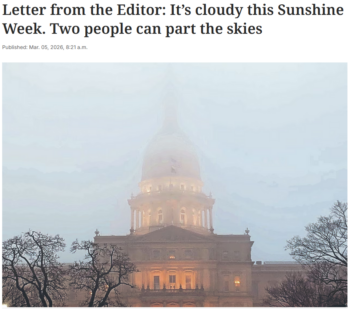
Saginaw News (3/5/26)
JJ: That’s interesting. Let’s talk a bit about media, because, I will say, I saw a heartening amount of Sunshine Week mentions in newspapers, some of it substantive, but I’m talking the Valley Stream Herald in New York, your Citizen’s Voice in Willsbury, PA, your Saginaw News. And like I say, some of this coverage was substantive, and was linking Sunshine Week to local problems and issues that they had.
But I guess I was disappointed to see virtually all of the attention at the local level. It seems as though it’s not seen as an overarching issue, even when we know that, as you’ve just indicated, censorship and opacity at the federal level is wild right now, and is deeply impactful, but the coverage of Sunshine Week just didn’t seem to match up to that.
AM: Yeah. And it may have to do, too, with just the way that information has been shared out around now, what’s going on with newsrooms right now and what their attention’s on. At the federal level, the administration has reporters running from one thing to the other on purpose, right? Nobody can dig into anything, and everything’s just a chaotic fire. And I think it’s difficult for these federal reporters to focus on that. And then, of course, we’ve seen state houses just decimated across the country in media.
I’m glad to hear the effort by local reporters. When I was a reporter at the Morning Call in Pennsylvania, we had a statewide project where newsrooms across the country went out and solicited public records, specifically that we knew should be public, from government offices up and down the state. But it’s such a big deal, when reporters are struggling to get basic information that, not only they used to get, but was always a problem to get, and should be expanded. Now we’re just seeing it go the opposite way.
EFF (3/15/26)
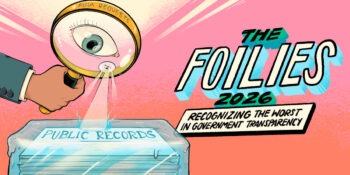
JJ: Yeah. One of the things that I saw that was heartening was Electronic Frontier Foundation, along with MuckRock News, have something called the “Foilies,” which are “awards” that recognize the worst in government transparency. But what I love is that it’s a project from journalism students at the University of Nevada, Reno, where they file FOIA requests as part of their journalism training.
So it does seem like these ideals are alive, at least in the way that journalists are being trained. I’m concerned that once they get jobs working in journalism, then they come up against this brick wall. Things didn’t work the way that they were taught in school they should work.
AM: Yeah. I spent a lot of time in small and medium-sized newsrooms when I was a journalist, and resources were always a big issue. I mean, I would file a lot of records requests, and I would do appeals, but once they denied it a second time, there wasn’t any money for the next step, which would have been a legal battle to get records that I maintain were still public. But, yeah, it’s hard when you hit a brick wall, and especially some of the bigger agencies know how few resources some of these smaller and mid-sized newsrooms have.
JJ: Yeah. You’re exactly pointing to where ideas and economics in modern media conflict, where, as we say at FAIR, journalism as a public service runs up against media as a profit-driven business. And transparency, and the ability to access government records, is one of those very specific areas that maybe you don’t think about, sitting at home reading the paper, but reporters absolutely know about.
AM: That’s right, Janine. And you just reminded me one thing that I completely failed to mention was this huge media consolidation happening. As we know, as a lot of these very ideological, powerful men are buying up social media platforms, the Washington Post, CBS, CNN they’re coming for. So when you have information consolidated, and coming out from a smaller number of national voices, you’re going to see a different coverage, especially if it’s ideologically focused.
JJ: Let me just ask you, finally, because I did come away feeling hopeful from Sunshine Week coverage, both from Good Jobs First and from a wide range of local outlets. But what would be your takeaway for listeners who care about sunshine and transparency and, in terms of what you learned—good, bad, indifferent—what would you like folks to know?
AM: Local governments, the people who work at local governments who are the closest to the people, I think are interested in improving the experience of residents when it comes to transparency and public records. We had a webinar last week talking to a couple economic development officials. We were lifting up their websites for really being good: Denton, Texas, and Eugene, Oregon. And what I walked away from that, and many other conversations that we’ve had from economic development practitioners, is there’s a real desire to do better by residents, and to play a partnership role. And maybe that’s not the case in every statehouse, and maybe, at the federal government, that’s not necessarily the case right now, but at the local level, there is so much impact that a small group of residents can have, and there are a lot of willing public servants who want to do better and are willing to listen.
JJ: All right, let’s end on that note. We’ve been speaking with Arlene Martinez from Good Jobs First. They’re online at GoodJobsFirst.org. Thank you so much, Arlene Martinez, for joining us this week on CounterSpin.
AM: Thanks, Janine.
From FAIR via This RSS Feed.
Transparency is necessary, true, but isn’t sufficient: accountability, & responsibility, both, are necessary, too.
( & probably more I didn’t notice! )
_ /\ _