

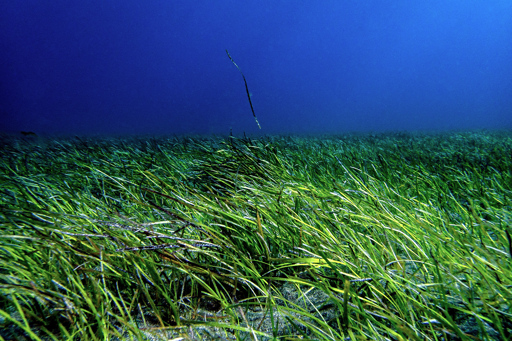
Seagrass meadows, which rarely draw the attention given to coral reefs or mangrove forests, perform a steady but important task: they help hold coasts in place. The plants anchor themselves in sediment through dense root systems that bind the seabed, similar to how forests stabilize soil on land. Oscar Serrano Gras, a researcher affiliated with the Blanes Center for Advanced Studies in Spain and Edith Cowan University in Australia, told Mongabay contributor Sean Mowbray that these underwater meadows can form a natural barrier against erosion. Their structure also allows them to capture and store large amounts of carbon dioxide. As climate change strengthens storms and extends their duration, many coastlines are facing more frequent flooding and infrastructure damage. The loss of seagrass reduces a layer of natural protection. Dense meadows slow water movement, reducing wave energy before it reaches shore. Heidi Nepf, a civil and environmental engineering professor at the Massachusetts Institute of Technology, explained that the leaves create resistance to flowing water, weakening waves as they pass through the vegetation. The details matter. Larger species with broader leaves interact more strongly with moving water. Neptune grass, common in the Mediterranean, can blunt waves far more effectively than smaller varieties such as dwarf eelgrass. At the same time, the plants stabilize sediments and gradually build them up. A study published in Nature in 2024 suggested that widespread loss of Neptune grass could lead to markedly higher water levels along parts of the Mediterranean coast. Even so, scientists caution against treating…This article was originally published on Mongabay
From Conservation news via This RSS Feed.