

This article by Mireya Cuéllar originally appeared in the March 31, 2026 issue of La Jornada Baja California, the Baja California edition of La Jornada, Mexico’s premier left wing daily newspaper.
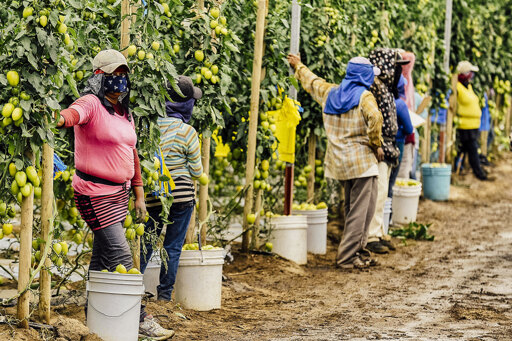
San Quintín, Baja California. How many workers are registered with the Mexican Social Security Institute (IMSS) in San Quintín? The state Secretary of Labour, Alejandro Arregui Ibarra, hesitates. Before revealing the number, he offers an explanation: “Most agricultural workers are seasonal, meaning they are hired according to the product’s cycle and seasonality… this causes registrations and cancellations at the IMSS. The latest figure we have is that there are almost 5,000 registered workers, but the berry season is just beginning.”
According to the latest agricultural census conducted by INEGI in 2022, there were 47,197 farmworkers in San Quintín, of whom 28,841 were men and 18,356 were women. Based on this figure, there are at least 42,000 people living without any form of social security in one of the most technologically advanced agricultural areas in the country, a pioneer in protected agriculture (greenhouses and shade netting), where all irrigation is by drip system.
Raquel started harvesting cucumbers at age 8 on the Los Pinos ranch. “Since I couldn’t carry the bucket, because I couldn’t handle it, I made little piles (of the vegetables) on the ground. My dad would collect them and put them in his bucket. The same with the tomatoes. We children helped,” she recalls, adding that the situation began to change after 2015, when thousands of farmworkers blocked the Transpeninsular Highway and stopped the strawberry and tomato harvest.
“Things have improved,” she points out, “because from the age of 10—imagine, I was in fifth grade!—I was part of a group of kids who waited for the truck on Saturdays and Sundays to go weed or pick scallions, broccoli… and then, when I was 14 or 15, I went to pick strawberries. I could earn a thousand pesos a day picking them because I picked them so fast. And I even stopped studying for a year. When the inspectors came, they would warn my boss a day in advance; we were always on alert and would run and hide in the woods.”
At 36, she has worked in several agricultural fields. Her last job was with BerryMex, where she was so productive that the company helped her obtain an H2A visa so she could work at a U.S. facility. There, she selected strawberry roots during September, October, and November (a cycle she completed several years in a row). Once grown, the seedlings are brought from Nevada or California to be planted in San Quintín, in fields that operate under contract with the multinational corporation.
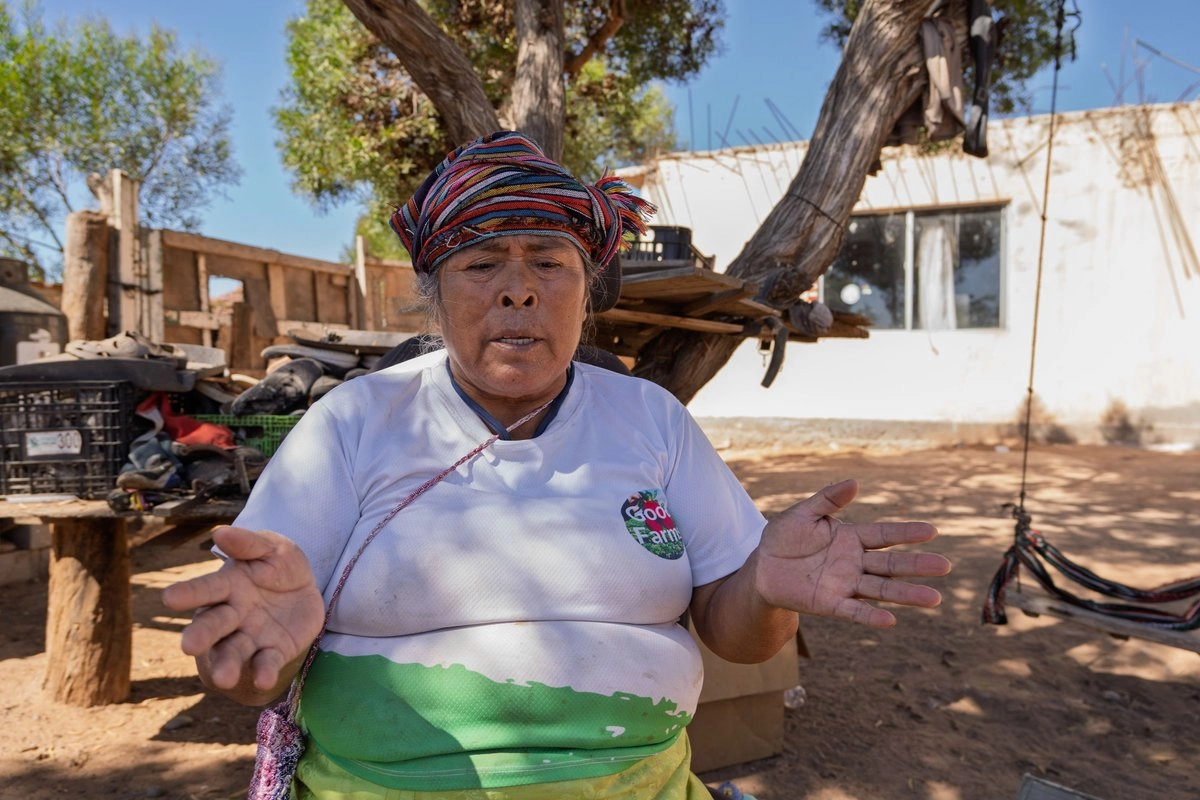
Guadalupe García Darío, originally from Oaxaca and a resident of the area for about 30 years, recounts that she lives without basic services in the San Francisco neighborhood and is experiencing problems with her land due to irregularities in its sale. Photo: Edgar Lima
“We are being selected to work in the US”
“They select us. One of the requirements is having a passport and no problem traveling to the United States. They take us there; we complete the initial application process. If we qualify, they take us to the consulate (in Tijuana), pay for our work visa… it costs 3,200 pesos. They don’t charge us for housing there, so we can save money. We sleep in barracks. And you have to return immediately if you want to come back the following year.”
There is no option other than “going out and paying”
The contracts at the large companies in San Quintín are for five or six months, she explains, “and they don’t always renew them, sometimes not until the following harvest year,” so there’s no other option but to work “going out and paying” for part of the year. “It’s a system that allows us to go to different ranches: to pick peas, cucumbers, whatever’s available, and since nobody asks for papers, we can start working as soon as we arrive from Oaxaca, Chiapas, or Guerrero. It also helps young couples who aren’t yet 18 and don’t have papers… even Haitians were here for a while,” she says without a hint of annoyance.
The technological development achieved by large companies allows for year-round crops, which led to the settlement of farm laborers in San Quintín, forming a community that identifies as “Oaxacalifornians,” a term that initially had a derogatory connotation, but is now reclaimed by some sectors.
In the 2020 census, 41.3 percent of those living here reported being born in Oaxaca. Raquel’s parents are from Tlaxiaco and arrived when they were 15 and 16 years old, with a six-month-old baby—her older brother—going straight to the agricultural fields.
In the 1970s and 80s, migration consisted mainly of men traveling without their families. Many of these day laborers alternated between harvesting in San Quintín, from June to September, and agricultural work in Sinaloa, which began in October and ended in late April. Later, in addition to tomatoes, spring and winter crops such as strawberries and green onions began to be grown, extending production throughout the year.
Thus, the migration pattern was transformed from temporary and individual to permanent and family-based, as noted in the study Agricultural Growth and Working Conditions in the San Quintín Valley, by the Center for Research and Higher Studies in Social Anthropology (CIESAS).
SAN QUINTIN, BAJA CALIFORNIA, MEXICO – 22JANUARY26 – Farmworkers and other residents of the Zapata colonia in the San Quintin Valley blockade the Transpeninsular Highway to protest corruption in the new government of the San Quintin municipality.
Day labourers with the highest minimum wage
The minimum wage today is 440 pesos—up from 130 pesos in 2015—the highest in the country. Businesses and public institutions are combating sexual harassment against women in the fields, children are rarely seen in the countryside, and most families no longer live in the shacks on the ranches, although their homes in the settlements are very precarious.
The United States sometimes includes labor issues in the USMCA (United States-Mexico-Canada Agreement) negotiations. This has changed the situation for farmworkers, as the study describes over more than 150 pages.
They do not accumulate weeks of contributions to the IMSS.
However, this study, published in 2022 – one of the most up-to-date and with a large amount of data, because it obtained permission from the owners of the fields to survey the day laborers at their workplace – found that on average the day laborers accumulate only three years of contributions to the IMSS, not only because the contracts are temporary, but because, as the workers themselves expressed, they are registered for a few days and then deregistered, so that they do not accumulate weeks.
The study concludes that, although the working conditions of day laborers have changed, “this transformation has not occurred in a homogeneous way.
While some workers have formal contracts and all legally mandated benefits, it is possible to identify those who work for daily wages with different employers and without any recognized employment relationship,” which is “a consequence of the very development of the export-oriented agribusiness in the region.” However, it leaves large companies untouched.
In this regard, the study Agricultural Day Laborers and Transnational Corporations in the San Quintín Valley, by Anna Mary Garrapa, published by the Colegio de la Frontera Norte, offers another angle on this export-centered development scheme.
“In true Californian style, the region shifted to intensive production of high-value crops, and thanks to technological innovations, increased yields per hectare and balanced production were achieved almost year-round. Tomatoes, the leading crop in the valley, were reduced, while varieties expanded, particularly onions, cucumbers, and finally strawberries.”
In particular, with the Driscoll’s/BerryMex model (where one acts as the exporter and the other as the producer), he explains, “the farmer receives exclusively proprietary varieties, which he has to destroy once the production quantity required by the marketing company is met… the relationship of the local company associated with them is very close and is characterized by a strong financial dependence and deep control of the entire production process…”
The valley is an extension of California
The valley is “geographically and economically much more integrated with the United States than with Mexico.” Its border location aligns with the thriving U.S. consumer markets and its primary export orientation. Berry production “represents the most emblematic phenomenon of how the valley currently constitutes a productive extension of California.”
But “despite the huge profits made in the US market for fresh berries… wage conditions and access to social protection for employees, especially temporary ones, have not substantially improved after the massive work stoppage in March 2015.”
“The separation between landowners, agricultural companies, and transnational corporations, combined with the multiple levels of labor intermediation, creates an extremely complicated context for workers, who in many cases are unable to identify the economic actors ultimately responsible for the exploitation they experience in the fields,” Garrapa concludes.
-

Tariffs Without Industry: The Trap of Mexican Trade Policy Towards China
March 31, 2026March 31, 2026
Without a policy aimed at increasing the productive investment rate to accompany the country’s reindustrialization process, trade barriers will be inefficient due to the rigidity of the productive structure.
-
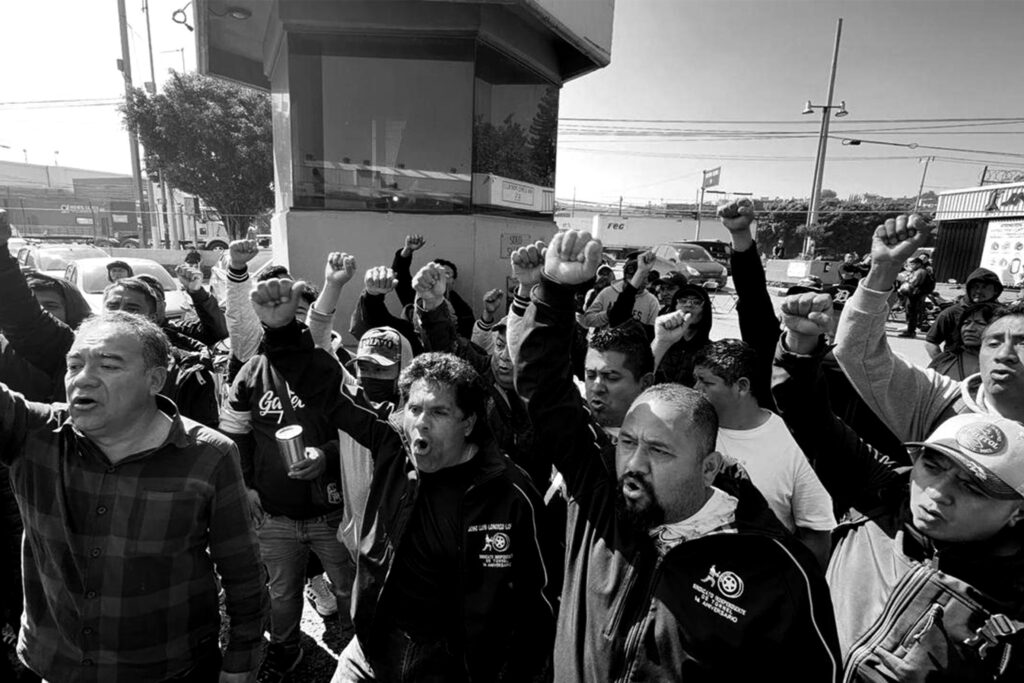
Second Suspect in Attack on Striking Tornel Workers Prosecuted
March 31, 2026
What began as a workers’ protest escalated into an armed attack against those protecting the movement, with four workers shot.
-

Nine Out of Ten Agricultural Workers in San Quintín, Baja California Don’t Have Social Security
March 31, 2026March 31, 2026
“The separation between landowners, agricultural companies, and transnational corporations, combined with the multiple levels of labor intermediation, creates an extremely complicated context for workers.”
The post Nine Out of Ten Agricultural Workers in San Quintín, Baja California Don’t Have Social Security appeared first on Mexico Solidarity Media.
From Mexico Solidarity Media via This RSS Feed.