


The British state has a problem with direct action. It even wants to equate it with terrorism. What’s strange, though, is that the state doesn’t seem to know what ‘direct action’ is or what it means.
Direct action punished
It is a lack of understanding made clear by the re-arrest of Qesser Zuhrah.
At 6:20am on 30 March 2026, Zuhrah was re-arrested only 45 days after being granted bail. The youngest of the Filton 24, she spent 15 months in prison on remand, during which time she was also one of eight hunger strikers. At the time of writing, she is now back in custody, charged with encouraging crime and terrorism.
Video of Zuhrah’s arrest showed masked officers placing her in a car and citing Section 44 of the Serious Crime Act 2007 as grounds for arrest, which reads:
A person commits an offence if
(a) he does an act capable of encouraging or assisting the commission of an offence; and
(b) he intends to encourage or assist its commission.
Supporters have inferred that Zuhrah was arrested for a social media post, in which she used to phrase ‘take direct action’ alongside a video of a group of protestors disrupting an arms factory.
Here we see the British state trying to equate direct action with criminal activity. In some cases, it does take that form. The most high-profile cases associated with Palestine Action are alleged to have caused millions of pounds worth of damage to property. But out of the hundreds of Palestine Action protests that have taken place since 2020, these cases remain a minority. It is clear that direct action cannot be defined on the basis of criminal damage alone, nor can it be understood as terrorism either.
Direct action is a principle
The controversy surrounding direct action has grown exponentially in recent years. The proscription of Palestine Action, in particular – as the first protest group to be ‘disproportionately‘ proscribed as a ‘terrorist’ organisation – has brought new awareness to direct action as a practice. It has also highlighted the disillusionment of a generation.
Since 2023, Western governments have done next to nothing to stop Israel’s genocide of the Palestinians. Instead, they have preferred to maintain relations with rogue states under the guise of lucrative weapons contracts, all at the expense of their (and our) humanity.
Faced with this monolithic indifference, ordinary people have sidestepped negotiations with governments and instead chosen to act directly. Because that’s what ‘direct action’ means. It is a form of protest that sidesteps political negotiation… That’s it…
You’d think this was a simple enough concept to grasp. Unfortunately, as far as the British state is concerned, this definition might as well be written in Arabic.
Lost in translation
British police forces are already in the habit of banning words and phrases they don’t understand. Typically, they ban words in other languages that they don’t like.
Late last year, a joint statement was released by British police forces, warning protestors that they could be arrested if they used the words ‘globalise the intifada’. Highlighting how the most literal translation of ‘intifada’ is ‘uprising’, the Canary‘s Jamal Awar wrote:
The British state can ban words. It can misdefine them. Pretend to understand them… But language can’t care less. You ban words, we find synonyms.
There are, of course, many synonyms for ‘uprising’: ‘insurrection’, ‘revolt’, ‘rebellion’, ‘revolution’, ‘mutiny’. None of these words will get you in trouble with the law. But if you borrow a word from another language — especially a language as scaryas Arabic – you could find yourself in front of a judge. It is racism, plain and simple.
More stupidity
Racism is often grounded in ignorance, but stupidity comes in as many forms as direct action does. Cue the British state now fumbling the meaning of English words and phrases too.
This is not only an issue on social media, but also in the courts themselves. A fundamental contradiction arises when the British state tries to equate direct action with terrorism.
According to the Crown Prosecution Service’s exceedingly broad definition, terrorism includes acts ‘designed to influence the government, or an international governmental organisation’. Synonyms for ‘influence’ include ‘persuade’, ‘change’, ‘talk into’, ‘prompt’… The sorts of words you might use to describe tactics within a negotiation.
But direct action doesn’t seek to negotiate. Direct action aims to stop crime when governments and the police will not. In fact, it aims to stop crimes being committed by power itself. Unfortunately, challenges to power often lead to power flexing itself in response. What this looks like in practice is emboldened repression of dissenting action and speech alike.
Repression of legitimate protest
A recent report from Netpol noted a pattern of repression in British policing in this regard, arguing:
Protest is increasingly policed as a matter of threat management rather than democratic expression.
After approaching Netpol for comment in light of Zuhrah’s arrest, Kevin Blowe called the development “just bizarre, frankly”, telling the Canary:
Direct action is an entirely legitimate thing to be calling for.
Blowe highlighted that there is an important difference between civil disobedience and direct action in this context. Civil disobedience is designed to communicate opposition to injustice. The most obvious contemporary example is the Defend Our Juries campaign, which has persistently protested the proscription of Palestine Action as a terrorist organisation.
Unlike direct action, this form of protest is expressly intended to change government policy through conscientious objection. Direct action takes an entirely different approach. It seeks to obstruct power where it is exercised with impunity. Nevertheless, Blowe continued: “Both are legitimate.”
There is a risk of forgetting that direct action is not entirely new… There have been direct action campaigns going back decades, including the Suffragettes…
[These are] people have tried to engage in more ‘acceptable’ forms of political discourse and found themselves not listened to at all. The arguments aren’t rejected, but seen as inappropriate in themselves, and are therefore attacked.
[Governments take the position that] we are not going to engage with your arguments, but claim you are extremist just for raising them… There is no justification for that level of response from the state.
Dying democracies
The UK government’s attempts to equate direct action with criminal activity are a further development in its attacks of various forms of protest. Viewing all of these attacks together makes one thing clear: political action taken by those who are not members of the political class is feared and subsequently criminalised. But those who take direct action are not a threat to democracy. They are a symptom of disenfranchisement with political ineffectiveness overall.
This is the corner that the UK government has painted itself into. Consider the bare-faced irony of Lord Walney’s 2024 report into ‘Protecting our democracy from coercion‘, which focuses explicitly on a perceived ‘coercion’ from below. It makes no comment on his own capture from above by the Zionist regime. ‘Coercion’ is now a word used exclusively against those who have been shut out of all judicial and democratic remedies to state violence. Our politicians will not save us from this. On the contrary, they are the ones driving it.
Direct action is not terrorism, nor is it (always) criminal. It is a principled and legitimate form of protest with a celebrated history. If incidents of direct action have increased, it certainly raises questions about the state of our democracy. But direct action is a symptom, not a cause, of democratic disenfranchisement. In fact, it is the most glaring symptom of democratic crisis we have seen in a generation.
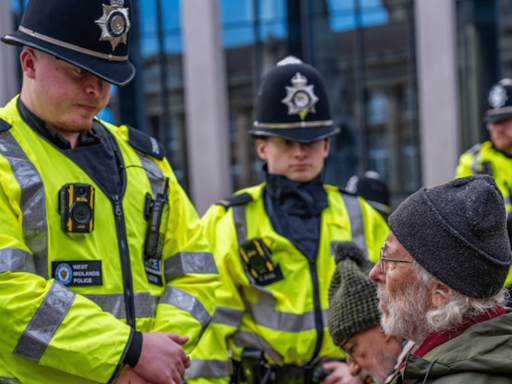
Featured image via the Canary
By Em Colquhoun
From Canary via This RSS Feed.
I mean it’s the british, of course direct action is terrorism to them. They know what it is and they have historically not liked it.