

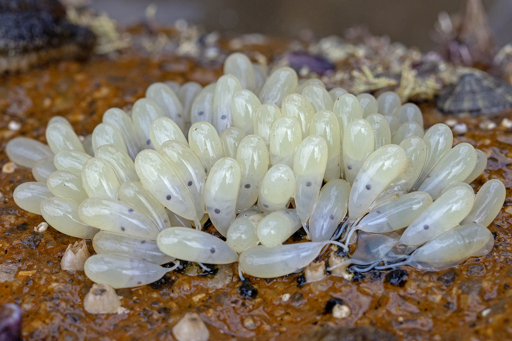
These eggs belong to a small octopus known in Argentinian Patagonia as pulperos. The Patagonian octopus (Octopus tehuelchus) is one of the more common octopus species in the region, but researchers still haven’t been able to determine its global conservation status, although reported catches in Patagonia have declined over the past 50 years. The photo offers a rare glimpse into the early life of the species: The black dots inside each egg are the developing eyes of the embryos, indicating that they’re progressing toward hatching. The female octopus of this species often lays her eggs in the shell of an oyster, then guards them fiercely. She even stops eating during this period. The photo was taken in the intertidal boulders of Argentina’s Puerto Lobos Protected Natural Area by Martin Brogger, a researcher with the country’s Institute of Marine Organism Biology (IBIOMAR). “Finding the nest was a very special moment,” Brogger told Mongabay by email. “Encountering egg clutches in situ always reinforces the idea of how much is happening beneath the surface, even in environments we think we know well.” The species plays an important role as both predator and prey in coastal ecosystems ranging from Argentina’s Patagonia up to the southern coast of Brazil. While the species isn’t considered endangered, overfishing and habitat disturbances caused by human activity, common to coastal ecosystems, are active threats. Banner image: Patagonian octopus eggs in Puerto Lobos Protected Natural Area in Argentina. Image courtesy of Martin Brogger.This article was originally published on Mongabay
From Conservation news via This RSS Feed.
Octopi?
