

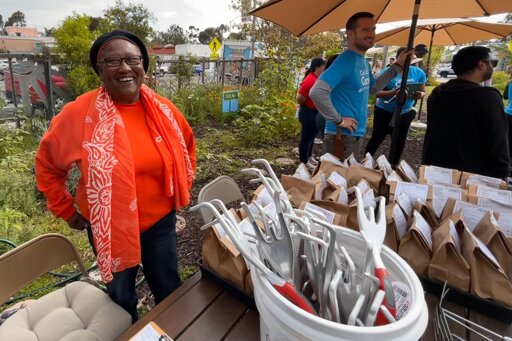
Every Wednesday morning, a refrigerated solar-powered truck arrives at the Mt. Hope Community Garden in Southeast San Diego. The driver hops out and lifts an awning on the side of the truck, revealing shelves that will soon be filled with leafy greens, beets, eggs, avocados, honey, and even specialty fruits like kumquats.
Since 2022, this truck, the People’s Produce Mobile Farmers Market, has sold affordable fresh fruits and vegetables to local residents, helping many stretch their Supplemental Nutrition Assistance Program (SNAP) benefits. With its rotating weekday schedule of stops, the truck can serve a wide swath of neighborhoods in need.
“The first time I entered Mt. Hope community garden was due to food insecurity,” says resident Lucia Davis, who heard about it from a family member. Now she shops at the produce truck weekly. She has also joined a neighborhood growers’ network that donates food raised in backyards to the truck and to the Golden Groceries program, a CSA subscription. The community garden, produce truck, grower’s collective, and CSA all stem from the same place: a multifaceted nonprofit called Project New Village.
The organization has been working to reshape the local foodscape since launching its community garden in 2011 on land initially leased from the city.
“In the neighborhoods of southeastern San Diego, there are many fast-food and junk-food establishments, but very few healthy food outlets,” says Project New Village co-founder Diane Moss.
The organization, funded mainly through private donations, has been working to reshape the local foodscape since launching its community garden in 2011 on land initially leased from the city. In its mission to improve the health and well-being of the residents of Southeast San Diego, Project New Village has evolved into a full-fledged food justice organization. It’s also part of an emerging model called equitable food-oriented development (EFOD), which uses food as an engine to build community wealth.
Now, plans are underway to expand this project with a $10 million food hub called The Village, which would provide the kind of permanent food and wellness infrastructure the neighborhood has never had. The two-story development will integrate the existing community garden and also include a fresh‑food marketplace, prepared‑food vendor stalls, a commercial kitchen, and a community gathering space. Project New Village hopes to start construction later this year and open the food hub in 2027.
“[This is] real community ownership of a physical space and economic resource that contributes to long‑term wealth and resilience at the neighborhood level,” Moss says.

The People’s Produce Mobile Farmers Market sells locally grown produce at the Vision Culture Foundation farmers’ market in National City, near San Diego. (Photo credit: Vito Di Stefano)
From Garden to Food Hub
Twelve African American–led organizations, including SD Black Psychologists Association and Jackie Robinson YMCA, founded Project New Village in 1994 as a response to neighborhood concerns like youth violence and family fragmentation. By 2008, their social‑justice lens expanded to food access and health.
“At that time there were no farmers’ markets, farmstands, or community gardens [in Southeast San Diego],” Moss says.
Outdated zoning made urban gardening difficult in Southeast San Diego, despite plentiful vacant lots and interest from the community. In 2011, Project New Village secured approval to start the Mt. Hope Community Garden on a third of an acre, leased from the city. Its 40 beds flourished, becoming an inspiration for civic change: In 2012, San Diego’s Development Services Department instituted urban agriculture reforms to make small-scale farming more feasible, relaxing rules for raising livestock, starting and operating community gardens, and selling produce grown on-site.
The mobile market “is beginning to address food apartheid to promote health equity.”
However, those reforms didn’t protect the garden when its lease ended in 2019, and the city put its land up for sale to align with evolving state laws to address the housing crisis. The Mt. Hope parcel was legally classified as surplus property, not a community asset, which the reforms would have safeguarded. The group managed to secure a loan from the nonprofit Conservation Fund in the nick of time, and outbid developers.
Owning the garden brought stability and fueled new initiatives. The group purchased the produce truck with state and private funds. U.S. Department of Agriculture (USDA) grants supported farmers’ market promotion, and a 2023 Alliance Healthcare Foundation grant contributed $2 million toward building a market—a cornerstone of the planned food hub.
In 2024, San Diego State University researchers who evaluated how these efforts were impacting food security noted that the produce truck “is beginning to address food apartheid to promote health equity.”
An Underserved Community
Project New Village’s work is increasingly urgent. Food insecurity affects 26 percent of San Diego County residents, comparable to pandemic levels. In Southeast San Diego, where Project New Village operates, the numbers are higher because the poverty rate is [up to three times](https://www.sandiegocounty.gov/content/dam/sdc/hhsa/programs/phs/CHS/healthequity/povertyseries/Poverty brief-2.pdf) the county average. This area also has the county’s highest enrollment for CalFresh, California’s version of SNAP.
Many people in this majority Black and Latinx area live more than a mile from a supermarket, and most small stores lack fresh produce and healthy food. But don’t call Southeast San Diego a food desert. The term “food apartheid” more precisely captures what’s missing: land ownership and capital.
San Diego County has the nation’s highest concentration of farms, with more than 5,000 operations, 69 percent of which are small—between 1 and 9 acres—and located mostly in the unincorporated inland and northern parts of the county. It is a top producer of nursery products, floriculture, and avocados.
Things look much different in Southeast San Diego. In the early 20th century, racially restrictive covenants concentrated non‑white residents in Southeast San Diego, and redlining denied them federal mortgage loans to buy land and build wealth. Many families once farmed small plots, but as suburbs grew and land values rose, the foodscape hollowed out, a casualty of development.
Now, federal cuts under the 2025 One Big Beautiful Bill have deepened nutrition insecurity, slashing programs like SNAP, which had contributed most of the food aid in San Diego (for every meal provided by the Feeding America charitable network, SNAP supplied nine). The cuts total roughly $300 million per year for San Diego nonprofits and safety‑net programs, putting 100,000 San Diegans at risk of losing food assistance.
To help offset the cuts, private funders led by the San Diego Foundation awarded more than $2.5 million to programs that provide resources such as medically tailored meals and weekend food kits. Project New Village was able to use $250,000 of this aid for operating its mobile farmers’ market. The nonprofit is otherwise less dependent on federal dollars, powering through with a mix of philanthropic funders, state and city grants, and community‑based donors.

A rendering of The Village, a $10 million project that will integrate the Mt. Hope Community Garden and include a fresh‑food marketplace, prepared‑food vendor stalls, a commercial kitchen, and a community gathering space. (Credit: MW Steele Group)
The EFOD Model
The Mt. Hope Community Garden, mobile farmers’ market, backyard growers’ network, and future food hub form what Project New Village calls the Good Food District.
The nonprofit is building this community‑owned economic engine through a strategy called Equitable Food-Oriented Development, which focuses on reparative wealth building rather than maximizing investor profit.
The EFOD strategy was [formalized in 2019](https://www.daisaenterprises.com/blog/equitable-food-oriented-development-a-justice-forward-framework-for-community-change#%3A~%3Atext=Equitable%2520Food%2520Oriented%2520Development%2520(EFOD%2CEFOD%2520Collaborative%2520and%2520Steering%2520Committee.) by a collaborative of nonprofits across the country that had spent decades working to give their communities a say in their food systems, with support from DAISA, an equity-focused consulting firm, and the Kresge Foundation. To date, the collaborative has funded more than 40 BIPOC‑led food and agriculture projects, including the Detroit Food Commons, a national model for community‑owned retail, and El Depa, in Puerto Rico, which advances seed sovereignty and agroecology.
San Diego has few community‑wealth models, according to the San Diego Food System Alliance (SDFSA), a sustainable food nonprofit and Project New Village partner. There are too many barriers, including zoning limits, redevelopment pressure, and sky-high land costs. Cheaper lots often lack water, accessibility, and other features that would make them suitable EFOD candidates.
“Land is the foundation,” says Sona Desai, SDFSA co‑executive director. The organization is developing the county’s first agricultural land trust to help underserved growers secure land.
Project New Village applied for and received an EFOD designation in 2021 and remains the only EFOD organization in San Diego. Membership is highly selective. While designation doesn’t guarantee funding, it opens access to capital designed for community‑owned, non‑extractive food‑system work and strengthens eligibility for other public and private dollars. EFOD is backed by philanthropic, affordable-lending, and community‑investment partners, which still includes the Kresge Foundation.
With a public market, commercial kitchen, healthy food vendors, and event space, The Village will bring the kind of amenities to Southeast San Diego that many communities take for granted.
“The Village project brings food dignity to a community lacking in neighborhood healthy food choices,” says Ami Young, a resident who shops at the produce truck and prioritizes local and organic food.
Most pre‑development milestones for The Village are complete, and the team is awaiting city approval of construction permits. EFOD funds supported early consulting work; now a capital campaign is underway to secure the remaining $4 million for construction and operations. Meanwhile, the garden, where it all began, along with the mobile farmers’ market truck and backyard growers’ network, will continue its important work.
When you ask Moss about the challenge of overcoming the funding gap, her answer is calm. Project New Village plans to pursue public and private grants and equity loans, Moss explains, while further cultivating its donor base.
“If needed, we can approach the construction in phases, and the timeline would need to be adjusted,” she says. “Ours has been a journey of small miracles, and we can see the finish line.”
The post In Southeast San Diego, a Model for Creating Community Wealth Through Food appeared first on Civil Eats.
From Civil Eats via This RSS Feed.