

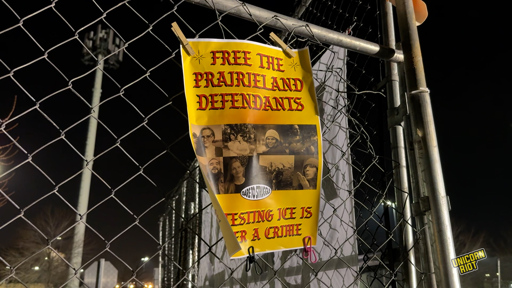
On March 13, a jury declared nine protesters guilty for terrorism-related charges pertaining to a noise demonstration at an ICE facility. The state’s case focused on the protesters’ use of encrypted messaging via Signal, their “black bloc” clothing, and their insurrectionary rhetoric in printed materials (zines), arguing that these were hallmarks of “Antifa,” which the Trump administration designated as a domestic terrorist organization last fall.
Most defendants face a minimum of 10 years in federal prison. Benjamin Song, the alleged shooter, faces life imprisonment, with a minimum of 20 years.
The case now heads to appeals, where decisions will set a precedent for future prosecutions of protest activity. Supporters, concerned for both the defendants and the future of political dissent, have organized defense networks to legally and morally aid the incarcerated. But the case remains relatively obscure, not yet rising to the type of national outrage that could provide a meaningful political shield.
The Protest
On July 4, 2025, 12 protesters gathered at the edge of the Prairieland Detention Center in North Texas, launching fireworks and using loudspeakers to boost detainees’ morale. The fireworks did not cause any damage. Two protesters split from the group to disable ICE vehicles. One of them, Song, was legally armed.
Hearing the fireworks, Prairieland officers exited the detention center, prompting most of the protesters to disperse. A local police officer then arrived and drew his weapon, though the Prairieland officers later testified that the protesters posed no threat.
When Song saw the officer’s drawn weapon, he allegedly fired toward the officers, and an officer was struck nonlethally. Video evidence shows clouds of dust erupting near the officers’ feet, and ballistics evidence shows that the injuring bullet was curved, suggesting the officer could have been wounded by ricochet. The prosecution charged Song with three counts of attempted murder of an officer.
Police apprehended 11 protesters after the gunfire subsided, while Song evaded arrest for 11 days. The final defendant, Daniel Sanchez Estrada, was not present at the demonstration but was apprehended on charges of corruptly concealing a document after allegedly attempting to destroy a defendant’s zines.
The Trial
During the initial jury selection, jurors expressed anti-ICE and anti-Trump sentiments but insisted they could set aside ideology to uphold the law. In the midst of the process, Judge Mark Pittman declared a mistrial, stating that one of the defense lawyer’s T-shirts, which displayed civil rights leaders, violated the court’s dress code. He claimed he had never declared a mistrial before, adding, according to NPR, that he was “‘absolutely disgusted’ with the state of the country.”
Defense lawyers initially argued a case of self-defense or defense of others, claiming that the evidence demonstrated shots were not fired with lethal intent. The prosecution, however, contended that self-defense was not a legally permissible argument because the use of “explosives” (fireworks) constituted a valid basis for the officer’s use of force. The prosecution invoked precedent set by the Waco siege, a 51-day conflict resulting in more than 80 casualties. Pittman sustained this motion, effectively delegitimizing any defense that argued against lethal intent.
The state explicitly pursued this case as a coordinated federal effort to “systematically dismantle Antifa,” which, according to Attorney General Pam Bondi, is “a domestic terrorist organization that has been allowed to flourish in Democrat-led cities — not under President Trump.” The prosecution turned five protesters into state witnesses, intending to use their testimony as evidence of terrorist conspiracy. The state’s witnesses repeatedly stated that there was no group formally known as “Antifa,” that they had discovered the protest incidentally, and that there had been no intention of violence.
The state later called Kyle Shideler for purported expert testimony. Shideler conducts non-peer-reviewed analysis of publicly available information for a conservative nonprofit. His testimony claimed the event bore all hallmarks of Antifa activity, such as encrypted messaging, face coverings, uniformly black clothing, and insurrectionary material. He testified that he had no direct experience with “Antifa chat groups,” and that although there had been no discussion of violence or destruction of property, he wouldn’t expect those sentiments to appear in writing.
Pittman repeatedly noted that the state did not need to define the defendants as members of “Antifa” in order to try them as domestic terrorists, raising speculation about the prosecution’s intent to set a precedent for future cases.
The Decision
As the trial concluded, observers heard jurors yelling in their deliberation room, prompting the judge to order marshals to investigate. While the jury was reading its decision, one juror was visibly crying. No one has yet been able to interview these jurors, though defense teams hope this may change.
Despite the absence of violence, property damage, or demonstrable intent to commit either, seven defendants were found guilty of riot, material support to terrorists, and using explosives. Their names are Autumn Hill, Zachary Evetts, Savanna Batten, Meagan Morris, Maricela Rueda, Elizabeth Soto, and Ines Soto. They face a minimum of 10 years in federal prison and a maximum of 60 years. Song was found additionally guilty of attempted murder of an officer and discharging a firearm in furtherance of a crime of violence. He faces life imprisonment, with a minimum sentence of 20 years. Daniel Sanchez Estrada could face 40 years. These defendants are now able to receive letters and books. Their mailing information, as well as updates on their defense, can be found here.
The Prairieland trial is not a criminal case; it is a political one. There are openings to declare a mistrial and opportunities for appeals, but the strength of these chances depends, in part, on public political support. The prosecution succeeded through cynical maneuvering and the hope that regular Americans would turn their backs on the exposed; that with enough tar painted by the “terrorist” brush, anyone deemed Antifa — anyone in black clothes defending their neighbors — could face decades in federal prison. But there is still a chance to make it loud outside Prairieland: demand all charges dropped, defend the noncooperators, and bring this ugliness into the streets, into your workplace, and into your constant conversation. Obscurity serves only the worst impulses of the state.
The post Prairieland Anti-ICE Protesters Sentenced to Decades in Prison appeared first on Left Voice.
From Left Voice via This RSS Feed.