

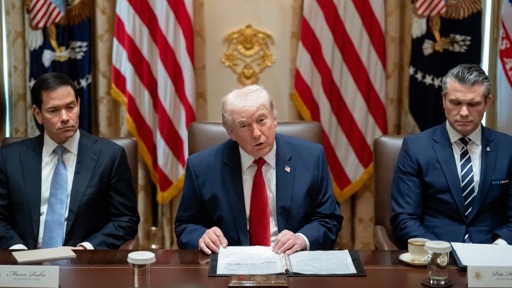
We are witnessing a turning point in history. We are experiencing a crisis that goes beyond the economic level. We are facing a true crisis of civilization. The US, as an imperial power, is increasingly showing its decline, and in that decline, it acts irrationally, endangering all of humanity. It is not merely the fact that they have an “incoherent” and violent president, a racist and misogynistic sexual predator; Trump is not an anomaly. He is merely an extreme and bizarre manifestation of what the US has been since its founding.
The United States was founded by white slave-owning landowners, convinced of their racial superiority and exceptionalism, coupled with a deep-seated belief that they were destined to dominate the world (Manifest Destiny). A look at the recent National Security Strategy, published in November 2025, directly reveals this claim to superiority, which, in Trump’s case, takes on pathological traits.
Between 1776, the year of its independence, and 2019, the US carried out 392 military interventions, half of which took place after 1950 and 25% after the end of the Cold War. It is a fact that in the 250 years following its independence, the United States was not involved in a war for only 17 years. Since its inception, it has been a nation with imperial ambitions, which has made it a true power since the Anti-Fascist World War (the so-called Second World War according to Eurocentric historiography). Its imperial trajectory has evolved over time, and today we find ourselves at a moment when its power and society show clear signs of decline, and when new forces – capable of challenging that power – have emerged worldwide. Despite this (or perhaps because of it), its actions have become more dangerous and threatening.
One of those forces is, without a doubt, the People’s Republic of China, which was identified at the NATO Summit held in Madrid in 2022 as a threat to “the interests, security, and values” of whatever NATO represents.
The Declaration has the audacity to claim that China seeks to undermine the “rules-based international order”. A way of saying that China is challenging that international order based on NATO’s rules.
China was consolidated as a state in 221 BC under the reign of Emperor Qin, who succeeded in centralizing the state after two centuries of the so-called “Warring States period”. During his rule, Qin developed professional armies, organized the collection of taxes, had legal codes written, invented instruments for long-distance trade, and stabilized the mandarin bureaucracy. We could say that, during that period – more than 1,500 years before Latin-Germanic Europe – China had moved beyond feudalism. By that time, China had already developed a political thought and philosophy (the “Period of the Hundred Schools”) that would underpin, with variations, normative and ethical action in China for the next 30 centuries.
In classical Chinese philosophy, political wisdom is grounded in knowing how to wait, so that the “situation” may transform into an “opportunity”. This waiting is not, however, passive. It involves observing the “potential of the situation” and preparing for and accompanying the transformation (the path, the Tao) toward the opportunity. From the European perspective, Machiavelli said 20 centuries later that opportunity arises from fortune (chance), and it was the ruler’s skill to know how to take advantage of those opportunities. In Chinese philosophy, the opportunity arising from fortune is not lasting. It is fleeting. One must prepare for the opportunity. The ruler must therefore not fight opposing forces, but know how to use them to his advantage without denying them.
This brings us to the words spoken by President Xi Jinping during the centennial of the Chinese Communist Party. In his words, the president takes us from the party’s founding, the struggle for liberation, the Long March, the defeat of the Nationalists, the triumph of the revolution, the Cultural Revolution, the 1978 reforms, and the present day. A historical journey that reveals a path (Tao), a journey during which the transformation of the “situation” into an “opportunity” has been prepared.
In concrete terms, this opportunity has meant the eradication of critical or extreme poverty, officially declared in 2021. China lifted 850 million people out of extreme poverty. This achievement has resulted in a 70% reduction in extreme poverty worldwide. China has achieved economic development unparalleled in human history. The rate at which GDP, life expectancy, total consumption, and per-household consumption have increased, among other metrics, is on a unique scale. In 1978, only 1% of the world’s population lived in countries with a GDP lower than China’s. By 2012, that figure stood at 51%. These indicators can be reviewed in John Ross’s insightful book, China’s Great Road, published by 1804 Books. All of this translates not only into positive impacts for the Chinese people but also reinforces a vision centered on working to consolidate what President Xi has called a “community with a shared future”. This implies positive impacts on a global scale.
We see that the challenge China poses to NATO – and especially to the United States – goes beyond macroeconomic indicators or trade advantages.
It is a civilizational challenge. It is a different worldview. While President Xi Jinping speaks of building a community with a shared future, the Trump administration’s National Security Strategy emphasizes making the US the strongest, richest, most powerful, and most successful nation in the world. While China works to transform the situation into an opportunity, the United States acts impulsively, hoping that fortune will grant it the opportunity. That is why China invests in health, education, science, housing, and transportation, but the US invests in weapons and in maintaining a deadly military force capable of destroying the entire world. This makes the US a true threat to humanity. A nation of supremacists and superstitious people who promote a culture of death and possess a powerful army. An empire whose decline we are witnessing, whose end is beginning to loom, but an empire that dies fighting. Today, more than ever, anti-imperialism is a necessity and must be the common ground for all the struggles of the peoples of the world. The struggle today is anti-imperialist. For peace, for life, for humanity.
Guillermo R. Barreto is Venezuelan and holds a Ph.D. in Science (University of Oxford). Retired professor at Simón Bolívar University (Venezuela). He served as Deputy Minister of Science and Technology, President of the National Fund for Science and Technology, and Minister of Ecosocialism and Water (Bolivarian Republic of Venezuela). He is currently a researcher at the Tricontinental Institute for Social Research and a visiting fellow at the Center for the Study of Social Transformations-IVIC.
This article was produced by Globetrotter.
The post The United States of America: a threat to humanity appeared first on Peoples Dispatch.
From Peoples Dispatch via This RSS Feed.