

Media are dropping the ball on this story - help me cover it by becoming a paid subscriber
Most Americans are bracing for a massive ground invasion of Iran, one that military sources tell me will not happen. That’s because there’s another plan entirely.
What’s in store is a “raid,” all of these sources agree.
Of course, it all depends on what Donald Trump orders, and sources say they don’t know what that might be on any given day. So they offer the White House different alternatives, highlighting the cost for operations that they don’t want to undertake and focusing on the epic, derring-do nature of those that they would prefer.
Planning for small raids onto Iranian soil has taken over as the favored outcome, I’m told, operations that would be carried out by commandos rather than conventional soldiers.
Those missions include taking Kharg Island as leverage to use it as a bargaining chip since it dominates Iranian oil and gas exports, or a similar island raid in the Strait of Hormuz to help open up shipping, or, most spooky and Maduro-like, a “black” operation to seize Iran’s nuclear materials.
And what do the American people think? Millions are afraid of what won’t happen and largely unaware of what could. This is reflected in a recent poll by Reuters/Ipsos finding 65 percent of Americans believe Trump will order troops into a large-scale ground war in Iran, though only seven percent support such a scenario.
Seven percent! In other words, Americans want a ground war like they want to give a hug to Congress (which enjoys a slightly higher approval of 10 percent, per Gallup).
Tucked away in the Reuters poll is another question that no other pollster seems to be asking": whether Americans “support deploying a small number of special forces for targeted operations?”
The results? Some 34 percent of Americans say yes — including 63 percent of Republicans. That is roughly in line with American opinion on the Iran war in general, which clearly hasn’t deterred the White House so far.
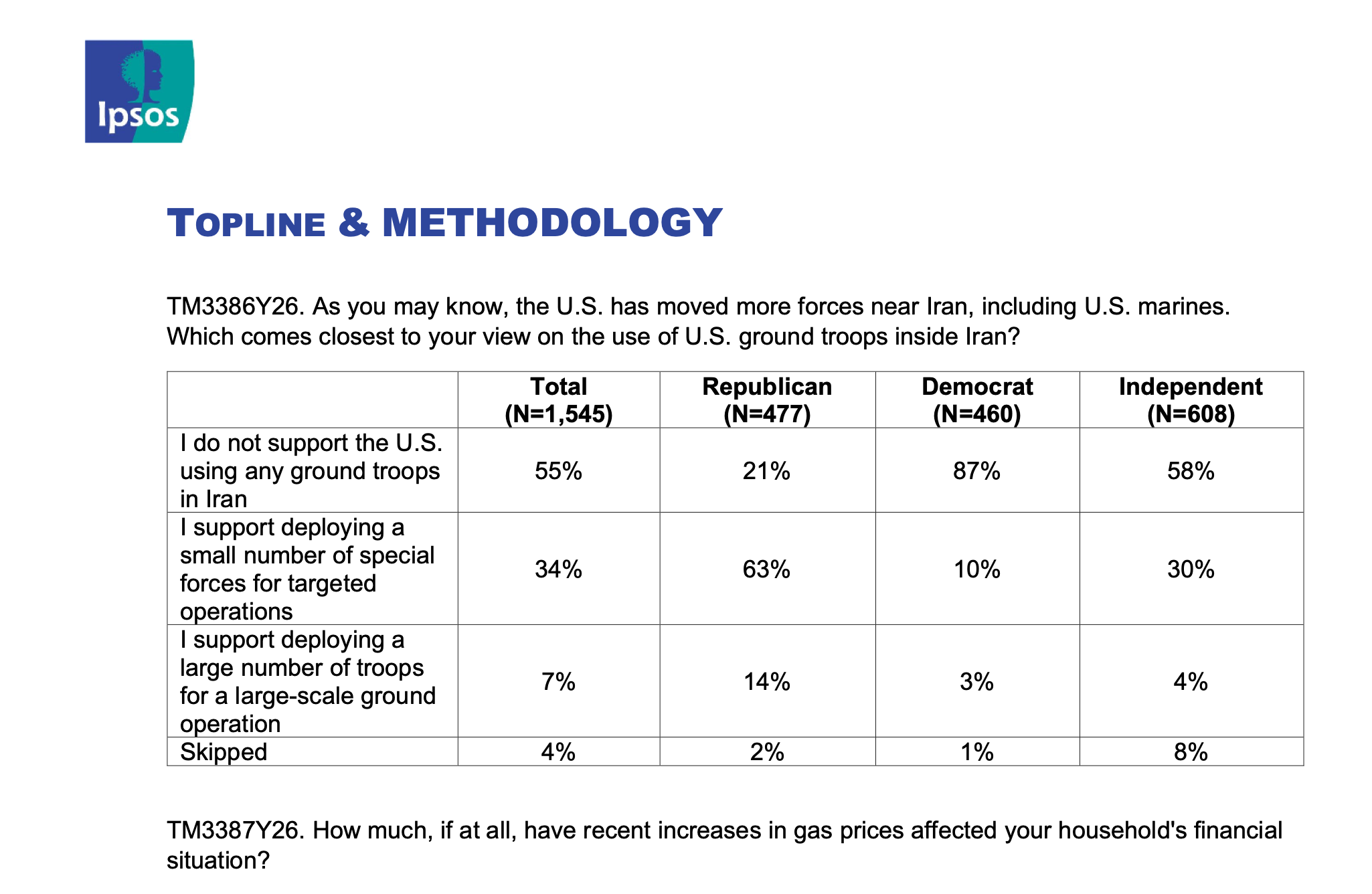
Reuters/IPSOS poll
In other words, though a full-scale ground invasion is not politically viable, a special operations raid is.
A full-scale ground invasion isn’t even logistically feasible (at least for now). The U.S. troop presence in the Middle East has increased just 20 percent since the beginning of mobilization two months ago, The New York Times reported Sunday. And most o of those people are not “boots on the ground” types of forces, but are augmenting operations, logistics, maintenance, air defenses, etc.
When the Marines aboard the USS Tripoli group arrive and the 1st Brigade of the 82nd Airborne Division are deployed and ready, there will be some 5,000 troops at the “ready,” but even here, we’re talking about some 2,500 actual “boots,” fighters with guns.
That’s a significant number of course, but it is hardly the numbers you’d need for an Iraq War-style invasion or occupation. In 2003, for context, 466,985 U.S. personnel were deployed for the Iraq operation using the same count that includes air, ground, and naval forces across the region. Today, there are some 50,000 personnel in the region, roughly 10,000 of which are part of the increased ships and aircraft, etc.
What none of this fiddling includes are the number of special operations forces which are not officially disclosed. This includes special operators from Army special forces groups, Army Rangers, Army aviation from the 160th Special Operations Aviation Regiment, Navy SEALs and “special warfare” personnel, Air Force “special tactics” fighters, Marine commandos, the Joint Special Operations Command that spearheaded the Maduro operation, and supporting intelligence, transport, communications, as well as CIA paramilitaries, clandestine intelligence collectors and others.
These are exactly the kinds of forces that would carry out the various limited raids.
When I reported last week on the unlikeliness of a conventional ground invasion, it created a flurry in major media which had been starved of any actual reporting on the ins and outs of actual deployments and readiness.
This weekend, CNN broadcast a segment about our story, with anchor Michael Smerconish practically tugging at his collar in discomfort over having to cite me in the absence of someone more mainstream.
“I read something online from a guy who writes provocatively, admittedly, his name is Ken Klipperstein [sic],” Smerconish said, putting to his guest, retired Admiral James Stavridis, my point that a major ground invasion of Iran was simply not in the cards at this time.
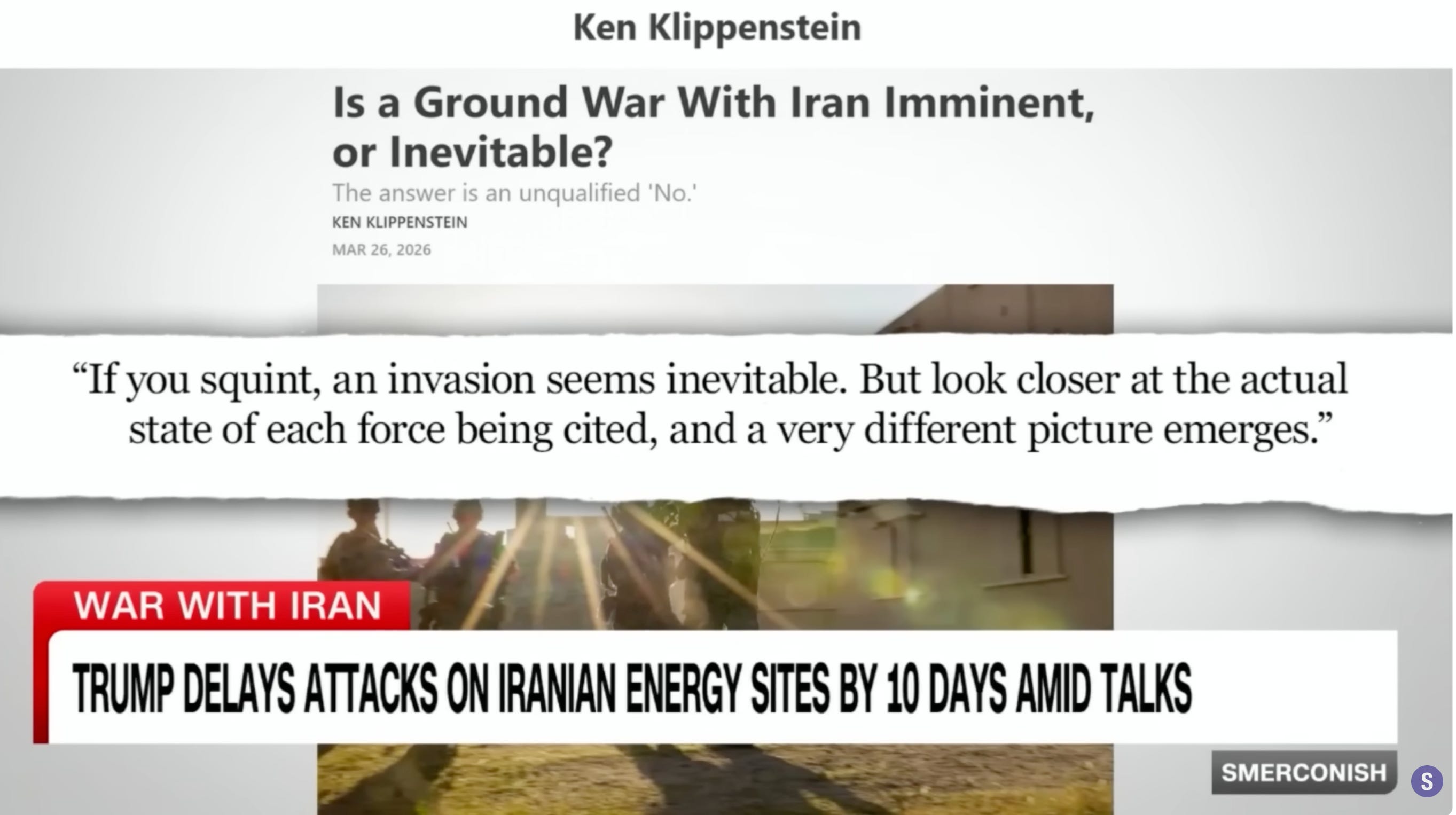
Screenshot of CNN segment about my story
A clearly flustered Stavridis, who like other cable news retired military brass was making coin off hyping the war, replied: “It’s not inevitable, obviously,” adding: “inevitable, no; possible, yes.”
That’s what four stars and hundreds of thousands of dollars a year buys you: ‘Well, this could technically happen.’ Admiral, it’s technically possible that an asteroid wipes us all out, or the sun doesn’t rise. Yet you still bother to get out of bed and show up for these cable hits because you know there’s a difference between possible and probable.
What we should focus on is the probable that is the raid(s). Like with the raid that deposed Venezuelan leader Nicolas Maduro in January, or the killing of the Ayatollah, or even the raid on Bin Laden’s compound in Pakistan in 2011, we will likely just wake up and find out it happened after all. In these types of operations, the government has developed a remarkable capacity to evade public scrutiny and make them feel inevitable, like the weather.
Partly that is done through “messaging” and disinformation which encourages the media and even the experts to look in one direction, in this case, a “boots on the ground” invasion. The confusion is stoked by messaging like the letter (embedded below) written by Lt. Gen. Leonard F. Anderson IV, head of the Marine Corps Reserve, which blithely says that “a mass mobilization could become reality.”
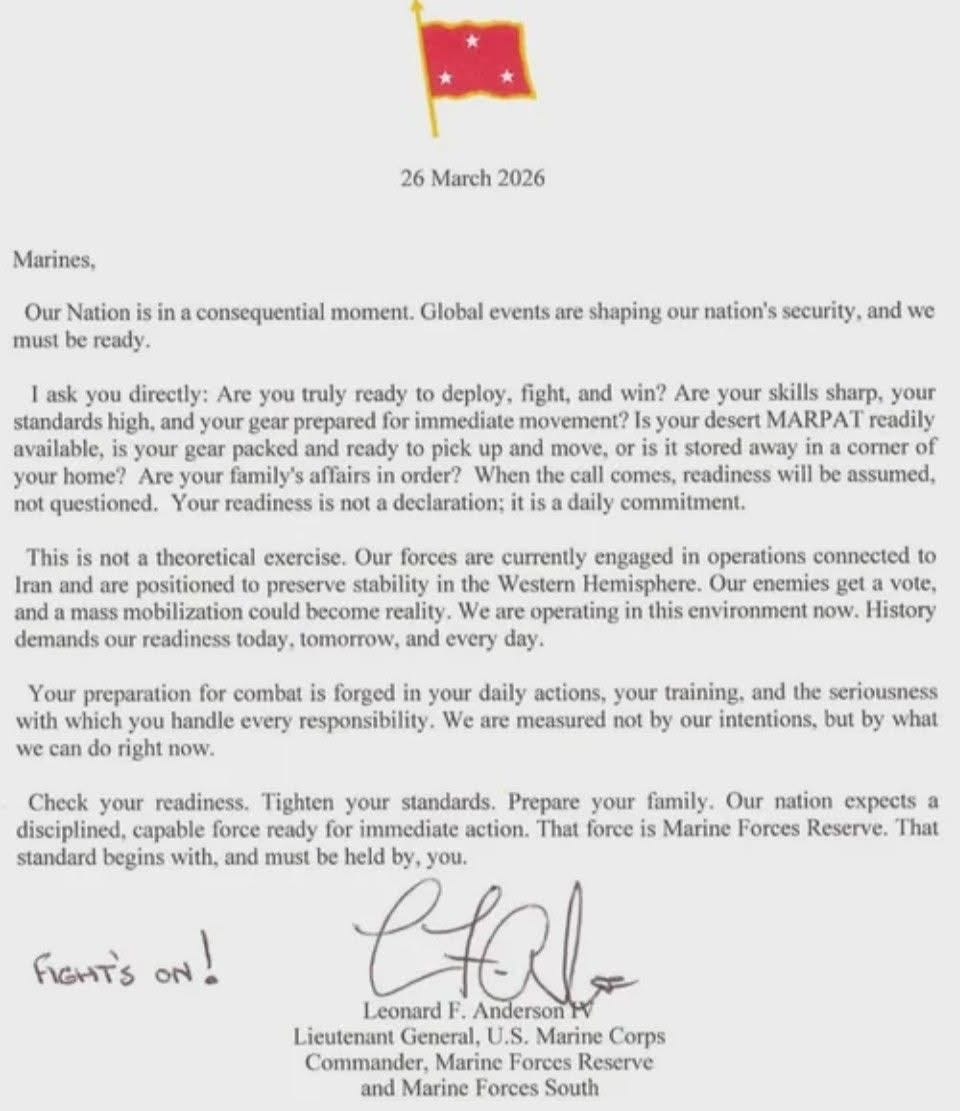
With millions of Americans already nervous about a ground war and even a possible draft, one wonders what Gen. Anderson knows that we don’t. I asked and the answer I get from reliable sources is: nothing. There are no preparations for any kind of mobilization and there is not any thought of some draft.
So, see how it works? Boots on the ground, a months-long ground war that smells like Iraq (or even Vietnam for the seniors), a mass mobilization, a draft, such stories fill the media and social media and in the end when the special operators come to the rescue, people are not only relieved but they “support” such an operation.
Support, of course, when it’s all over, if it’s successful. The cycle of disinformation and secrecy ensures that your only job is to discuss what happened after-the-fact, not whether it should have happened at all.
It’s a style of warfare perfected for decades that limits public involvement and consent because a combination of remote air and drone warfare and the favored clandestine special operators make the war machine impervious to true debate. As the deliberations continue regarding the mythical ground war, or as Donald Trump continues to babble about destroying this or that, the bombing continues. The Pentagon is saying practically nothing about what is being bombed or how much, or what the assessed impact is, and certainly what it is saying is so exaggerated and fact-free that it’s hard to determine what the true effect is.
Meanwhile the media has nothing much to say. Organizations with dozens of reporters on the case focus on every Trump utterance while the actual war “on the ground” is referred to in passing. Retired cable news generals and admirals with conflicts of interest that would make the Wolf of Wall Street blush have nothing to say either.
Bolstered by the “success” of the Maduro raid, Trump will inevitably fall in love with the next seductive briefing involving some slickly produced video that shows jumping and rappelling and shooting all coming together in a cinematic ending.
The only question is if the American public approve of these operations — assuming the media bothers to report on them.
Subscribe if you would rather not see Trump go commando
— Edited by William M. Arkin
From Ken Klippenstein via This RSS Feed.