

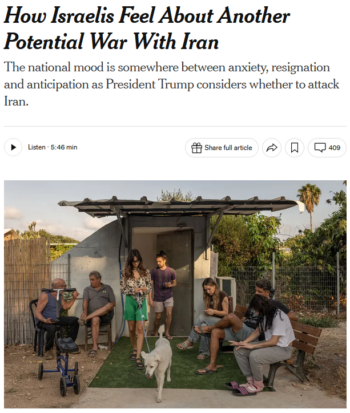
The New York Times (2/26/26) was able to present a range of Israeli views on attacking Iran; relying mainly on telephone interviews, it’s harder to get a cross-section of Iranian opinion about being attacked.
Since the US and Israel first attacked Iran in late February, it has been easy to spot the stark difference between the New York Times’ distant coverage of Iran and its up-close and personal coverage of Israel.
Multiple Times employees are reporting from and currently living in Israel. These include reporters Isabel Kershner, Aaron Boxerman, Gabby Sobelman, Natan Odenheimer, Ronen Bergman, Adam Rasgon, Johnatan Reiss and Raja Abdulrahim, as well as Jerusalem bureau chief David M. Halbfinger.
They routinely report stories that center Israeli citizens, as in “How Israelis Feel About Another Potential War With Iran” (2/26/26). First-hand Times reports have Israelis taking “Shelter as Sirens Warn of Incoming Missiles” (2/28/26), feeling “Tense But Relieved That Iran’s Supreme Leader Is Dead” (3/1/26) and celebrating “Purim Amid Iranian Missile Attacks” (3/4/26). They also have penned stories on Iranian missile strikes in Israel mere hours after they took place (3/1/26, 3/18/26).
Many articles have been based primarily on statements from Israeli officials (3/1/26, 3/3/26, 3/11/26, 3/19/26) and US officials (3/2/26, 3/7/26). Other articles have centered on the perspective of Israeli Prime Minister Benjamin Netanyahu, and what would benefit him (2/28/26, 3/14/26, 3/18/26).
Meanwhile, the Times has no reporters based in Iran, as its editors admitted in two Q&A-style articles (3/9/26, 3/16/26). Instead, the paper has largely relied on its Visual Investigations team (3/12/26) and reporters based elsewhere to cover Iran, including correspondents in Israel, the US, Turkey, Lebanon, Saudi Arabia, India, Sri Lanka, South Korea, England, France and Germany. The Times reporters who most often quote Iranian voices—like Farnaz Fassihi, Parin Behrooz (both based in the US) and Yeganeh Torbati (reporting from Turkey)—largely rely on telephone interviews (3/2/26, 3/27/26), along with “text messages and social media posts” (3/18/26).
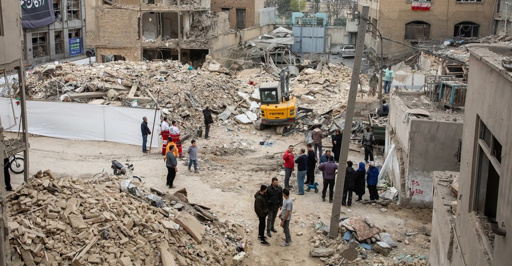
This lack of on-the-ground coverage in Iran has directly resulted in slower coverage and confirmation of US/Israel culpability for deadly strikes. For example, it took five days for the Times (3/5/26) to report that the US was “most likely to have carried out the strike” on the school in Minab that killed at least 175 Iranian civilians, mostly schoolchildren.
‘Very restrictive in terms of access’
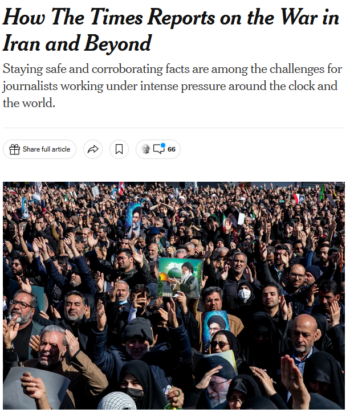
Editors explain “How the Times Reports on the War in Iran” (3/9/26) without being in Iran.
When asked why the New York Times didn’t have reporters on the ground in Iran, editors argued that it is difficult to report from within Iran due to its harsh press restrictions. In an online Q&A (3/9/26), Adrienne Carter, the paper’s senior international editor, said that “Iran, like a number of countries, is very restrictive in terms of access for journalists.”
Carter said the Times has received “two or three visas” to enter Iran over the past couple of years, including around the 2024 Iranian presidential election and “after the recent war.” The Times didn’t receive a visa during the 12-day war, nor during the recent protests, according to Carter.
Carter acknowledged that “we are not on the ground in Iran,” adding that “communications are limited in the country”:
So the reporting is always going to be more difficult and slower than in places like Israel and Lebanon, where we have reporters who can see firsthand what is happening.
“We could drive” to a strike in Israel, Carter said, and Times reporters “could talk to witnesses.” Carter added, “We were able to better understand because we could be there.”
‘We can’t be there’
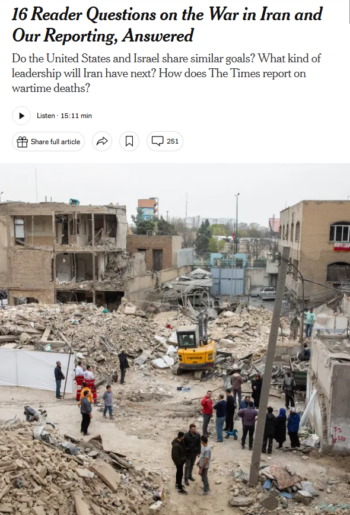
New York Times (3/16/26): Q: “How do you report on what’s happening in Iran?” A: “We rely heavily on verified visual material, user-generated content, social media posts and satellite imagery.”
In another Q&A (3/16/26), a New York Times reader asked whether its journalists were “on the ground in all of the countries involved,” and how they report on “what’s happening in Iran.”
Carter reiterated:
Iran is one of the hardest places to report. It’s incredibly restrictive for journalists, especially during sensitive times like now. The communications are largely shut down. So unlike in Ukraine and Russia, Gaza, Lebanon and Israel, we can’t be there. We can’t easily reach people.
Another reader asked why “US soldiers who signed up for wartime action seem to get significantly more coverage than the hundreds of Iranian civilians killed by the bombing.”
This time, Times managing editor Marc Lacey responded that “reporters do not have free access” in Iran. He added:
Believe me, if we were able to traverse Iran right now, we would have interviewed the families of those who lost their lives in the American missile strike on an elementary school in the opening days of the war.
‘We could do everything we wanted’
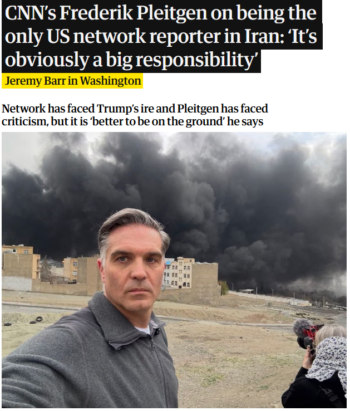
CNN‘s Frederik Pleitgen (Guardian, 3/14/26): “Even if there are restrictions, it’s always better to be on the ground than to not be on the ground.”
CNN reporter Frederik Pleitgen, the only reporter for a US outlet to be granted a visa from Iran, was readily transparent about his on-the-ground coverage in a Q&A with the Guardian (3/14/26). Right after the US attacked Iran, Pleitgen said, he applied for a visa. Pleitgen said he told Iran’s Culture Ministry: “We really want to come in, and I told them that it’d be important to have international media there. And then they granted the visa.”
Pleitgen said he didn’t have a minder, though he did have an Iranian translator who was asked by Iran’s Culture Ministry to “not take us to places that are sensitive.” He “needed to inform them before we went anywhere,” Pleitgen said.
Still, Pleitgen—who ultimately filed more than a dozen written dispatches from Iran in the eight days he was based there and appeared onscreen more than 40 times—said: “It was more restrictive this time than it had been in the past, but still, by and large, we could do everything that we wanted to do.”
Violent and systemic abuse
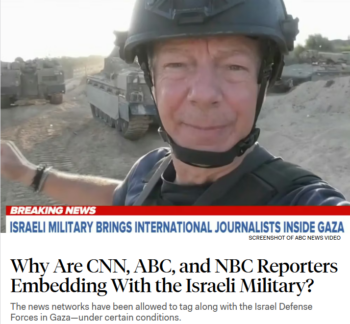
US reporters are comfortable reporting Gaza from the point of view of an army credibly accused of committing genocide (New Republic, 11/15/23).
It’s remarkable that the Times‘ Carter would suggest that, unlike in Iran, journalists in Gaza can “be there” and “easily reach people.” While Iran has very real press freedom issues, Israel’s own extensive press controls include much more violent and systemic abuse of journalists.
Israel is responsible for killing 212 journalists in 2023–25; Iran killed three during that time period, according to the Committee to Protect Journalists (CPJ). Israel is also currently imprisoning almost four times as many journalists as Iran.
As I recently wrote for FAIR (3/11/26), US corporate media continue to ignore the latest reports of Israel’s systemic killing and jailing of (largely Palestinian) journalists—which FAIR (3/26/25, 8/22/25) has previously noted.
Moreover, Israel has banned foreign journalists from entering Gaza since October 2023 (Al Jazeera, 1/7/26) unless they are embedded with the Israeli Defense Forces (New Republic, 11/15/23).
‘Special situation on the home front’
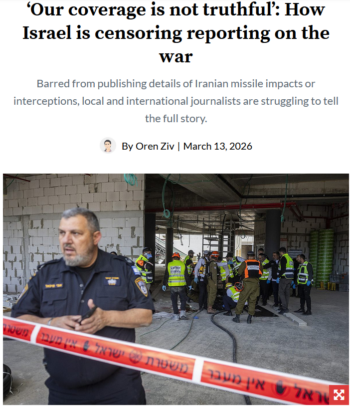
“It’s hard to understand what is actually happening,” a journalist working for a non-Israeli outlet told +972 (3/13/26). “We have a partial understanding of the reality on the ground.”
Furthermore, Israel has always imposed military censorship (CJR, 3/25/26), which currently forces every journalist working inside the country “to submit any article dealing with ‘security issues’ to the military censor for review prior to publication,” as +972 Magazine (5/20/24) reported.
Since +972 began collecting data in 2011, military censorship in Israel reached its “most extreme levels” in 2024. That year, Israel “completely banned the publication of 1,635 articles and partially censored another 6,265” and it “intervened in about 21 news reports per day,” according to +972 (5/2/25).
After the Iran War started, Israel quickly declared a “special situation on the home front,” which gave additional power to the Israeli government and military, including over the media (Israel Democracy Institute, 3/2/26).
Israel has prohibited reporters and networks from “publishing the precise location of Iranian missile impacts, or even filming or photographing the extent of the damage in a way that could give away the location,” wrote +972 (3/13/26).
The increasingly strict Israeli military censor quickly impacted journalists: After Iranian missile strikes hit Tel Aviv on March 3, Israeli security forces detained CNN Türk correspondent Emrah Çakmak and camera operator Halil Kahraman during a live broadcast (CPJ, 3/3/26).
‘Strictures of military censorship’
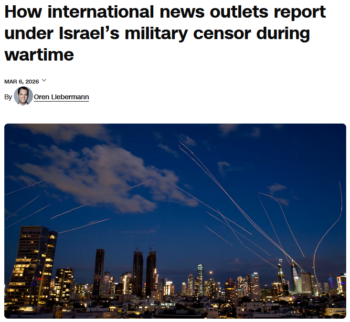
“Anyone who endangers Israel’s citizens in the name of ‘journalistic reporting’ will face a determined and tough police force,” said Israeli Minister of National Security Itamar Ben Gvir (CNN, 3/6/26).
Israeli military censorship has been met with near-silence in US corporate media during the Iran war. Indeed, the only US corporate media outlet to publish a stand-alone piece about the censor that I could find was CNN (3/6/26; reposted by Yahoo, 3/6/26).
A handful of outlets mentioned the censorship in passing. NPR (3/12/26) dutifully parroted the Israeli perspective on why they have maintained the censor. NPR’s international correspondent in Jerusalem, Daniel Estrin asked:
Has Iran successfully hit military targets? We don’t have that information. Israel has a military censorship unit, and they censor that kind of information. They say that they don’t want to help the enemy, to help Iran improve its aim if they’re publishing where exactly it’s hitting.
In an article about Iran reportedly striking Israel’s secretive nuclear sites, the Times’ Isabel Kershner (3/22/26) noted:
The Israeli news media, operating under the strictures of military censorship, reported on Sunday that the Arrow 3 was not deployed against the missiles that struck Arad and Dimona.
Kershner failed to note that all media outlets reporting in Israel—including foreign ones like the Times—also operate “under the strictures” of the military censor (CNN, 3/6/26; +972, 3/13/26).
Bloomberg, meanwhile, published an article (3/23/26) headlined “Iran Is the First War of the Social Media Age. It’s a Black Box”; its account of Iran’s press restrictions appeared under the heading “Repressive Regime,” while Israel’s were covered under “War Guidelines.”
Bloomberg‘s Alan Crawford and Galit Altstein labeled Israel’s press abuses in Gaza as a “press-defiant approach” and Netanyahu’s relationship with the media as (like Trump’s) “complicated”—omitting any mention of Israel’s systemic targeting and killing of largely Palestinian journalists.
Crawford and Altstein wrote that Israel’s “military censor this month forbid all reporting on missile impacts in or around security sites,” but failed to note how extensively the censor has suppressed reporting, as +972 has documented.
The sparse recent US corporate media coverage of Israel’s military censor starkly contrasts with the nonprofit press freedom organizations that have long denounced the policy, most recently during the Iran War (CPJ, 3/1/26; Reporters Without Borders, 3/11/26; CJR, 3/25/26).
International media outlets have also referenced Israel’s military censor, and occasionally criticized it (Arab News, 3/3/26; New Arab, 3/24/26; Al Jazeera, 3/25/26). Even Israel’s Haaretz (3/21/26; 3/12/26) and Times of Israel (3/10/26) have acknowledged the censor.
Solution: hiring local reporters
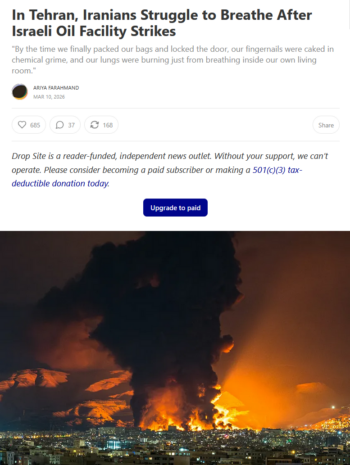
Using Iran-based journalists, Drop Site (3/10/26) is able to provide first-hand accounts of the consequences of US and Israeli bombing.
To be clear, reporting on the front line of a war is extremely dangerous, with journalists increasingly facing both indiscriminate weapons and intentional targeting. This is in addition to the negative mental health effects that living in a war zone has for anyone, as CPJ has noted.
But if the New York Times is unable (or unwilling) to send its own reporters to Iran, it can hire local Iranian reporters. After all, the Times has hired local reporters in Gaza (1/30/24, 7/27/25, 3/23/26) and the West Bank (1/31/26).
As just one possible solution, the paper could start using Egab, an Egypt-based organization that connects local journalists based throughout the world, including the Middle East, to news outlets.
Several media outlets have used Egab to hire local Iranian reporters who have written numerous incisive reports, including the London-based New Arab (3/24/26, 3/23/26, 3/6/26), Spain-based El País (3/3/26) and US-based Drop Site News (2/28/26, 3/1/26, 3/10/26, 3/11/26, 3/18/26).
In choosing not to report on the ground in Iran, and then coming up with unpersuasive excuses to cover its tracks, the New York Times has stopped readers from quickly learning the grotesque horrors that the US government has carried out on a daily basis there.
From FAIR via This RSS Feed.