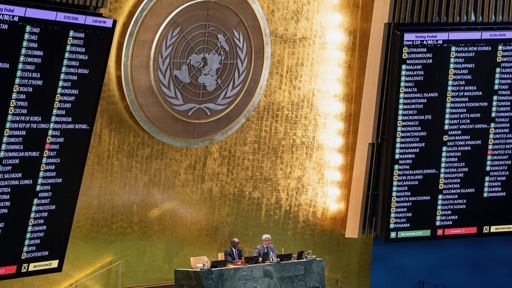
On March 25, 2026, the United Nations General Assembly adopted a landmark resolution declaring the transatlantic trafficking and racialized chattel enslavement of Africans as the “gravest crime against humanity”. The decision, passed with 123 votes in favor, 3 against (Argentina, Israel, United States), and 52 abstentions, marks a historic shift in the international recognition of one of the most devastating systems in human history.
The resolution places reparations at the center of global justice discourse, affirming that addressing historical wrongs against Africans and people of African descent is both necessary and overdue.
A long struggle for reparations
The declaration represents the culmination of decades of Pan-African advocacy, intensified in recent years through coordinated diplomatic efforts led by the African Union (AU) and supported by the Caribbean Community (CARICOM).
In February 2026, African heads of state had already adopted a continental position recognizing slavery, deportation, and colonialism as crimes against humanity, setting the stage for the UN vote. At the forefront of this effort was Ghana’s President John Dramani Mahama, serving as the AU champion for reparations.
Ahead of the vote, Mahama told member states: “Let it be recorded that when history beckoned, we did what was right for the memory of the millions who suffered the indignity of the slave trade … Let our vote restore their dignity and humanity.”
UN Secretary-General António Guterres, in his address, described the transatlantic slave trade as; a “deep betrayal of human dignity”.
A system in which millions were abducted, one in seven dying during the Middle Passage, while a global economic order was constructed on exploitation, racial hierarchy, and violence sustained for over 400 years.
Further, Guterres emphasized that slavery was not just an isolated historical crime, but a “machinery of mass exploitation and deliberate dehumanization” whose legacies persist today in inequality and systemic racism.
By explicitly recognizing reparations as a “concrete step toward remedying historical wrongs,” the resolution advances a demand long championed by African and Caribbean movements.
Read more: “70% of Africans back reparations,” says Pan-African Progressive Front
Reparations debates have historically faced resistance from former colonial powers, often framed as impractical or legally complex. However, this declaration strengthens the argument that, the transatlantic slave trade constituted a crime under international moral law, its economic benefits were systematically extracted and accumulated and its harms remain measurable in structural inequalities, underdevelopment, and racial injustice.
Geopolitics of denial
The vote revealed deep geopolitical fractures. The opposition by the United States, Israel, and Argentina, alongside 52 abstentions, show ongoing resistance to fully confronting historical accountability. These positions reflect broader patterns of imperial power and reluctance to accept liability, particularly given the potential economic and legal implications of reparations.
From a Pan-African perspective, this resistance is not surprising. Princess Yanney, from the Pan-African Progressive Front, told Peoples Dispatch:
“The countries that voted against the motion; US, Israel, and Argentina. It is no secret that these countries particularly, even in the current situation in the Middle East (US and Israel), attest to them being major drivers of imperialism and the drivers of oppression. Hence, these countries presumably never wanted a day, where the African people get the justice that they deserve. And more so, that this recognition would affect them in so many ways than one.”
Yet, she adds, recognition alone is insufficient.
“The real work has only just begun … several systems must change for a new structure to emerge.”
Beyond legal and economic implications, the resolution intervenes in the politics of memory and healing. For centuries, the transatlantic slave trade was either minimized or distorted through racial ideologies that justified exploitation.
“There is something unique about healing. Without healing it is difficult to genuinely aspire forward, forgive and forget. Africans are suspicious of others who have tormented them and practically aimed to destroy their existence. Now we live together and coexist, but with this burden of hurt. It is vital to ensure complete healing so that we can all move forward as a global family, and this is exactly what this resolution asserts,” Yanney says.
The controversy extended beyond the opposition by the United States and its close allies. On the same day that the Ghanaian head of state addressed the UN to speak on the historic resolution, his government signed a security and defense partnership with the European Union. The move was heavily criticized by progressives as on one hand the nation was leading the fight for historical memory and reparations, and on the other, assisting in cementing neo-colonial presence in West Africa, a frontline of the struggle against colonialism and imperialism.
The post UN declares transatlantic slavery the “gravest crime against humanity” appeared first on Peoples Dispatch.
From Peoples Dispatch via This RSS Feed.
WTF’s wrong with them, in declaring that all other slavery somehow “isn’t” the gravest crime against humanity??
Slavery’s in the greatest-crime-against-humanity, transatlantic, trans-asiatic, within-India, within-Africa, within Europe, ANYwhere!!
They had ZERO right to limit the declaration to the Atlantic region of the world.
ALL of it is.
( get a taste of Asian history, & discover that White re Black history isn’t the “center of reality, that all the world revolves around” the way White education presents “world” history… it’s eye-opening, & what little I’ve encountered of African history, which definitely goes back … at-least 10x as far as non-African history … human nature was doing its thing, there, too.
That the European empires were industrious about enforcing slavery, with Middle Eastern slavers & African slavers being the providers, is true.
Was the White genocide of the American Indians “less” grave a crime? ( 1 example: filling a ship with blankets to sell in the Americas the English intentionally infected the blankets with smallpox, to exterminate as much of the population of the buyers-of-the-blankets as possible, to “clear the land” of Indians… was that imperial-programme of genociding somehow “less” grave a crime?? )
Was the Catholic Inquisition “less” grave in its crime against humanity, in genociding women & to-less-extent Jews?
Were the evils done by the Aztecs against their neighbors “less” grave?
I want ALL evils identified as evils, & not just the current-politically-correct ones.
Here’s another:
is India’s caste-system’s abuse of about 160,000,000 “untouchable” caste lives somehow “not” a grave crime against humanity, that has been going-on for about 16 centuries, & continues even now? )
See the world as the right-frame-of-reference, not only the West’s momentary “significance” as the right-frame-of-reference.
_ /\ _