

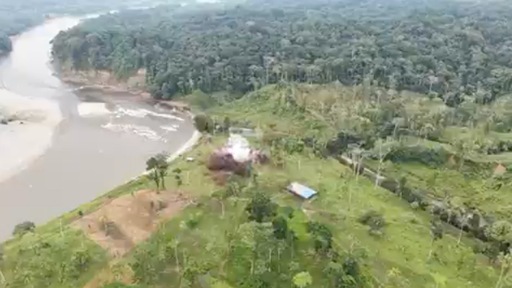
Several weeks ago, Ecuador’s Ministry of Defense reported bombings of alleged sites of illegal mining. The government has claimed responsibility for more than 100 operations as part of its offensive against organized crime. Added to this is a curfew that has already been in place for several days in the country’s most dangerous provinces. Washington has confirmed that it is collaborating with the military operations in Ecuador.
However, a recent New York Times report questioned whether one of the camps that was bombed by the US and Ecuador was indeed a drug trafficking camp, as they claimed. The video was released by US authorities before the meeting in Miami to sign the Shield of the Americas initiative. Rather, the report states, it appears that it was a dairy farm.
“The military raid appears to have destroyed a cattle and dairy farm, not a drug trafficking site, according to interviews with the farm’s owner, four of his workers, human rights lawyers, and residents and leaders of San Martín, the remote farming town in northern Ecuador where the raid took place,” the report states.
Furthermore, the report affirms that several of those interviewed claimed they were tortured by the Ecuadorian Army: “Farm workers told the Times that Ecuadorian soldiers arrived by helicopter on March 3, doused several shelters and sheds with gasoline, and set them on fire after interrogating the workers and beating four of them with the butts of their rifles. Three of the workers, who requested anonymity for fear of government reprisals, said the soldiers then choked them and subjected them to electric shocks before letting them go.”
In response to the New York Times article, which has sparked widespread criticism of President Daniel Noboa’s right-wing administration in Ecuador, the Ministry of Defense and the Ecuadorian Armed Forces denied the US newspaper’s allegations. “The Ministry of National Defense rejects any claim that distorts the facts. The Armed Forces will continue to act firmly against transnational organized crime…” the government stated in an official communiqué.
This report raises a new series of doubts about the security policy of the Noboa administration, which claims that its actions are indeed working and are reducing crime in the country. However, several government critics claim that recent actions are not having the desired effect, and that they are instead leading to an increase in cases of military and police abuse against a segment of the civilian population that has nothing to do with criminal groups.
But the truth is that Noboa urgently needs a boost in popularity and support. Following his electoral defeat in November 2025 – in which he lost on every issue he put to the Ecuadorian people – and in the face of a sharp decline in his popularity as evidenced by the polls, the government hopes that recent security measures will raise the executive branch’s profile.
Read more: Ecuadorian workers fight back against 10-hour workday
To this end, Noboa has decided to once again capitalize on the serious security crisis to seek legitimacy for the domestic and foreign policy agreements he is proposing.
Ecuador’s alignment with the US deepens in Shield of America’s initiative
On March 25, President Noboa awarded the highest national honor to Kristi Noem, the US government’s special envoy for the Shield of the Americas initiative, a new hemispheric military agreement promoted by Donald Trump and endorsed by Latin America’s right-wing presidents; the continental agreement seeks to ensure US military supremacy in the hemisphere and align the armed forces of Latin American countries with Washington’s geopolitical interests.
Before taking this position, Noem served as US secretary of Homeland Security. In that role, she became one of the most prominent voices opposing immigration, supporting the controversial deportations that have recently taken place in the United States. This has sparked a strong reaction from the Ecuadorian opposition, which accuses President Noboa of awarding the country’s highest honor to someone who was allegedly responsible for seeking out, capturing, detaining, and deporting tens of thousands of Ecuadorians harshly and controversially.
However, Noboa seems unfazed by the opposition’s criticism and allegations that his administration has an unpatriotic and subservient attitude toward the US. Noem and Noboa demonstrated a close rapport during a previous visit by the then-secretary of security, during which security projects were agreed upon – projects that, it is now speculated, may have been related to Ecuador’s incorporation into the Shield of the Americas.
But Noem did not arrive alone. On March 24, it was announced that the powerful nuclear-powered aircraft carrier, the USS Nimitz, had arrived in Ecuadorian waters to conduct military exercises as part of the new hemispheric security strategy led by Washington.
Added to this is the recent opening of an FBI office in Ecuador and the deepening of cooperation in security, military intelligence, and diplomacy between the two countries, while several opposition leaders speak of the Noboa government’s total submission to US interests.
For its part, the Noboa administration asserts that the agreements with the United States aim to defeat criminal groups linked to drug trafficking and illegal mining. Despite the so-called “Plan Fénix” (a security initiative Noboa announced during his election campaigns), Ecuador’s executive branch has been unable to resolve the crime it promised to eradicate.
In fact, 2025 was the most violent year in Ecuador’s history, with the country recording one of the highest homicide rates in the world (nearly 50 deaths per 100,000 inhabitants).
The US has shown itself open to collaborating with Ecuadorian authorities in their purported fight against crime, but such assistance does not appear to be “free”.
“An unequal trade agreement for Ecuador”
In recent days, a trade agreement was signed between the United States and Ecuador that the government in Quito has celebrated with great fanfare. However, various economic and political sectors in the country – many of which were even allies of Noboa – have harshly criticized the agreement, as it subjects the country’s economic policy to Washington’s geopolitical agenda.
Under the agreement, which will take effect in 2026, if the US decides to impose sanctions on a third country, Ecuador must do the same (which could cause enormous trade problems for Ecuador’s modest economy, which would be unable to weather a tariff war with its current trading partners). Similarly, the South American country will receive products subsidized by the United States, which would imply unfair trade competition, in which US products, according to some right-wing economists, could cause bankruptcies in Ecuador.
In fact, this is not a Free Trade Agreement, but rather an agreement in which Noboa asserts that there are short-term advantages for Ecuador (elimination of certain tariffs), but that, in the long term, according to a significant portion of the Ecuadorian business community, it could destroy the fledgling local industry and agribusiness.
Read more: Trumpism in the style of a “banana republic”: authoritarian destruction of the public sphere in Ecuador
This is how right-wing economist Alberto Acosta Burneo, who had previously publicly defended the Noboa administration, explains it: “It is a very asymmetrical agreement … The U.S. market will be more closed than it was before April 2025. Meanwhile, the Ecuadorian market will open up, including by adopting other commitments, in line with U.S. objectives.”
As a result, Noboa now faces open criticism from a segment of the right that had previously supported him, in addition to opposition from the Correísmo movement (whose top leaders are facing ongoing investigations or trials, many of which have unfolded during the current administration) and from left-wing groups that are currently pushing for a recall referendum against Noboa.
Furthermore, local elections are approaching. In these elections, council members, mayors, and prefects will be elected nationwide. A defeat for Noboa could demonstrate once and for all that his political project no longer holds appeal for Ecuadorians. This could quickly sow doubt among his domestic and foreign allies. Noboa needs a victory as much as a man lost in the desert needs water, and to achieve it, it seems he will align himself with whoever is necessary, though it remains to be seen whether his gamble will pay off.
The post NY Times report suggests US and Ecuador bombed a dairy farm appeared first on Peoples Dispatch.
From Peoples Dispatch via This RSS Feed.