

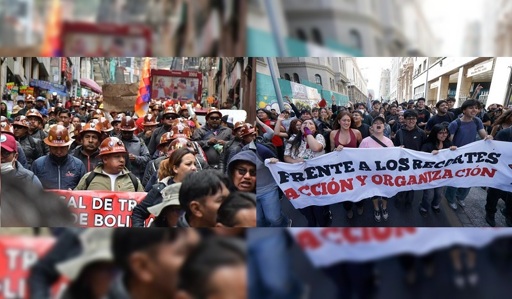
Chile’s new right-wing president, José Antonio Kast has just taken office and protests against the government have already begun. Thousands of high school students have taken to the streets to protest fuel price hikes and attacks on public education. The first question that comes to mind is whether these students represent a new generation of activists, foreshadowing further mobilizations. And will a workers’ movement take up the banners of struggle alongside them? This resistance will have to be built, navigating the mediating (and outdated) leadership of the Socialist Party and the Communist Party, as well as the Broad Front of former president Gabriel Boric.
Our comrades from the Revolutionary Workers’ Party (PTR) of Chile, who are part of our international organization, the Current for Permanent Revolution (CPR-FI), are already talking about a short honeymoon period. In the two weeks since Kast took office, he has faced environmental mobilizations against his extractivist policies, a massive pot-banging protest in Santiago, and student mobilizations (which in Chile always serve as a sounding board for deeper problems). To develop this resistance and defeat Kast’s entire program, they are proposing the need to promote and strengthen grassroots organizing and move towards a National Strike Front.
But why are right-wing governments like Kast’s now facing such short honeymoons?
One possible answer is that President Kast is pulling a Milei — that is, striking hard from the outset while the election results are still fresh, and then waiting to see what happens. Milei himself had publicly criticized his (former) right-wing ally, Mauricio Macri, for being lukewarm and even cowardly for not daring to implement the harsh and absolute austerity measures that the Right Wing believes are necessary. It seems the political conclusion to Macri’s failures was “we must follow Machiavelli’s maxim,” a classic principle of political strategy: “evil should be done all at once, and good should be given little by little.” Politicians like Milei and Kast seem to think that evil should be done all at once and from the start, and the sooner the better. Undoubtedly, it’s a risky gamble, but the Right Wing is enthusiastic about Milei’s achievements thus far.
Bolivia is another example of a short honeymoon period. In December, protests began against the fuel price hike, a decree by President Rodrigo Paz (who took office on November 8) that eliminated fuel subsidies, impacting farmers and driving up the prices of basic consumer goods. Blockades and marches headed toward La Paz in a dynamic process that seemed to be leading to Paz’s downfall. It took the open betrayal of the COB (Bolivian Workers’ Center), which negotiated with the government to find a way out, to end the ongoing struggle.
Our comrades from the LOR-CI (Revolutionary Workers’ League for the Fourth International), also a party of the CPR, explain that the cycle of struggles in Bolivia has by no means ended. The agreement between the leadership of the COB (Bolivian Workers’ Center) and the government was sufficient to contain and prevent a national uprising. But the working class demonstrated its capacity for combat and grassroots organization, and an open structural crisis persists. The challenge is to equip this force with a program and an organization that confronts the domination of capital and opens a perspective for socialist transformation.
It’s clear that shock therapy — striking the masses as soon as a government takes office — doesn’t work on its own. A brutal initial adjustment, in order to avoid massive resistance, requires mediators who can soften or dismantle the response to the attack, as can be seen in the examples of Chile and Bolivia. In Argentina, as Congresswoman Myriam Bregman has explained, Milei’s strength stems from the betrayal of the union leadership, starting with the CGT, Peronist party leaders, and the governors who play their part in Congress through their Peronist representatives and senators. Because it’s already known that such adjustments will have the support of the Right Wing, the key to containing dissent lies with those who falsely claim to represent the interests of workers, youth, peasants, and students.
Such mediators are not enough, though. Repression is needed, and so they strengthen the coercive regime. Unsurprisingly, this was the first thing that Patricia Bullrich, Milei’s current minister of National Security, did by passing the “anti-protest law” to prevent street blockades. But fences and repression couldn’t stop the demonstrations, whether they were the intense and persistent vanguard of pensioners, who have the sympathy of the masses, or the massive demonstrations like those in defense of the universities, or the recent one on the 50th anniversary of the coup. Similarly, in Bolivia, government repression has been quick. Just fifteen days after taking office, water cannons and tear gas were deployed against high school students, the “penguins,” as they were called in the huge marches of 2006 against the education law inherited from the dictatorship.
What these right-wing governments clearly failed to consider is that at some point, after “doing all the bad things at once,” the day would have to come when “good things must come little by little.” Saying that inflation has fallen in Argentina is no longer enough. Nor is lying about official unemployment figures, improvements in wages and pensions, or GDP growth. The masses are not fooled and the workers, as Trotsky said, feel it in their “muscles and nerves.” The middle classes feel it in the decline in consumption and the standard of living. And all these elements are the breeding ground for new rebellions, as long as there are no profound defeats like those of the dictatorships of the 1960s and 70s, or those of neoliberalism in the 1990s.
We are still in the period in which, with varying degrees of radicalization of the class struggle, we are emerging from neoliberalism. This includes Argentina in 2001, Bolivia in 2003, and Chile in 2019. The institutional coup in Brazil was not as bloody as those of Operation Condor in the 1970s and early 80s. And the coup in Bolivia was quickly reversed through class struggle. These are power dynamics won by the masses that are still in effect and can be leveraged. In short, these right-wing governments have come to power as a result of profound disillusionment with previous attempts to solve the crises they are facing, be it Peronism, Evo Morales’s policies, or the Boric administration. They lack initial strength; they are governments born weak, which can only consolidate power through the betrayal of the opposition and union leaderships, as well as through repression and increased Bonapartism. However, as we noted above, given that there have been no strategic defeats among the workers and the mass movement, nothing suggests that their plans cannot be defeated in the streets.
In early March, Donald Trump convened twelve Latin American right-wing presidents at the Shield of the Americas summit, framing it as a kind of military coalition to combat drug cartels. In reality, however, it was a way of demonstrating their submission to imperialism. It was revealed that the meeting consisted of a series of monologues by the U.S. president and his cabinet while the rest remained silent. Nevertheless, this gathering also served to strengthen the political ties of the far right across the continent, ties that have their roots in forums like the CPAC (Conservative Political Action Conference). Perhaps it is in these political arenas that experiences are exchanged, and today we see how, as soon as right-wing governments take power, they unload the burden of austerity onto the masses, in the style of Milei.
These agreements of submission to U.S. imperialism, however, tie the fate of those administrations with that of Trump’s, which is rapidly losing ground in the war against Iran and facing domestic resistance. The alliance with Trump greatly benefited Milei in his victory in the last elections. The support of U.S. imperialism was fundamental. However, the opinion is now widespread that Trump could fare very poorly in the midterm elections in November, when the entire House of Representatives and part of the Senate are up for reelection. This Saturday, the No King protests returned, expressing the overwhelming disapproval of the war. This will add to the existing erosion of support and the internal defeat caused by the de facto expulsion of ICE from Minneapolis, and may open a new situation favorable to the masses on the continent. To paraphrase a popular saying, if the ringmaster weakens, the clowns will be even more vulnerable.
Originally published in Spanish on March 28 in La Izquierda Diario.
The post Right-Wing Governments in Latin America Face Short Honeymoons appeared first on Left Voice.
From Left Voice via This RSS Feed.