

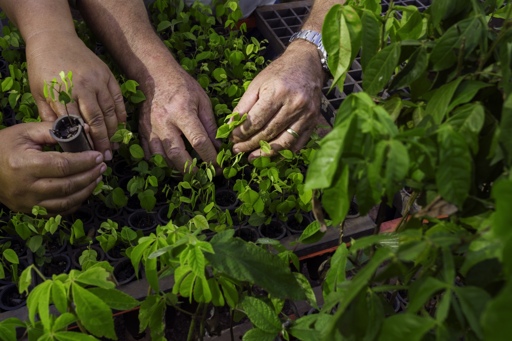
PONTAL DO PARANAPANEMA, Brazil — Sugarcane fields undulate across the landscape as a line of water stretches to the horizon. We travel along a dirt road in western São Paulo, on the banks of the Paraná River — the watery border between the states of São Paulo and Mato Grosso do Sul. Here, monoculture overwhelms a landscape once covered by semideciduous seasonal forest, known as the Inland Atlantic Forest, where trees shed their leaves during the dry season. In his pickup truck, biologist Haroldo Gomes, who holds a master’s degree in agronomy, carries a small forest: ipês (Handroanthus spp.), aroeiras (Myracrodruon urundeuva) and guarantãs (Esenbeckia leiocarpa) are some of the nearly 70 native Atlantic Forest species looking for a place to take root. There was a time when Haroldo’s family, too, had no land. “When we arrived at the encampment, I was 11,” said Gomes, the son of land reform settlers. “During the conflicts, we lived for six years in a makeshift tent. I’ve run from gunfire during land occupations.” Today, Haroldo serves as field coordinator for the Corridors of Life project at the Institute for Ecological Research (IPÊ). Through the initiative, both he and a diversity of native plant and animal species have found a place to call home. Since 2002, the project — driven by land reform families — has restored more than 6,000 hectares (14,800 acres), with 10 million trees planted. The ambitions ahead are even greater: By 2041, the group aims to restore 75,000 hectares (185,000…This article was originally published on Mongabay
From Conservation news via This RSS Feed.