

By AARON ERNEST CRUZ
DUPAX DEL NORTE, Nueva Vizcaya – Mothers from this small town are busy staying in the barricades protecting their land and livelihood against mining operations.
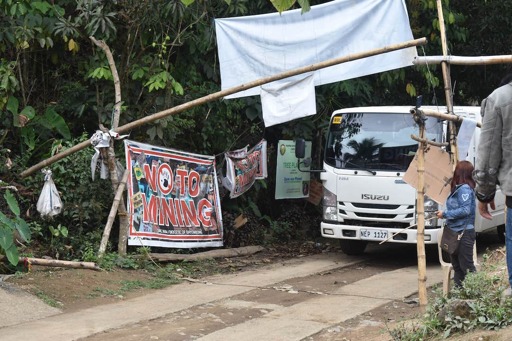
Despite the Mines and Geoscience Bureau (MGB) of the Department of Environment and Natural Resources’s (DENR) order to halt the mining exploration of UK-based mining firm Woggle Company, residents said that drilling equipment have yet to retrieved. Residents, mostly mothers, decided to maintain the barricade at Keon Road, Barangay Bitnong.
Read: Woggle Corp ordered to stop mining for now
Many of them went to the barricade, which they now refer to as Sitio Barikada since Woggle entered the community in late 2025. Although some of them experienced threats, intimidation and arrest on January 23, 2026 when the police tried to implement a court order to dismantle the barricade, the residents literally stood their ground.
The role of women, particularly mothers, has been vital in the community’s resistance. They juggle child care, livelihood and their tasks at the barricade. It is not difficult to understand why.
Cristina Legazpi, 45, shared how life was much better and bearable before Woggle came to their land. She and her husband are working as farmers while taking care of their only son.
Legazpi had been content with their simple life. They grow and harvest tomatoes, beans, and gingers which they consume and sell to get income.
Legazpi said although they used to earn P300 to P500 ($5 – $8.34) per harvest, she had been able to meet their basic needs. She tried to work as a staff member for a non-government office promoting organic farming but she went back to farming after a year.
“I realized that working in agriculture is really better compared to other jobs. With my previous job, the salary is low and the work is extremely tiring. That’s why agriculture is better as long as you have land to plant your crops,” Legazpi told Bulatlat.

Metal pipes of the Woggle Corporation not yet pulled out from the community at the time of Bulatlat’s visit. (Photo by Aaron Ernest Cruz/Bulatlat)
Things have changed when Woggle came. Most of their crops have been infected and became smaller in size. Legazpi said that their tomatoes rotten easily unlike before.
Legazpi added that they did not need to use so much fertilizer since the land was fertile. Recently, they needed to use multiple pesticides just to maintain the nutrients in the soil.
At first, Legazpi was not bothered by the presence of Woggle until she witnessed the changes in her crops. Her neighbors have experienced the same, and encouraged her to join the protest against the mining operations.
She also said that Woggle did not hold any consultation with the local residents.
Woggle Corporation secured their mining exploration permit through DENR – MGB Region II in August 2025. It covers 3,100 hectares in Barangay Bitnong, and four others barangays in Oyao, Munguia, Macabenga, Inaban, and Parai.
Joy Watat, 44, shared similar experiences with Legazpi. She said that the quality of her beans was affected by the mining operations. The beans became smaller and wilt easily, affecting her income when selling her produce to the market.
Watat also sells kakanin (sticky rice cake) and plants vegetables to augment the family’s income. To earn extra, she would also work in her neighbor’s vegetable garden. She earns P300 or P400 ($5 – $6.67) per day, just enough for the basic needs of her four children.
Watat learned about the mining operations from Episcopal Church’s Information and Education Campaign led by community leader Florentino “Tino” Daynos.
“Since I learned about the effects of mining on us, I have been at the Sitio Barikada every day. I saw people from DENR and MGB and also members of advocacy groups visiting the barricade,” Watat said.
Although being at the barricade consumes her energy physically and mentally, Watat knows that their efforts are all worth it.
“I get home late at night after performing my duties at Sitio Barikada. In the morning, I leave early since my children are going to school and I will sell my homemade food,” Watat added.
There had been attempts to dismantle the barricades. Woggle secured a temporary restraining order (TRO) against the protesters.
The police served the writ of preliminary injunction, an order from the court to stop the protest, on January 23, 2026. This led to escalated tension between the community and police forces. Legazpi and Watat, along with other women went to the frontline to protect the Sitio Barikada. Eight of the residents were arrested – seven of them are women. Their case was dismissed later on.
Unbreakable barrier, spirit
Watat recalled that day. “At that time, I had just come from the hospital for two days because I took care of my father who was sick with hypertension. My anxiety was so high and I hadn’t had any rest, and then the confrontation happened.”
As the police pulled them away from the frontline, Watat was captured but later found a way to escape and return to the barricade. “I told the arresting officer that I would just get my bag. They released me, and then they were surprised when I returned to the line.”
For Legazpi, being at the frontline means protecting her kid’s future and defending their land and livelihood. “When the police begged us to step aside and allow the entry of the drilling equipment, I told them that we are the most vulnerable to the side effects of mining, that I have a son who depends on us.”
The MGB issued a temporary suspension of Woggle’s exploration permit on February 6. On March 10, Woggle started pulling out some of their equipment.
The residents want Woggle’s permit to be cancelled, saying that the temporary suspension is not enough.
Legazpi chooses to stay at the barricade. “I really devote time because the barricade protects our community and it symbolizes our opposition to mining,” she said.
“When you see your companions getting hurt and caught. I feel even more determined to protect not just our companions but also our livelihood,” Legazpi said. “What will happen to my child if we don’t fight for this? This is our only livelihood, and now there’s an attempt to destroy it.”
“Sometimes I think there’s no hope, but when I inspire others, I feel happy because their spirits are uplifted to continue the fight,” Watat said.
As they push for the cancellation of Woggle’s exploration, Legazpi emphasized the importance of unity in their community.
At Sitio Barikada, Legazpi, Watat and other women found their rightful place. Their courage has been contagious, with four other barangays putting up their own barricade against Woggle operations. (RVO)
The post Mothers in the frontline against British mining operations appeared first on Bulatlat.
From Bulatlat via This RSS Feed.