

Each month, we share the stories of World BEYOND War volunteers around the world. Want to volunteer with World BEYOND War? Email greta@worldbeyondwar.org.

Current Location:
Helsinki, Finland
How did you get involved with anti-war activism and World BEYOND War (WBW)?
I was born in Afghanistan at a time of war, and I grew up in war. Thus, war has been with me from the beginning and has remained with me throughout my life. When one lives in a war context, most people desire its end and long for a normal life. However, it is often a small number of people at the top who decide and sustain wars. This raises an important question: why is it that the majority, who do not want war, are unable to stop it? This was a question that stayed with me as a child and teenager—why can we, the people, not stop war?
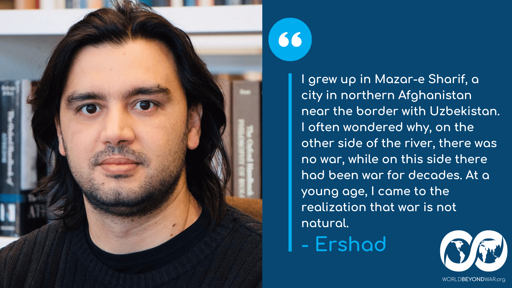
I grew up in Mazar-e Sharif, a city in northern Afghanistan near the border with Uzbekistan. I often wondered why, on the other side of the river, there was no war, while on this side there had been war for decades. At a young age, I came to the realization that war is not natural. If it were natural, it would exist on the other side of the river as well. For example, when it rained in my city, it also rained across the river; when we had snow, they had snow too. Yet we had war, and they did not. This became a clear lesson for me: war is not natural; it is man-made. And what is made by humans can also be stopped by humans.
As a result, an anti-war perspective emerged in me at a very young age. Over time, however, this perspective developed beyond opposition to war alone. While I am anti-war, I see this as part of a broader stance against violence. War is only one form of violence among many. Violence can be verbal, psychological, emotional, and structural.
To illustrate the structural nature of violence, we can look at global homicide rates. Studies show that in some parts of the world, homicide rates are significantly higher than in others. [1] If violence were natural and inevitable, why would such disparities exist between regions and countries? These patterns are not genetic; rather, they are structural. Violence arises from specific social and political conditions. In other words, societal structures create the conditions for violence. In the same way, wars are created by human beings. We construct the conditions in which wars emerge and are sustained—and therefore, we also have the capacity to stop them.
In this broader sense, I do not identify only as anti-war; I also see myself as a follower of the tradition of ahimsa, as articulated by Mahatma Gandhi. I became involved with World BEYOND War (WBW) about three years ago through a friend who had started the Afghanistan Chapter.
What kinds of WBW activities do you work on?
Within WBW, I engage in several types of activities. First, I learn. WBW is a global community of individuals who oppose war and who come from diverse contexts of violence and peacebuilding. Many members bring extensive experience and wisdom in peacebuilding and conflict resolution, making it an excellent platform for learning. I have taken several classes through WBW and have learned a great deal.
Second, I write. I have contributed to WBW as well as to other platforms, focusing on nonviolence as a way of life (see Ershad’s article “Afghanistan and the Baltics: A Tale of Two Resistances” and his essay “Home as Nightmare and Nostalgia” in Coordinates, published by WBW and The Sahira Collective). In addition, I serve as a Co-Coordinator for the Afghanistan Chapter of WBW, where I work as an organizer, educator, and mentor.
What’s your top recommendation for someone who wants to get involved with anti-war activism and WBW?
I strongly encourage people to take the course “Unarmed Civilian Defense Instead of War.” I also highly recommend the book Civil Resistance: What Everyone Needs to Know by Erica Chenoweth. Finally, I recommend WBW’s book A Global Security System: An Alternative to War.
What keeps you inspired to advocate for change?
When we think about change, we can take two approaches. One is to say that it is none of our concern, as long as we have our jobs and personal safety, that is enough. If we decide this, there is no guarantee that violence won’t affect us. The other is to strive to change the world, to make it a better, safer, kinder, and more just place for everyone. The choice is ours.
For me, history is a source of inspiration. A few centuries ago, democracy did not exist as we know it today. Kings held absolute power, and ordinary people had very few rights. Women were not allowed to study, and even after the emergence of democratic systems, it took decades and centuries before women gained the right to vote or access higher education. At the time, these conditions were seen as normal. Many would have argued that such systems could not change—that kings would always rule and women would remain excluded. Yet this has changed in many parts of the world. Today, in many societies, absolute monarchy has declined, and women are no longer barred from education or voting.
The same question arises with regard to war: can we stop it? Just as the idea of democratic societies with educated and enfranchised women would have seemed impossible centuries ago, the idea of ending war may seem impossible today. Yet it is within our power. If we choose to act, we can stop wars. If we do not, history will not remain passive; others will shape its course. For instance, the Taliban.
As someone from Afghanistan, I have witnessed firsthand how religious extremism can gradually suffocate a society. We are entering what I describe as a phase of “Talibanization” in parts of the world, where religious fanaticism fuels conflict. Religious extremism, misogyny, dictatorship, and war are not separate phenomena; they are interconnected, different sides of the same coin. War and the decline of democracy, freedom of speech, and the rise of misogyny are interconnected.
Posted March 30, 2026.
[1] United Nations Office on Drugs and Crime, Global Study on Homicide 2023: Special Points of Interest (Vienna: UNODC, 2023), 5.
The post Volunteer Spotlight: Afghanistan Chapter Co-Coordinator Ershad Noorzai Balkhi appeared first on World BEYOND War.
From World BEYOND War via This RSS Feed.