

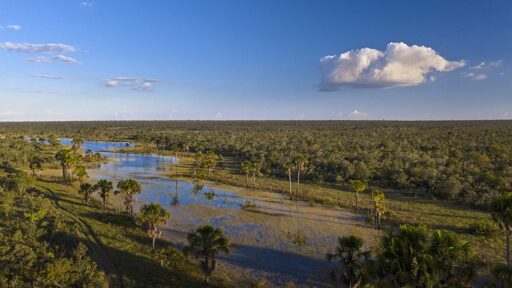
Wild ecosystems such as grassland savannas, bush and open wetlands are losing ground worldwide to make way for large pastures and grain fields. A new study found these ecosystems are being converted at a rate four times higher than for forests. Over a 15-year period, from 2005-2020, researchers found that 190 million hectares (470 million acres) of natural ecosystems, a combined area almost the size of Mexico, was converted, mostly into pastures and farms. Policies that protect only forest ecosystems are partly to blame for this pressure, the researchers wrote in a recently published study. “A narrow policy focus on forests has fueled agricultural expansion into ecologically significant but severely overlooked non-forest ecosystems, including grasslands and open wetlands,” they wrote. Half of the world’s nonforest ecosystems were lost to pasture, while 27% were cleared for crop plantations for human food, and another 17% for animal feed. Grasslands alone account for a third of all global biodiversity hotspots and hold 20-35% of global carbon stocks. Brazil leads the ranking, accounting for 13% of the world’s nonforest land conversion. Most of the nation’s losses come from the Cerrado savanna, an ecosystem that’s been dubbed an inverted forest due to its extensive underground root network responsible for storing so much carbon and water. Inverted forest visual representation. Image courtesy of Walisson Kenedy-Siqueira. Grassland ecosystem loss is notably harder to study than forest loss. Technical restraints, such as the lack of fine-grained satellite imagery, can make it difficult to distinguish pastures from a…This article was originally published on Mongabay
From Conservation news via This RSS Feed.