

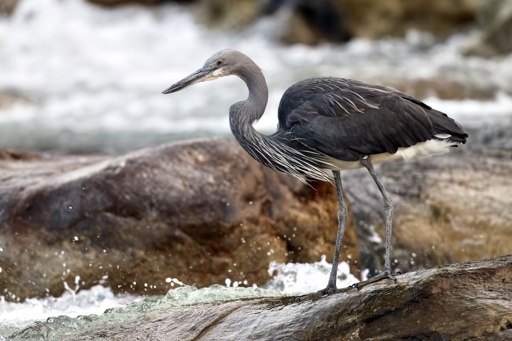
Community-led bird surveys have confirmed that one of the world’s most threatened bird species, the white-bellied heron, still survives in northern Myanmar’s Kachin state. As few as 50 mature white-bellied herons (Ardea insignis) are thought to remain globally, confined to a handful of undisturbed forested valleys in Bhutan, northeastern India and northern Myanmar. Their rarity comes down to their extreme dependence on large, fast-flowing, clean rivers, which means they can’t adapt to the world’s increasingly human-modified watercourses. These slender and shy fish-eaters are also notoriously flighty, easily abandoning their nests if disturbed. With numbers dwindling across their range due to hydropower, mining, pollution, destructive fishing and climate change, the latest IUCN Red List assessment estimates their critically endangered global population at no more than 50-249 adult individuals. White-bellied herons depend on pristine watercourses where they catch fish. Image courtesy of Jonathan P. Slifkin. Local efforts plug gaps Led by Northern Wildlife Rangers (NWR), a local civil society group with a long history of conservation work in Kachin state, the surveys identified three to five individual white-bellied herons from 25 separate sightings in their survey area between 2022 and 2023. The grassroots initiative was exclusively conducted by surveyors from local communities and funded by a WWF small grants program. The latter aims to boost local capacity for conservation to cover diminished government support and reduced NGO presence amid Myanmar’s political crisis triggered by a 2021 military coup. Locally led efforts are increasingly significant in Myanmar, where the post-coup instability has seen…This article was originally published on Mongabay
From Conservation news via This RSS Feed.