

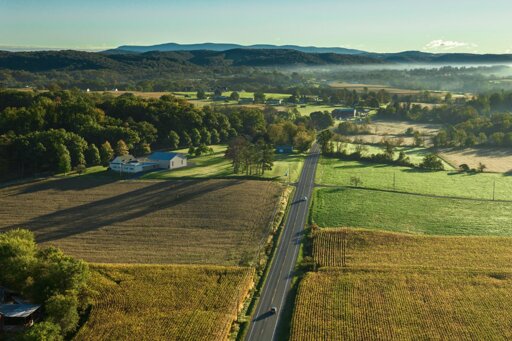
On a bright day in early February, farmers Mark Shultz and Mike Leighow drove along the ruler-straight roads of Montour County in north-central Pennsylvania. From Shultz’s new Chevy Silverado, they gazed at the snow-covered farmland with a sense of nostalgia. These fields were at the heart of a proposal to rezone more than 800 agricultural acres to make way for a data center that residents had been fighting for months. Shultz and Leighow were just two out of hundreds of opponents.
Shultz slowed the truck as they passed the area where residents expected the data center would go, just a short distance from Talen Energy’s Washingtonville natural-gas power plant.
The company aimed to partner with Amazon Web Services for a data center buildout that would kick farmers off the land they leased from Talen and further reduce the county’s dwindling farmland. Even though the rezoning hadn’t yet been approved, workers dotted the open fields, surveying them for the anticipated development.
As tech companies and developers seek to power the artificial intelligence boom by building data centers anywhere they can, farmland is increasingly in high demand. The surge is sparking backlash in places like Montour County, where the loss of farmland, spiking property values, and a suite of environmental concerns threaten to destabilize agricultural communities.
As tech companies and developers seek to power the artificial intelligence boom by building data centers anywhere they can, farmland is increasingly in high demand.
Talen had already recently sold a nuclear-powered data center to Amazon in Berwick, about 20 miles from the proposed site in Montour County, and Amazon was expanding that complex to 960 megawatts—equivalent to the annual energy consumption of nearly one-fifth of all Pennsylvania households. This was the fate Shultz, Leighow, and their neighbors feared for their community.
But just a few days later, Montour county commissioners unanimously rejected the rezoning request. Sam Burleigh, a co-founder of Concerned Citizens of Montour County, a community action group formed to fight the proposal, called it a “David and Goliath” moment.
As data centers proliferate, the response in Montour County shows what it might take to stem the tide. Commissioner Rebecca Dressler cited “extraordinary public engagement” in voting against Talen’s request, which she said failed to demonstrate a clear public benefit.
“Public participation matters,” she said, “and it has mattered here.”
An Ideal Base for Data Centers
Pennsylvania is already home to more than 50 data centers of various sizes, and at least 50 more have been proposed. Ginny Marcille-Kerslake, a senior organizer with Food & Water Watch who supported the community’s resistance in Montour County, says the state has become a hotbed because of its abundant power, water, and land—the three essentials for data center development.
Pennsylvania is the country’s third-highest producer of energy, needed in enormous quantities to power data centers. It offers the largest network of waterways in the contiguous United States, necessary for cooling down the thousands of computers inside data centers. And it boasts millions of acres of relatively flat and open agricultural land that is ideal for development, if it can be secured.
The state’s Democratic governor, Josh Shapiro, a presumed 2028 presidential candidate, has also welcomed the influx, promoting Amazon’s proposed $20 billion investment in the state by signing into law a tax break on purchases of key data center equipment.

Residents attend a Montour County Planning Commission meeting in November 2025, at which the data center proposal was discussed. (Photo credit: Sam Burleigh)
Farmers Face Disruption
For farmers in Montour County and beyond, the data-center boom threatens to shrink farmland and reduce the productivity of what remains.
Multiple sources, including Shultz and Leighow, say that if Talen had succeeded in its bid, it would have removed from agriculture additional neighboring land that it purchased contingent on getting its own land rezoned. Already, Montour County—at 132 square miles, the state’s geographically smallest county—has watched its farmland steadily disappear, losing 22 percent of its land and 28 percent of its farms between 2017 and 2022 alone. The rezoning would have exacerbated that trend.
Andy Bater, a Pennsylvania Farm Bureau board member, says the disappearance of farmland can lead to “a vicious cycle” of increased prices that push out current farmers and keep away new entrants. “That’s the dilemma that I think about all the time,” he says.
The disappearance of farmland can lead to “a vicious cycle” of increased prices that push out current farmers and keep away new entrants.
What’s more, nearby farmers would be forced to reckon with operating alongside a data center. Shultz has already gotten a taste of the risks, due to transmission lines that run to and from the Talen plant in Washingtonville, cleaving his 500 acres of corn, soy, and hay. The energy company tramples his crops to access the lines, and he worries about the effects of stray voltage. Talen has been “an unfriendly neighbor” for years, he says; residents still lament the destruction of Strawberry Ridge, a farming village that was razed to make way for the power plant decades ago.
Data centers have prompted a litany of community environmental complaints, including for their massive draw on local water supplies—a particular concern in Montour County, where the vast majority of residents and farms rely on wells.
“If we can’t get water, we can’t survive,” says Leighow, who grows 105 acres of corn and soy in Montour County on land first purchased by his grandfather in 1901.
The round-the-clock noise and light that data centers produce can also stress animals and inhibit dairy production. Their incredible need for electricity risks disruptions to the grid that Shultz and Leighow worry would affect their own needs, and it drives up electricity bills in the community overall.
The Community Stands Up
By the time Montour County residents learned about the rezoning bid last summer, many feared it was already too late. They heard about Talen’s plans not from the company, but through word of mouth as neighbors began receiving offers to buy their land at six to seven times the market rate. Residents formed the Concerned Citizens group. Through right-to-know requests, they discovered that a data center complex was the ultimate goal of the rezoning bid and quickly rallied behind an effort to quash it.
“I don’t want to be treated like a mushroom, kept in the dark and fed bullshit,” Leighow says.
In the months before the county commissioners’ vote, residents showed up by the hundreds to town halls and a public hearing on the request, carrying signs and wearing red T-shirts imploring “Say No!” to industrial rezoning. More people signed a petition against the proposal than voted in the 2024 election.
Residents were motivated to fight after witnessing what had befallen neighboring Berwick, where the community learned about the construction of the data center too late to do anything about it. “[It] lit a fire for us, seeing how they got railroaded,” Burleigh says.
The fight in Montour County is “a shining example of what a community can do and how to do it,” Marcille-Kerslake says.
The battle may not be over yet. Talen did not respond to requests for comment but has reportedly indicated it intends to continue pursuing a path forward in Montour County. People in surrounding communities are now being approached for land that could serve as an alternative location, Marcille-Kerslake says.
‘We Spoke With One Voice’
For Marcille-Kerslake, the vote in Montour County offers a reminder that opposition to data centers is most powerful at the local level. Food & Water Watch encourages municipalities across Pennsylvania to pass zoning ordinances to prevent development before it gets off the ground, particularly in agricultural areas where data centers are incompatible with farmers’ needs.
“These communities know firsthand that what they have is worth protecting. They cherish that land. They cherish their agricultural lifestyle and community, and what they are producing is the very thing that we depend on,” she says. “What this victory shows them is that it is possible to keep protecting it even when faced with these extremely wealthy and powerful corporations. They really just need to work together and use their voices at the local level.”
Burleigh has heard from communities across the country facing their own data center proposals, including groups from Texas, Oklahoma, California, and Maine, among others. Montour County’s rejected rezoning, he says, “gives a breath of hope to all the municipalities that are battling this.”
Shultz wants others to learn from what his community has accomplished. “Don’t lay down and let them roll over you,” he says.
Leighow adds: “We stood up as a community and were clear about our values. And we spoke with one voice.”
The post How a Tiny Farm County Fought a Data Center Complex and Won appeared first on Civil Eats.
From Civil Eats via This RSS Feed.