

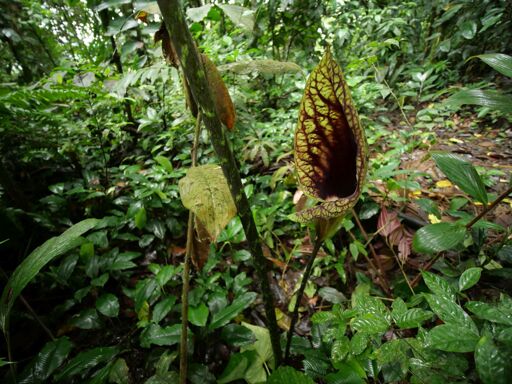
In 1991, botanists Calaway Dodson and Alwyn Gentry advanced a striking proposition. Surveying a rapidly deforested ridge in western Ecuador, they suggested that dozens of plant species known only from that site—Centinela—had likely vanished with the forest. The idea was later distilled into the “Centinelan extinction hypothesis”: that habitat clearing can trigger the immediate, global extinction of narrowly distributed species. It was a powerful claim. It gave a concrete example of how biodiversity loss might unfold in tropical forests, where many species appear rare, localized, and poorly documented. It also rested on a deeper uncertainty. In such systems, what has not been recorded is often treated as if it does not exist. A 2024 reassessment, published in Nature Plants, returns to Centinela using decades of additional collections and records. Drawing on herbarium records, literature, expert input, and targeted field surveys, the authors reconstruct what is known about the site’s flora. Their conclusion is straightforward. Nearly all of the species once thought endemic to Centinela have been found elsewhere. Of 98 putative microendemics, 99% are now known from other locations. Landscape of Centinela, Ecuador, and five plant species once hypothesized to have gone extinct in the region but now confirmed as extant. a, A typical landscape dominated by pasture and agriculture, with small remnant patches of forest (Photo by J. Nicolás Zapata). b–d, Herbs Gasteranthus extinctus (b), Gasteranthus atratus (Gesneriaceae) © and Dracontium croatii (Araceae) (d). e,f, Trees Browneopsis macrofoliolata (Fabaceae) (e) and Amyris centinelensis (Rutaceae) (f). Photos b–f by John…This article was originally published on Mongabay
From Conservation news via This RSS Feed.