

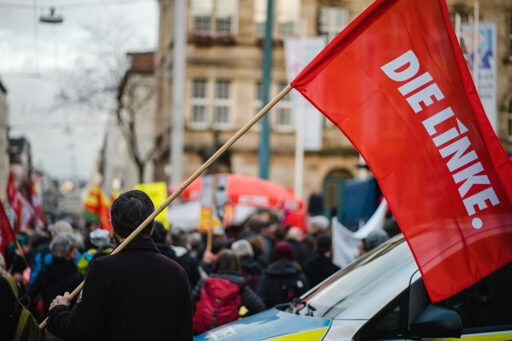
Under normal circumstances, the convention of a regional party federation is a non-event in national politics. Yet the Die Linke convention in Lower Saxony, a region in northwestern Germany, caused a veritable scandal across the country.
At issue was a motion adopted by a majority of delegates condemning “actually existing Zionism.” The motion calls for an end to the genocide in Gaza, colonization of the West Bank, and apartheid; it demands international prosecution of the war criminals President Benjamin Netanyahu and former Minister of Defense, Yoav Gallant; and it denounces the exploitation of antisemitism to stifle criticism of Zionism.
The German bourgeois press, the government, and parties across the political spectrum — from the far-right AfD to the Social Democrats (SPD) — rushed to claim the motion was antisemitic and demand a condemnation from the national leadership of Die Linke. Andreas Büttner, a Die Linke politician and a former police commissioner who had been a member of the right-wing CDU and the liberal Free Democratic Party (FDP) before joining the party — immediately returned his party membership card.
The president of the Central Council of Jews, a federation of Jewish associations aligned with unconditional support for Israel, denounced Die Linke as a party “that provides a safe haven for hatred of Jews.” For her part, CDU Education Minister Karin Prien said “this is not about Israel’s current policy, but about the existence of the Jewish people and the future of Jewish life in the world.”
Despite the controversy, the motion passed at Die Linke’s regional congress is actually very moderate. Zionism is not described as a structurally colonial and supremacist ideology, but as a movement with progressive and reactionary wings, of which only the current Israeli policy is said to be a problem. In fact, the violence of the settlers and the colonized is treated as equally blameworthy.
Despite this, the motion went so far as to attract the attention of the secret services. The Federal Office for the Protection of the Constitution (Verfassungschutz), a political police force whose informants were implicated in the terrorist acts of the National Socialist Underground (NSU) neo-Nazis in the early 2000s, announced via an Instagram Story that surveillance and espionage targeting the Lower Saxony branch of Die Linke would be stepped up.
A Panicked Leadership Denounces the Youth
In the days that followed, Die Linke leaders immediately responded to the call for action and condemned the motion adopted in Lower Saxony. General Secretaries Jan van Aken and Ines Schwerdtner (former editor-in-chief of Jacobin in Germany) denounced the motion as falling “clearly outside the party consensus,” arguing that “there can be no compromise with motions that call into question the foundations of our party. This applies to both regional and national congresses.”
Thus, the party leadership is committed to fighting any political expression that could be understood as calling into question the State of Israel’s right to exist or questioning Zionism — which the leaders of Die Linke present, in a tremendous historical misinterpretation, as protecting Jewish people.
The same position has been adopted by Elif Eralp, the candidate for the Berlin mayoral election, as well as by Heidi Reichineck, the leader of Die Linke in Parliament and its main public figure.
Finally, the Lower Saxony federation, where Reichineck is based, capitulated outright by issuing a convoluted statement in which the leaders claimed that the motion that was voted on “had failed to clearly articulate” that the Left fights both antisemitism and war crimes (even though the motion explicitly mentioned this). In doing so, this statement effectively validates the political and media campaign of recent weeks, which sought to equate anti-Zionism with antisemitism, and opposition to colonialism with hatred of Jews.
These events in Lower Saxony are in fact a larger-scale replay — this time within the party itself — of the crisis that erupted in December 2025 when the national congress of the youth organization Linksjugend ’Solid adopted a motion titled “Never Again Silent in the Face of Genocide.” The national leadership had already denounced the attitude of its youth, who, while not yet defending a fully revolutionary position, were no longer adopting the language of imperialism.
Palestine as a Dividing Line
These tensions between the rank and file and the leadership of Die Linke reflect underlying political trends within the German Left. The “anti-German” current, characterized by structural Zionism, for example, constituted for decades a considerable fringe on the German radical autonomous Left. In just over two years, this current has virtually disappeared, swept away by the anti-colonial politicization of a large portion of Germany’s left-wing youth in response to the genocide in Gaza. This wave of politicization naturally affects the new activists who have joined Die Linke by the thousands since its electoral resurgence in the face of the rise of the Far Right in early 2025.
This now creates a structural contradiction within a party that has always been committed to Zionism — a stance that was an expression of adaptation to the strategic interests of German imperialism, as the German bourgeoisie regards the alliance with Israel as a matter of “reason of state.” Thus, in October 2023, Die Linke MPs voted in unison with all the bourgeois parties and the AfD for the dissolution of Palestinian organizations and the expulsion of Palestinian refugees on political grounds.
Faced with the horror of the genocide and the courageous continued solidarity mobilizations in Germany, Die Linke was forced to begin offering a few timid words of support for the Palestinian people. In late September 2025, Die Linke called for the first time for a demonstration in support of Palestine, which brought together 100,000 people in Berlin. This gesture toward its left wing did not prevent the party from continuing internal repression, with expulsions handed down against several activists due to their anti-colonial activism, like Ramsis Kilani, or youth leaders like Martha Wüthrich.
The new, younger, and supposedly more left-wing leadership of Schwerdtner, van Aken, and Reichinek is in fact taking a position of arbitrator between two fundamental tendencies at work within the party. On one side is a right-wing faction favoring alliances with the Right to counter the AfD, ready to vote for rearmament plans aimed at turning Germany into Europe’s largest conventional army at a cost of hundreds of billions.
It is the members of this very faction who, quite logically, have become the zealous detractors of all anti-Zionists within Die Linke. Thus, Bodo Ramelow, a historic figure in the party, complained about young activists sharing photos of murdered Palestinian children on the party’s messaging groups, which he described as “shit coming from Hamas.” In recent weeks, Gregor Gysi, a prominent figure in Die Linke, made headlines by declaring that “the situation has become more dangerous because many more people with immigrant backgrounds — and from a specific immigrant background — have joined our party, which I am very pleased about, by the way. But they bring with them views on Israel that are mistaken.”
In stark contrast to these positions, which are entirely aligned with the policies of German imperialism, there is a younger generation for whom denouncing the horrors of the genocide in Gaza is a given and who want to confront Germany’s growing militarization. This generation has become politically aware amid the rise of the Far Right and state repression. It is learning the hard way that when state repression and media witch hunts are not enough, the party leadership directly intervenes. Conversely, as the situation in Lower Saxony has shown, when party leaders fail to censor their rank and file, the police apparatus steps in by publicly announcing the infiltration and surveillance of the federation.
New Battles Lines Within Die Linke
In recent days, several statements of solidarity with the activists in Lower Saxony have been published, often by local groups of Linksjugend ’Solid, such as those in Bavaria, Berlin, and Münster. Similarly, several Die Linke activists have taken the initiative in recent months to establish solidarity committees with Palestine, organized regionally and nationally, which are conceived as centers of opposition to the party leadership.
Within these structures, other fault lines dividing Die Linke intersect. Should the party participate in government through coalitions with social-liberal parties like the SPD or the Greens? What has long been the party’s core strategic perspective is now being questioned by sectors of the grassroots, particularly in Berlin, where Die Linke could fare well in this fall’s elections.
The issue of rearmament and militarization is, of course, also part of this. The party’s far-right wing, represented by the elected officials sitting in the Bundesrat, not content with having approved the Bundeswehr’s 900-billion-euro budget, is going even further to push for arms deliveries to Ukraine in joint resolutions with the German Right, in defiance of their own party’s program. At the same time, leaders van Aken and Schwerdtner offer critical support for militarization by presenting the German army as a “defensive” force. Younger activists, on the other hand, are actively organizing a school strike against the military service that the SPD/CDU government wants to impose on German youth.
These tensions will not disappear and will spark new internal battles within the party. This is the warning from our comrades at Klasse gegen Klasse, who are calling for broad solidarity with the activists of Die Linke in Lower Saxony: “Let’s be perfectly clear: as part of the next step aimed at ensuring the party’s ability to govern, anti-militarist positions will also come under increasingly virulent attack. ”
The events and positions taken on the issue of the Lower Saxony motion should therefore not be trivialized. They reflect the tensions arising between a government project serving the German bourgeoisie and a desire in certain sectors of Die Linke — though still nascent — to move toward an anti-capitalist and anti-imperialist perspective.
Originally published in French on March 25 in Révolution Permanente.
The post Die Linke Leadership Is Attempting to Silence Pro-Palestinian Voices appeared first on Left Voice.
From Left Voice via This RSS Feed.