



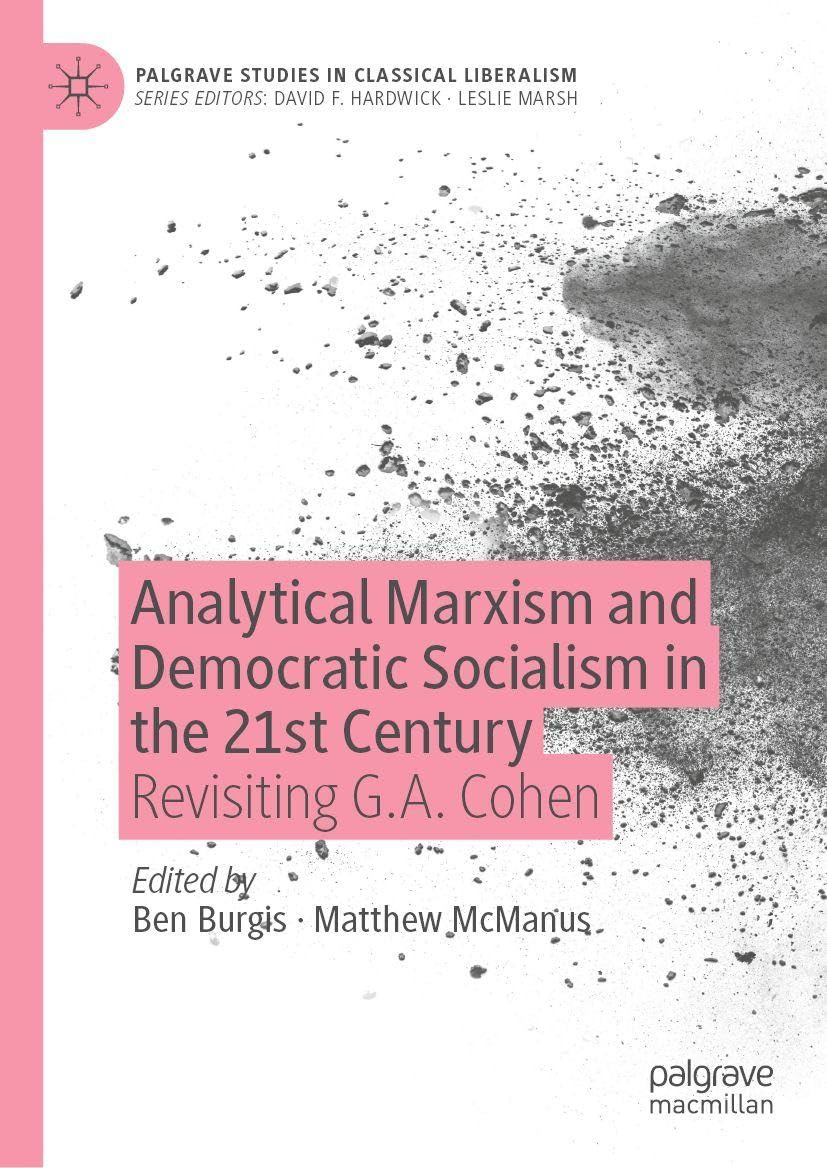
Last Monday, I participated in a panel at York University in Toronto on the collection I co-edited with Matt McManus on the late analytical Marxist philosopher G.A. Cohen. (The collection itself is now due in early May. Prices in academic publishing being what they are, I can understand if you don’t want to buy this one, but here it is if you want to get your library to order a copy.) Contributors Les Jacobs and Christine Sypnowich spoke first, then Matt, and I went last. I think someone was filming it for people in the department who wanted to watch over Zoom but I’m not sure if there’s going to be a public video. I hope so, since I’d love to share the other presentations (and there were definitely some interesting moments in the Q&A). Meanwhile, though, this is a lightly revised transcript of my comments.
There’s so much I want to say about all three of those! I’ll try to be good for the most part, though, and save it for the discussion in the Q&A. I do just want to point out three things, though.
One is that, with regard to what Les said about Cohen’s humor and impressions, way back in I think 2019, I remember playing a YouTube video of Cohen’s impression of his advisor Gilbert Ryle to the late great socialist podcaster Michael Brooks. Michael told me it made him mad that Cohen wasn’t still with us because he really wanted to get him on the show.
The second is that, while it might not be obvious, there’s an interesting range of views here about Cohen’s luck-egalitarianism. Christine was arguing that Cohen’s view actually isn’t demandingly egalitarian enough, and I think Les was saying that in his own way, while I suspect that Matt is, y’know, a right-deviationist. It sounds to me like he’s actually siding with Rawls on a lot of this stuff. So, while it’s not what I’m doing to be talking about today, I do want to point out that I’m sitting here alone in the sensible center as someone who thinks Cohen was basically right about all that!
Finally, in the actual paper in our book, I do include a short defense of, if not every detail of Cohen’s version in Karl Marx’s Theory of History, at least the general viability of an analytical reconstruction and defense of historical materialism. The state of the art there is still Reconstructing Marxism, which Erik Olin Wright, Andrew Levine, and Eliot Sober put out in the early 90s. It’s not like some devastating new objection was raised to the view after that, it’s just that sadly academic interest in thinking about historical materialism generally waned. If there are any grad students in the room today looking for thesis topics, I’d absolutely love to see someone pick up that torch where Wright, Levine, and Sober left it.
The main thing I do explore in the paper is the relationship between that analytical reconstruction and defense of historical materialism and Cohen’s normative philosophy. There’s a narrative about the trajectory of his career that I think anyone who’s interested in Cohen has run into. Even some of his friends and admirers sometimes subscribe to some version of it, I think we basically got at least one iteration of it here, and it’s certainly popular among both anti-Cohen people within the Marxist camp and liberal philosophers who distrust any attempt to rehabilitate what they see as stale Marxist dogmas. According to this narrative, Cohen started out attempting to combine real hard-core Marxism with the methodology of analytic philosophy, and that at some point that project ran into trouble or ran out of gas, and so he was forced to “switch” to doing moral philosophy. Having given up on the capital-L capital-H Laws of History, he settled for making normative arguments for the desirability of socialism.
The anti-Marxist version of this comes from Canada’s own Joseph Heath, who wrote a widely circulated essay two years ago called “John Rawls and the Death of Western Marxism.” And the story Heath tells is that starting with the publication of Karl Marx’s Theory of History at the end of the 70s, there was this tremendous upsurge of academic interest in renewing and clarifying Marxism, and you had all these “no bullshit” analytical Marxists who were doing some of the most intellectually interesting work out there, but somewhere along the line it all ran out of steam and Rawlsian liberalism just sort of absorbed it all like a philosophical version of the Borg. Obviously, Cohen, for example, very famously had deep disagreements with Rawls, but in Heath’s story, those are all just details. The important thing is that Cohen and the rest of the analytical Marxist crew started out being interested in exploitation, which is a properly Marxist concept (the different forms of class society that have existed over the course of history, Marx tells as, are differentiated by the form taken by exploitation), and trying to make sense of that was a bit of a conceptual mess, and anyway the analytical Marxists realized over time that exploitation didn’t matter very much and what actually mattered was inequality, which is a fundamentally liberal concern. And one of the things that was interesting to me about Heath’s essay when it started making the rounds was that Heath is an anti-Marxist liberal but his essay was being shared with equal enthusiasm by anti-liberal Marxists who signed off on the whole story but put the pluses and minuses in different places.
Liberals like Heath, or some conservatives and libertarians I also saw sharing the essay back then, basically think, ok, Cohen started out in Karl Marx’s Theory of History trying to do no-bullshit Marxism, and then he came to realize that when you took out all the bullshit there was nothing left—it turns out Marxism was bullshit all the way down—and that’s when he had to abandon the project and switch to making moral arguments. The parallel story told by orthodox Marxist critics of Cohen sometimes goes like this: The heart of Marxism is the dialectical method. (There’s a famous quote from Leon Trotsky about how Marxism without the dialectic is like a clock without a spring.) In dismissing that method in favor of the methodologies of analytic philosophy and the bourgeois social sciences, it was inevitable that a thinker like Cohen would wind up adopting fundamentally bourgeois-liberal conclusions. They might agree with the idea that real-deal Marxists only care about exploitation, not inequality. And some of them key into places where Cohen uses words like “Platonism,” where he endorses a “transhistorical” concept of justice, and say, see, this is all fundamentally incompatible with the historical materialism he started out endorsing.
And what I argue in the paper is that both the Marxist and anti-Marxist versions of this story are just wrong, for several reasons, and in the time I have left I’m going to mention a few of those reasons as well as at least gesturing at the positive agenda of the paper, the work I do think there is to do in improving on Cohen’s picture of historical progress.
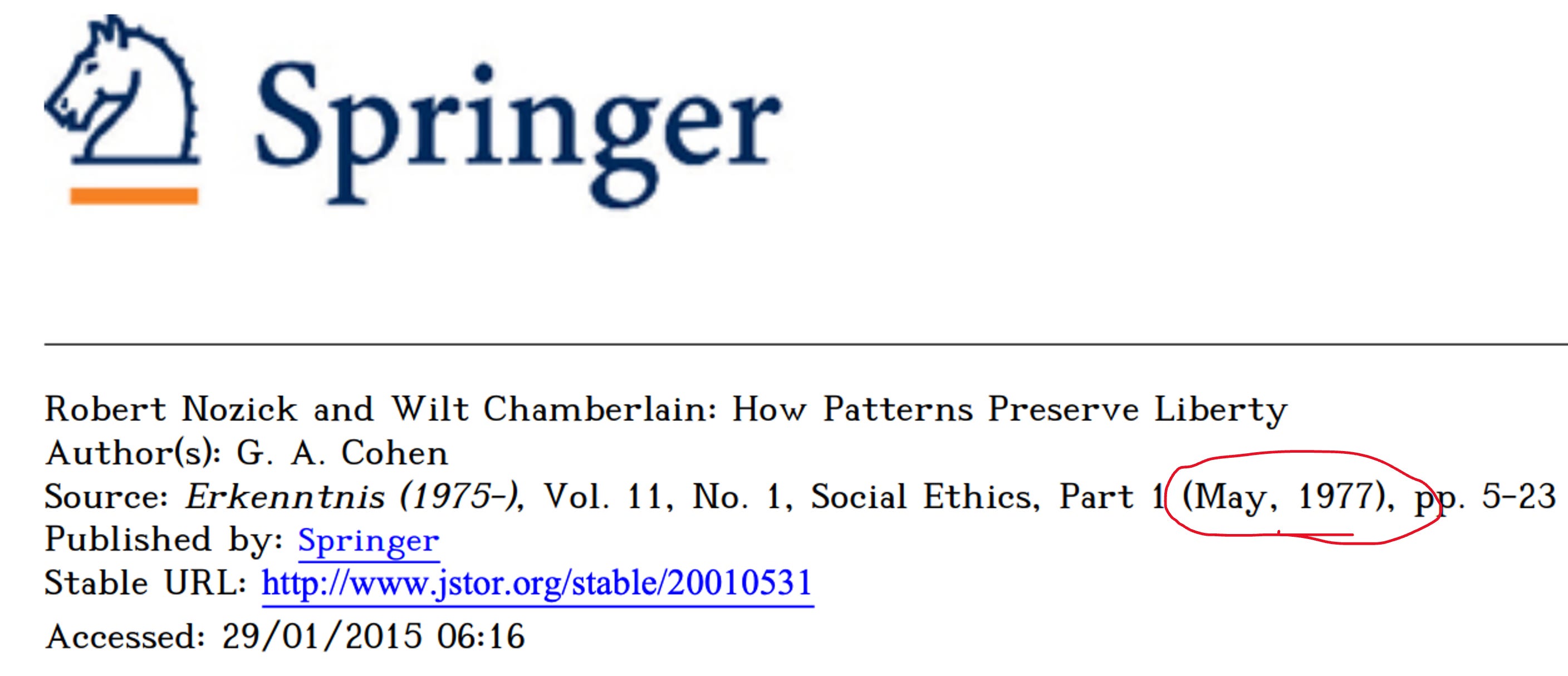
The first reason is maybe the least interesting, although I also think that as far as the actual claim people like Heath make about the trajectory of Cohen’s career goes, it’s absolutely decisive. And that’s that the chronology doesn’t check out. If you read Nozick’s big paper about Nozick’s Wilt Chamberlain example, that was published in 1977, and every major element of the moral case for socialism that Cohen makes at the very end of his life in Why Not Socialism? is already there. He’s already talking about equality as the most important socialist value. He’s already saying, this is footnote 8 in that paper, that justice just is equality, although strict justice sometimes has to give way to other values, and he’s already saying that the socialist principle of justice has to be tempered with a socialist principle of community. It’s all there, in a paper published before Karl Marx’s Theory of History even came out in 1978, in fact at whatever point he wrote that paper, the book wasn’t even going to be called that, in another footnote he calls his forthcoming book Philosophical Defense of Marx’s Theory of History. So, all the most important elements of the supposedly post-Marxist phase of Cohen were already there before he even came on the scene with the big attention-grabbing defense of historical materialism.
And a related point is that the idea that equality is somehow an un-Marxist concern would have been very surprising, I think, to Karl Marx. An argument Marx essentially makes in a few different places is that one of the reasons exploitation is so bad is because it leads to so much inequality. And anyone who’s read Capital knows there are a couple of points in there where Marx is talking about scenarios where the poverty of the working class might decrease at the same time as capital continues its skyrocketing accumulation, and every time he touches on that scenario he always says, well, but don’t get too excited, because “relative poverty” would actually be increasing, since the wealth of the capitalists is increasing more than the poverty of the workers and their families is decreasing. Even when the floor is rising, the size of the gap between the floor and the ceiling is always front and center as a concern for Marx. People who insist that Marx is dismissive about equality often quote-mine in a really misleading way from his brilliant and subtle discussion of distributive equality in Critique of the Gotha Program, where yes, he argues strenuously against a Lassallean slogan about equality in the distribution of the fruits of the workers’ labor, but if you pay attention to the actual argument he’s making there, Marx is bringing up exactly, and I mean exactly, the kind of considerations that would inform the “equality of what?” debates between different kinds of egalitarian philosophers in the late 20th and early 21st centuries.
Like, and I want to be clear about this, I’m not attributing luck-egalitarianism or any other particular view of these questions to Marx. That would be anachronistic, and besides, he was many things but one thing he definitely wasn’t was a moral philosopher. If anything, in some early writings he seems to find the whole enterprise of moral philosophy a bit suspect, and at any rate, over the course of his career he was far too busy theorizing about history and developing his history-changing critique of political economy to spend his time on moral philosophy. But those passages in Critique of the Gotha Program make me think he would have been a brilliant moral philosopher if that’s where he had focused his energies.
In those few pages, he’s anticipating those “equality of what?” debates in really interesting ways, talking for example about how distributing equally in the sense of giving everyone the same package of resources for putting in the same day’s work ignores that different workers have different needs. Meanwhile, distributing equally in the sense of equal reward for equal amounts of labor, measured in duration or intensity or both, ignores that different people have different bundles of natural talents. Not everyone is able to work as hard or as long, so giving equal rewards for equal labor contributions actually means inappropriately rewarding what Marx calls “natural privilege.” At the same time, he anticipates a line of thought about how these injustices have to be accepted for the sake of other values during the lower stage of socialist development that matches up very nicely with the kinds of points that Cohen would make in Why Not Socialism? about how, at any given stage of history, his demanding ideal of luck-egalitarian justice (“socialist equality of opportunity”) may have to give way in complicated tradeoffs with competing values, including economic efficiency, but we should still maintain the socialist equality of opportunity principle as our north star.
There’s another passage in Critique of the Gotha Program that trips people up about all of this, where Marx says that Right can “never be higher than the economic structure of society and its cultural development conditioned thereby.” Marxists often take that as Marx being a historical relativist about justice, denying that there’s a single “transhistorical standard” you can use to judge different societies where different material conditions prevail, but as Cohen points out in passing in his brilliant essay about Marx and Isaiah Berlin, the plain meaning of the passage is actually exactly the opposite of that. If we’re talking about how “high” Right can go, if we’re contrasting “lower” and “higher” stages of communism, then all of that is actually totally incoherent if we don’t have a transhistoric standard of justice. We need that “Platonic” yardstick to make sense of the basic picture.
And that brings me to one more reason many critics assume there’s a conflict between Cohenian moral philosophy and Marxist historical materialism, which is that they assume that historical materialism means that all ideas in everyone’s heads, about morality or anything else, are superstructural, so the idea that we can reason about moral philosophy without just vomiting back up capitalist ideology doesn’t make sense. Now, I don’t think Marx himself believed that, I’d be happy to cash this check as best I can in Q&A, but for the record I think that’s not a very careful reading of the sentences in Marx’s 1859 preface that people are getting it from. I’ll just note for now that Cohen himself certainly never believed anything like that. If you read Karl Marx’s Theory of History, he goes out of his way to explicitly deny that historical materialism as he understands it entails that all ideas in everyone’s head are always superstructural and if anything he seems to think that this is an incoherent idea. What’s superstructural for Cohen and for Cohen’s reading of Marx is primarily legal and political institutions.
OK, so everything I’ve said so far has been defensive, and I want to spend the last minute or two of this at least gesturing suggestively in the direction of where I think Cohen’s picture can be improved on. Historical materialism gives us a very powerful and, I still think, a very compelling picture of how historical change happens, on the fact side of the fact/value line. But then on the value side, we can ask when what we’re looking at is historical progress and how satisfied we should be with that progress. And one way of thinking about what Cohen is doing, though this obviously isn’t how it’s usually framed, is that he’s well within the tradition of thinking that socialism represents a deeper fulfillment of the values of the bourgeois revolutions. In publishing a collection on Cohen in Palgrave’s series on classical liberalism, I guess Matt and I are tipping our hands that this is what both of us think.
So, what are those values? In the classic slogan from the French Revolution, you’ve got:
- liberte
- egalite
- fraternite
Well, Cohen’s got his socialist equality of opportunity principle. That’s a powerful principle of egalite that he explicitly contrasts with bourgeois equality of opportunity, as a deeper form of the same principle. He’s got his community principle, which corresponds to fraternite, taken more seriously than the bourgeois revolutionaries could ever afford to, since the liberal-capitalist society they were building was necessarily still a wildly materially unequal one. Anyone who wants to be able to psychologically function in that society had better not take too seriously the idea that people who have fewer crumbs than them are their brothers and sisters. So, Cohen’s on top of equality and fraternity. But I think there’s a liberte-sized hole in his normative case for socialism.
I want to be clear about what I am (and am not) claiming here. I’m not saying he’s indifferent to liberty. He’s not. There are any number of places where he talks about the ways that our pursuit of equality has to be limited by proper respect for individual autonomy, for example. And there are places where he’ll defend traditional Marxist claims about freedom (most obviously in his “Structure of Proletarian Unfreedom Paper”) or where he’ll seizing the opportunity to turn the tables on bourgeois apologists by showing that they want to restrict freedom, which is basically what’s going on in Cohen’s wonderful “Freedom and Money” paper that Matt mentioned earlier.
But you don’t really see freedom playing any role in his main case for socialism, as he makes it for example in Why Not Socialism? You don’t really see him developing a rich account of freedom that he could contrast with a shallower liberal account, like he’s doing for equality with his demanding luck-egalitarianism. And this is where I think his contributions could be usefully supplemented by a lot of recent work that’s been done in rediscovering the small-r republican elements of Marx’s thought, as for example in William Clare Roberts’s Marx’s Inferno, or better yet in Bruno Leipold’s Citizen Marx. And there’s obviously a lot more to be said about this but I also said I’d keep this on the short side, so let’s go to discussion!
Thanks for reading Philosophy for the People w/Ben Burgis! This post is public so feel free to share it.
From Philosophy for the People w/Ben Burgis via This RSS Feed.