

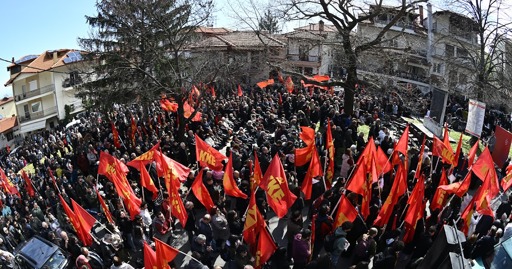

The Communist Party of Greece (KKE) held today, Sunday 29 March, a mass political event in Litochoro, northern Greece, to mark the 80th anniversary of the founding of the Democratic Army of Greece (DSE), bringing together party members, supporters and youth in a gathering that combined commemoration with a clear political message. The event, marked by strong participation and a militant atmosphere, reaffirmed the continuity of the struggle of the working class and its movement.
The choice of Litochoro, a small town in the foothills of Mount Olympus, is deeply symbolic. On the night of March 30–31, 1946, a small armed group of communist fighters attacked the local gendarmerie station. This action came just hours before national elections that the KKE and the broader left had decided to boycott, denouncing them as illegitimate under conditions of terror against leftists.
In his central speech, Dimitris Koutsoumbas stressed that the KKE honors the 80 years since the founding of the DSE by paying tribute to those who fought, were wounded or fell in its ranks, highlighting their sacrifice, determination and commitment to victory. At the same time, he underlined that this tribute is inseparable from the present, with the “flag of the struggle for socialism” remaining firmly raised.
He described the three-year struggle of the DSE as just, heroic and great, emphasizing that it expressed the interests of the overwhelming majority of the people against domestic and foreign exploiters. The bourgeois state power in Greece, he noted, faced then its greatest threat, while its survival depended decisively on the military, economic and political support of the United Kingdom and the United States. This intervention, he pointed out, determined the outcome of the conflict in favor of the ruling class.
Koutsoumbas highlighted that the KKE’s current strategy—reflected in the decisions of its recent congress—is rooted in its deep and lasting ties with the working class and the popular strata. These roots, he noted, are confirmed by the sacrifices of previous generations, referring in particular to the 200 communists executed in Kaisariani in May 1944. He rejected attempts to detach such historical moments from their political content, stressing that those who were executed were targeted precisely because they were communists.
He also dismissed the notion of a unified “national memory,” underlining that in a class-divided society memory itself reflects class interests. In this context, he strongly criticized the theory of the so-called “two totalitarianisms,” promoted by the European Union, which equates communism with fascism. Such positions, he noted, are supported by liberal, conservative and social democratic forces and aim to discredit the communist movement. At the same time, he pointed out that within the Greek people there are strong resistances to these views, to which the KKE and the labor movement have decisively contributed.

Referring to current developments, Koutsoumbas stressed that the international situation is marked by escalating imperialist competition and conflicts, warning that the danger of a wider war is growing. He pointed out that Greece is already deeply involved in these developments, particularly through its alignment with the United States and Israel in the Middle East, serving the interests of the bourgeois class.
He underlined that participation in the plans of NATO and the European Union constitutes a strategic choice of the Greek ruling class, unrelated to the real defense needs of the people. Decisions such as the deployment of military systems abroad, he stressed, serve geopolitical and economic interests rather than the protection of the country.
Linking foreign and domestic policy, he emphasized that governments which impose anti-people measures—such as extended working hours, pressure on incomes and policies affecting housing and social protection—follow the same criteria in international affairs: the interests of large business groups. He noted that the main political forces converge on these strategic choices, particularly regarding military involvement abroad.
A central point of his speech was the clear distinction between the interests of the exploiting class and those of the working people. The so-called “national interest,” he stressed, is used to justify policies that serve the former, even when they expose the people to serious dangers and burdens, especially in conditions of war.

On this basis, he called for the strengthening of the workers’ and popular struggle so that the people do not pay the price of war involvement and economic pressures. He stressed that the KKE is at the forefront of this effort, fighting for the disengagement of Greece from imperialist plans, for withdrawal from NATO and the EU, and for a path of development based on the power of the people and relations of mutual benefit with other nations.
He concluded by calling on the people to reject all bourgeois plans presented as “national goals” and to defend their own independent interests. The struggle for living standards, rights and social needs, he stressed, is inseparable from the struggle for a society free from exploitation, with the KKE playing a leading role in this direction.
Within this framework, the reference to Litochoro in March 1946 was presented as a decisive historical moment. The attack on the gendarmerie station marked the transition from repression against the popular movement to organized armed resistance, leading to the formation of the Democratic Army of Greece and the development of the struggle that followed.
Eighty years later, the event in Litochoro reaffirmed that this historical experience remains a point of reference for today. The central message was clear: the struggles of the past provide valuable lessons for the present, and the strengthening of the organized workers’ movement is the decisive factor for the developments to come.
From In Defense of Communism via This RSS Feed.