

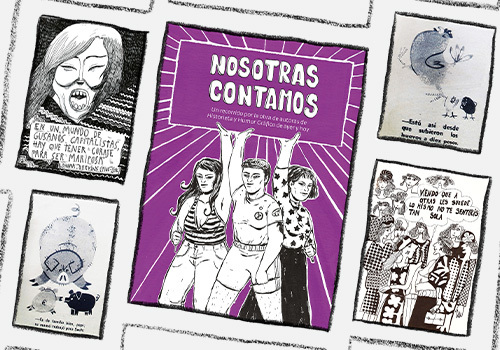
The Twenty-Fifth Art Bulletin (March 2026)
Listen to ‘Vivas y Furiosas’ (Alive and Furious) by Sudor Marika featuring Tita Print. Over the cumbia sounds that drift through working-class neighbourhoods in Argentina, ‘Vivas y Furiosas’ gives voice to feminist resistance.
March is a month in motion. In Argentina, 8 March (8M) – International Working Women’s Day – gets people on their feet and into the streets, painting the city squares and avenues in feminist and internationalist purple. Then, on 24 March, the Día Nacional de la Memoria por la Verdad y la Justicia (National Day of Memory for Truth and Justice) brings together organisations, political parties, students, and families to commemorate the victims of Argentina’s US-backed civic-military dictatorship (1976–1983) and to affirm ‘Nunca Más’ (Never Again), the enduring rallying cry of the country’s human rights movement against the crimes of the dictatorship. Under Milei, that struggle has renewed urgency as attacks on workers’ rights are paired with official denialist propaganda around 24 March. As Feminismo Gráfico (Graphic Feminism), a cultural collective born in Argentina that seeks to disseminate comics from transfeminist perspectives, we too belong to these struggles.
The circulation of culture and art is full of myths, obfuscations, and hidden marvels. 8M offers an opportunity to showcase the discussions and practices advanced by militant cultural spaces. On the terrain of comics, Feminismo Gráfico’s digital archive, Nosotras Contamos (literally, ‘We Tell Stories’, but also ‘We Count’ or ‘We Matter’), seeks to contribute to this effort. It is the space where Feminismo Gráfico compiles, disseminates, and recovers the names of women, trans, and non-binary creators in Argentina, from the early twentieth century to the present. In honour of 8M, we begin a new update to the archive, adding contemporary creators and recovering overlooked figures from the past. In doing so, the archive foregrounds Argentina’s feminist stories and comics, and with them a brilliant history of struggle and creation that is often rendered invisible.
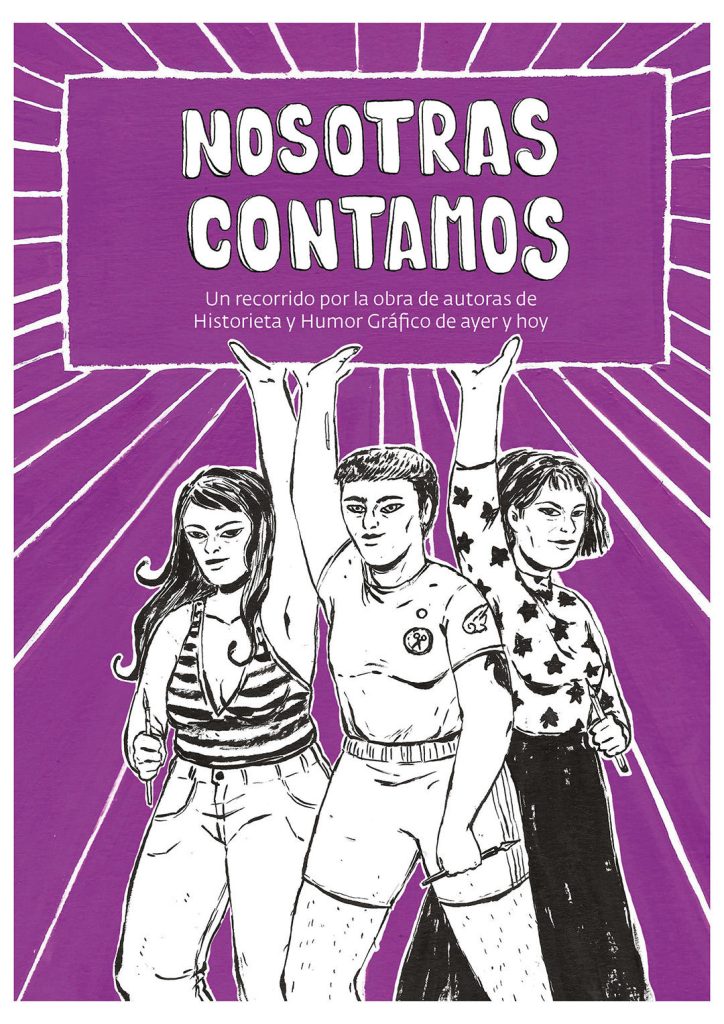
Jules Mamone, cover of the original Nosotras Contamos catalogue, 2019.
A Sea of Comic Panels and Cheap Paper
Let’s first situate comics within the field of cultural production: from satirical cartoons and newspaper strips to longer graphic narratives, they are an artistic language loved by working people yet long treated as inferior to ‘higher’ forms of art. They emerged in the heart of cheap, mass-produced periodicals. From the beginning, they made room for humour and satire, imagined possible futures, and turned monsters into vehicles for metaphor. They also have the incredible power of telling stories to those who are learning to read. Throughout the history of people’s struggles, comics have carried expressions of resistance across their pages in the form of fiction, journalistic chronicles, and poetic experiments.
Since the medium’s inception, Argentina has produced a rich body of comics and even managed to sustain popular magazines that fearlessly competed with those emerging from the Global North. Many authors were persecuted or their works banned, especially during the dictatorship. Héctor Germán Oesterheld, writer of the landmark Argentine science-fiction comic El Eternauta (The Eternaut, 1957– 1959), was among those targeted in that era. An author, editor, and militant in the Montoneros – a left-wing Peronist guerrilla organisation primarily active in the 1970s – Oesterheld was disappeared by the dictatorship as part of Operation Condor.
This month marks fifty years since that coup in Argentina that sought to take from us far more than our stories and storytellers. Since then, the changes wrought by the violent imposition of neoliberalism in this country have had a profound impact on our comics industry. But we never stopped drawing, whether in magazines, fanzines, books published by editorial cooperatives, or webcomics. And in all these spaces, women creators were present.
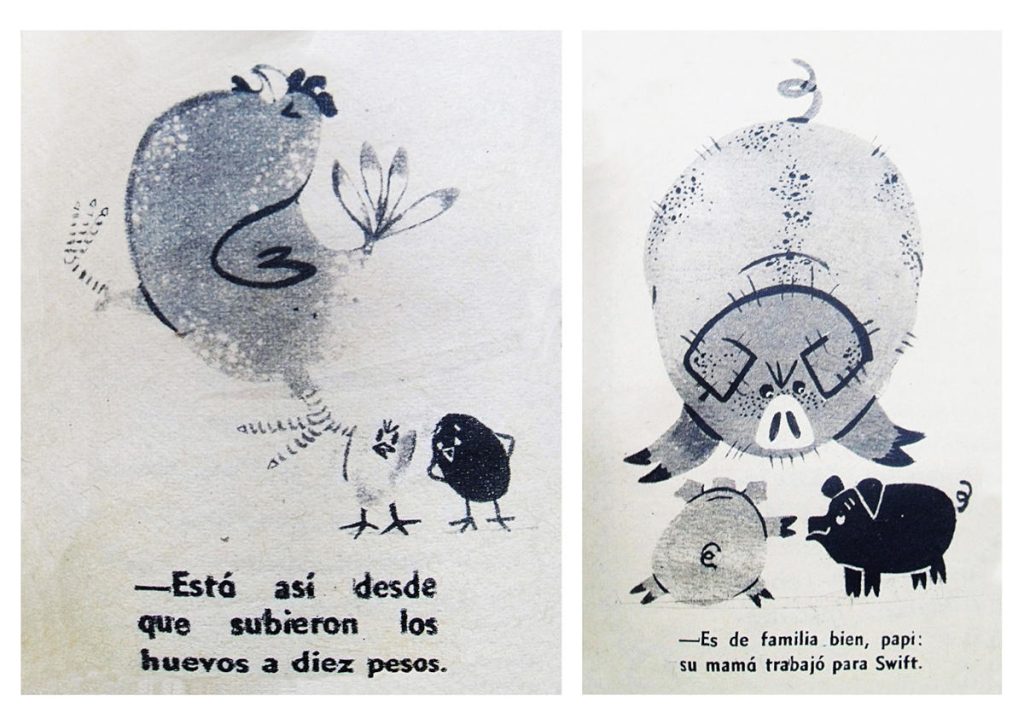
Signing as ‘Cerebella’ or ‘Cotta’, the popular Argentine chef Blanca Cotta published her cartoons in the satirical magazine Tía Vicenta (Aunt Vicenta). These two pieces were published in 1957.
The Myth of Absence
One tool of power is invisibilisation. If something goes unnamed, it eventually ceases to exist. We cannot build something when we are constantly starting from zero. What remains is an eternal reverberation of struggles stripped of memory, narratives buried, so that building resistance feels like raising walls on sand.
When it comes to the place of women and gender dissidents in comics, tired questions and prevailing myths reappear. The myth of absence is the first that must be shattered, because there have always been women comics creators. In Argentina, when women cartoonists and comics artists are discussed, perhaps only two or three are named even though there are more than a hundred. In fact, the Nosotras Contamos Digital Archive spans nearly a century.
The archive was created by Mariela Acevedo, feminist militant, researcher, editor, and comics scriptwriter. Drawing on her militant experience, she turned a furious curiosity into a collective project, setting out to find all those who had gone unnamed. She sought to contribute to that sense that ‘there are so many of us’, using feminist genealogy as a research method and acting on the contagious conviction that we must respond with information, wit, and militancy to the casual assertions that sustain machista common sense. The group that was assembled over this contagious spirit continues the project today.
By speaking with collectors, interviewing creators, and rummaging through libraries, we discovered that one should always leave room for doubt when someone says ‘this woman is the first to…’ We began to find that, behind ambiguous pseudonyms and abbreviated signatures, many women comics artists had long been assumed to be men. Looking at signatures on certain panels and reading a ‘G.’ before ‘Dester’, one might imagine a ‘Gonzalo’ or a ‘Gilberto’, but never a ‘Gisela’. Yet it was Gisela Dester who drew and signed pages of Ticonderoga, scripted by the disappeared compañero (comrade) behind El Eternauta. We also found that behind the work of male creators stood the women in their families who sustained the household and the care work that made their creative labour possible – including sisters or wives who anonymously helped finish pages to meet deadlines.
It might seem like a basic task – finding and naming these artists – but through those encounters a genealogy comes into view, making visible how the patriarchal system seeps into every facet of life. Those making a place for themselves in the field today might not know that in the 1970s Martha Barnes, one of the first women to work professionally in Argentine comics, worked at Columba, one of the country’s most important comics publishers. Yet she was consistently paid less than her male peers and assigned to romance stories, even though she wanted to draw horror. Knowing our history and building collective memory is essential.
From a popular feminist perspective, this is nothing new: care work is not recognised as work, feminised labour is rendered invisible, and women’s active roles in the history of masculinised fields are concealed. But outside feminist spaces, these forms of erasure are still poorly understood. The distortion deepens in the cultural field, where it remains necessary to insist that those who produce art are, in fact, part of the working class.
It is also nothing new that, over the years, women and sex-gender dissidents have elbowed their way into the industry, figuratively or literally. Whether creating new spaces or occupying and transforming established ones, the presence of women creators in comics today is undeniable. It is in this spirit that we often call ourselves okupas (squatters) – partly in jest, but more so as a provocation. Because as soon as this okupación (occupation) starts to become visible, we are labelled as ‘too many’.
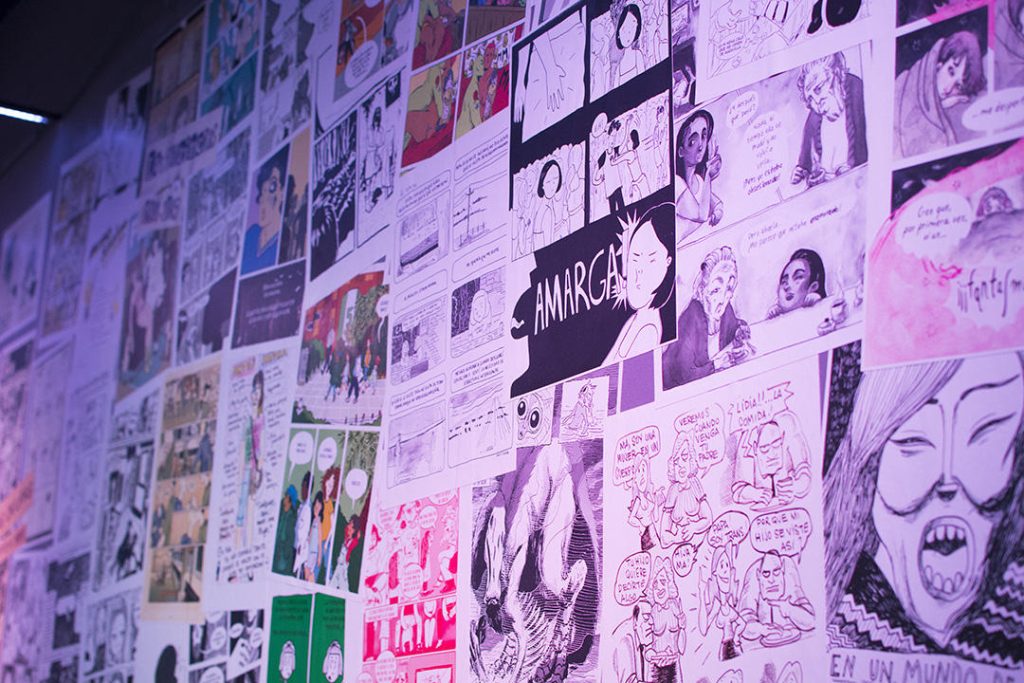
Feminismo Gráfico exhibition at the Feria de Editores, Buenos Aires, 2025. Photo: Cé, Archivo Intangible.
The Myth of Style and Subject
Another myth layered onto absence or exception is the myth of a homogeneous style or aesthetic attributed to a certain gender. It is assumed that women, trans, and non-binary creators only engage with certain themes, that they draw in certain ways, or simply that they ‘can’t draw’. It is especially brutal when judgement is disguised as a compliment: ‘Weird… you draw like a man’. As if hand and mind were mysteriously connected to one’s gender when one picks up a pencil and a piece of paper.
When we began to compile comics for the Nosotras Contamos archive, we found classical styles, bold lines, formal experiments, glimpses of fine art, and fanzine aesthetics. In short: we found everything – unbridled.
In narrative terms, all kinds of worlds emerged as well: horror, science fiction, political chronicles, autobiographies, experimental narratives, and humour. If there was a common thread, it was a commitment to representing what the mainstream industry tended to leave out. We found diverse bodies, skin tones usually rendered invisible, identities, and political demands that emerged sometimes explicitly, sometimes more obliquely. The archive proposed thematic axes, drawing connections that transcended time and linked the concerns of a mid-twentieth-century creator with those of a young one just starting out today. This was one more way of collectivising, of thinking of ourselves as part of something larger that unites us with those who came before, those who share these spaces today, and those who will come after us.
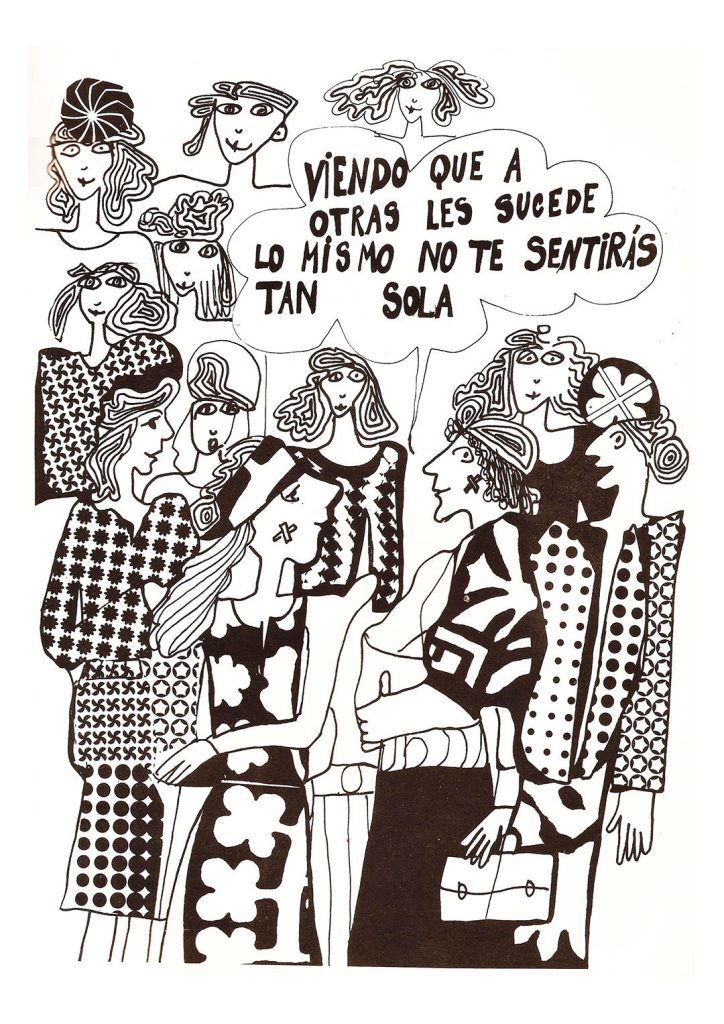
Diana Raznovich (drawings) and Lucrecia Oller (texts). Manual de instrucciones para mujeres golpeadas (Instruction Manual for Battered Women), Argentina, 1989. Works created for Lugar de Mujer, a key feminist collective in the 1980s. Donated to Feminismo Gráfico and made available for free public access.
To Break Myths, We Organise and (Re)Present Ourselves
Nosotras Contamos is alive and growing. We know it can never be complete. Its expansion must also form part of an internationalist cultural network. There are sister projects in the region, including Chile’s Mujeres Chilenas en la historieta (Chilean Women in Comics) catalogue, and in Europe, such as Presentes (Present). We are always looking for other projects engaged in documenting and historicising comics and graphic narrative, especially in the Global South.
The Feminismo Gráfico archive is a genealogy with gaps – missing pieces we have not yet managed to recover. We know that much labour remains invisible, that many collaborations continue to be poorly documented, and that many works still bear no signature. We also know that the field continues to grow, including through emerging creators working in new media whose contributions cannot yet be fully mapped. For this reason, we carry the words of our compañera Mariela like a banner made of comic panels: ‘We tell this story: it is incomplete and unfinished, but it is collective and seeks to make visible what is missing, so we can reconstruct in some way, imagine it, write it, and make it present’.
This month’s dossier, The Anti-Feminist Agenda of the Latin American Far Right, features artwork selected in collaboration with the digital archive. To explore the ever-expanding collection, visit feminismografico.com. We tell stories with the hope that, the next time someone reads a comic, they might imagine something other than a man’s name behind every signed initial.
Warmly,
Dani Ruggeri
Designer, Tricontinental: Institute for Social Research
Co-coordinator, Feminismo Gráfico
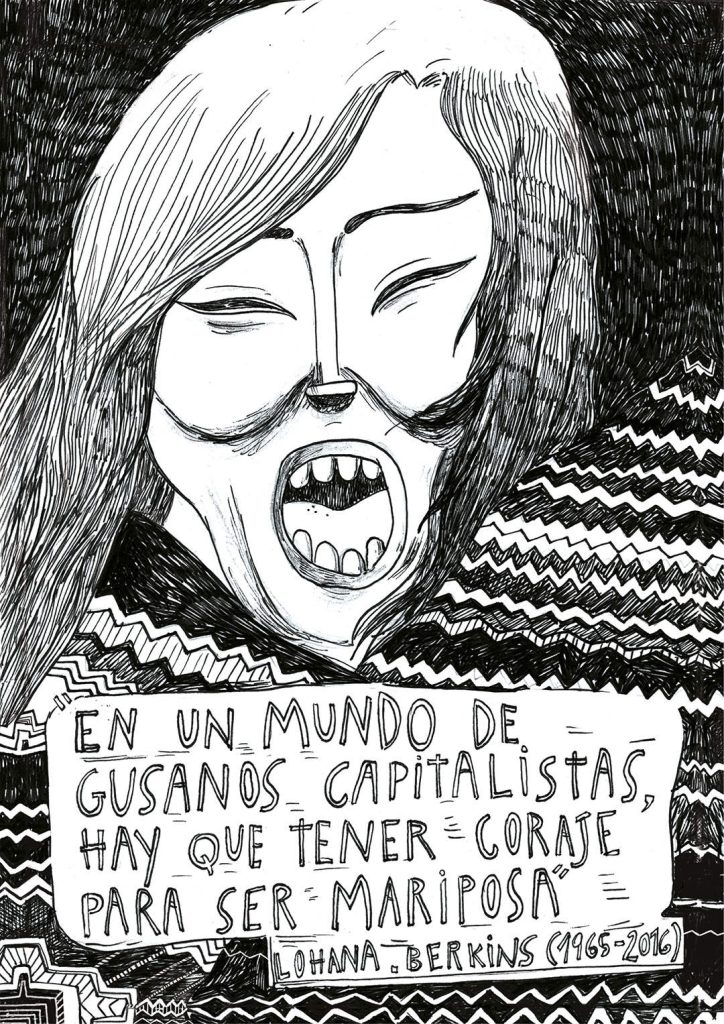
Valeria Reynoso, excerpt from the fanzine Sé vos (Be Yourself), Editorial In Bocca al Lupo, 2017. The phrase is a direct quote from Lohana Berkins, an Argentine travesti-trans activist and founder of Asociación de Travestis, Transexuales y Transgéneros de Argentina (Argentinian Association of Travestis, Transsexuals, and Transgenders People, ATTTA), who was also a leading advocate of Argentina’s Gender Identity Law of 2012 (Law 26.743).
From | Tricontinental: Institute for Social Research via This RSS Feed.