

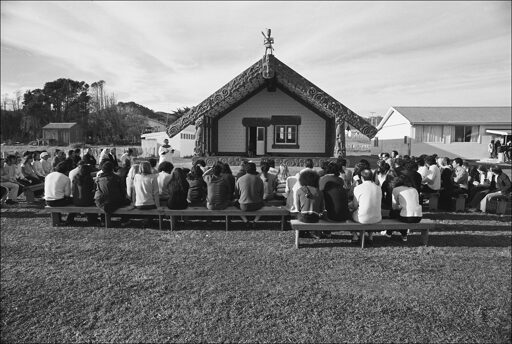

Arts “revolutions aren’t made at the Met, they’re made on marae and in towns like Te Kaha by people driven by a love of reo, whenua and whakapapa.” — Jamie Tahana, producer of Pūtātara: Revolutions in Māori Art. Pictured: Morning karakia at Māori artists and writers hui in Te Kaha, 1973. (Photo by John Miller.)
In 1973, dozens of the country’s most luminous and promising artists gathered in Te Kaha for what turned out to be a landmark weekend for contemporary Māori art.
Here, Jamie Tahana, who produced Pūtātara: Revolutions in Māori Art, a podcast series that looks at the role of contemporary Māori artists in the Māori renaissance, explains why that weekend was so significant.
When a group of artists and writers gathered outside Te Kaha Nui-a-Tiki marae on a crisp winter’s morning in 1973, their gaze was captivated by a pod of whales offshore. Their appearance in the deep blue waters of the Eastern Bay of Plenty on this of all mornings, the second of June, must have been a promising tohu.
The marae and its wharenui, Tūkākī, sit proudly atop a Pōhutukawa-fringed peninsula just down from East Cape. It’s an isolated settlement wedged between the sea and the Raukūmara ranges, a long drive from anywhere.
Yet dozens of the country’s most luminous and promising artists had heeded the poet Hone Tuwhare’s call to hui, to gather. It was a social get-together as much as anything, with little by way of an agenda. But by spending a weekend creating, dreaming, and sharing — wānanga as a verb, not a noun — they hoped that hearts would swell, minds would wander, and ideas would spark.
You can see the weekend in vivid detail through images captured by the photographer John Miller, archived on the National Library’s Digital NZ website. The energy is palpable in those soft black-and-white photos that display the arms of kaikōrero in full flight, or the expressions on the faces of writers deep in thought.
In one photo, Ralph Hotere, with that signature shock of wild hair, has his eyes fixed on something distant as he leans towards Marilyn Webb, their figures shrouded by a haze of cigarette smoke. Another shows Tuwhare sitting outside Tūkākī chatting with local kuia Kiritahanga Pohipi, broad grins spread across their faces. Syd Jackson, activist and unionist, is there too, clutching a pile of papers as he stands head bowed, absorbing the kōrero of Sonny Waru, the dull light of table lamps casting their shadows to the ceiling above.
One of the highlights of that weekend was an evening concert. Ivan Wirepa, a classical pianist, had strapped his grand piano to the back of a truck and driven down from Auckland. A dozen young men had to disassemble it to get it through the narrow door of the wharenui, before putting it back together again.
In the cold dark of a winter’s evening, the people gathered in the hushed light of the meeting house, reclined on pillows and mattresses lined around the four walls. Hone Tuwhare read some poems in that deep, melodic voice of his before Wirepa stepped to the piano. His fingers danced across the keys as Chopin’s Study in A Flat rang around Tūkākī.
The weekend was so successful that the writer Mihi Roberts booked a second hui in Wairoa. “People didn’t really know what to do, and yet it turned out so beautiful,” Roka Paora recalled. The actress, researcher, and later human rights commissioner Erihapeti Murchie said: “Te Kaha was a wonderful, glorious birth and we left it with a fervour and enthusiasm to go forward.”
Tuwhare, in a convener’s report published in 1974, wrote that “it did not appear that we had come merely to flaunt our talents and show off, but in turn to renew ourselves, to draw sustenance from the deep roots of the tangata whenua, and the land.” The conference chairman, Wiremu Tawhai, would comment: “Some new strength must come of this.”
This weekend hui is the start point for Pūtātara: Revolutions of Māori Art, a six-part podcast series I’ve spent much of the past year producing alongside Matariki Williams, the writer and curator who hosts the podcast.
It’s a series that details how our artists were an inextricable part of the Māori renaissance. Because, while that weekend became an annual fixture for more than 20 years, springboarding the careers of many of our most successful artists and writers, underpinning it were broader concerns about the state of the arts and society, and how they would respond, capture, or even influence events over the coming decades.
This was the early 1970s, after all. A time when Māori were concerned about the status of our land, culture and language, which, despite more than a century of petitions and appeals, remained in a parlous state. Frustration was mounting, particularly among a generation of rangatahi determined to punch back.
By 1973, there were already some seismic rumblings underfoot, much of it in response to a suite of land legislation that had provoked a fierce backlash from elders, like the totemic Whina Cooper. Other movements were also rumbling away. A group of students had been circulating a petition calling for the Māori language to be recognised, and a raucous group of activists had started picketing Waitangi Day festivities.

Protest on bridge at Waitangi in 1996. (Photo by John Miller.)
Art, as it is now and has forever been, is such a potent way to express these sentiments, to voice concern and convey history, thoughts and feelings in a way that captivates, moves, and motivates.
Tuwhare made no secret of his concerns, alluding to them in his 1964 collection, No Ordinary Sun. Our series has an excerpt of him reading Not By Wind Ravaged, which he said was about the marae — his marae — falling silent as its people scattered through urbanisation.
O voiceless land
Let me echo your desolation
The mana of my house has fled
The marae is but a paddock of thistle
It’s hard to divorce art from activism, even if those who wield the pen, paintbrush, or chisel don’t see themselves as such. Like the novelist Patricia Grace, who told us: “I just thought of them as about the things that I knew about, but then I was told ‘Well if you’re writing about marginalised people and their ordinary lives then it’s a political act’.” She would later come to embrace the label. “I think it was good for me, I felt as though I was on a right pathway.”
In the Nga Taonga archive, we found one particularly poignant interview with the late painter Robyn Kahukiwa: “A lot of people think Māori art, in inverted commas, is locked up in the museums and it’s the art that’s on marae,” she said. “But we also must have an art which changes with the times, which grows, which reflects what’s going on in our society.”
When we were first brainstorming this series, the art and museum world was in the throes of celebrating the 40th anniversary of Te Māori, a groundbreaking exhibition at New York’s Metropolitan Museum of Art.
That exhibition, in September 1984, proved extremely popular as tens of thousands of Americans filed through to see 174 taonga, ranging from small rei niho to giant pou tokomanawa, in what curator Hirini Moko Mead called a “liberating experience” for the Māori people, who could “realise that their culture is beautiful.”
Making Te Māori involved a laboured process over many years to convince iwi, hapū and marae to part with their treasures. But many would only release them on the proviso that they were given the respect they deserve: not as anthropological curiosities, but as art that was alive. It was also an exhibition that sparked a still ongoing quest for the repatriation of other taonga.
Nearly half a century later, Te Māori is still spoken of in reverential tones. Matariki and I had considered starting the series at this point, but it was the art historian Ngarino Ellis who suggested we look further back. Because, as kaihautu of Te Papa Arapata Hakiwai put it, Te Māori was “a political response” to the events of the previous decade, which were still swirling as the ope gathered at the stone steps on Fifth Avenue.
But it wasn’t without its flaws. Wāhine and contemporary art were sidelined by Te Māori, provoking some powerful responses, especially from groups like Haeata, the Māori women’s arts collective.
No culture remains frozen in time. Like the whenua that’s shifted by the wind and rain of Tawhirimātea, our culture and ways, and the ways in which we see ourselves, evolve, grow and adapt.
With that in mind, it’s hardly surprising that an event four decades ago might not meet the standards we set for ourselves today. While Te Māori undoubtedly deserves praise, giving way to pure nostalgia undermines responses that were just as consequential, leading us to repeat the mistakes.
After all, have our views on the role of wāhine and contemporary art shifted in any significant way? Have our institutions truly moved beyond seeing our taonga in an anthropological sense? If you stepped into an exhibition today, would you get a sense that we are alive as a people?
They’re questions worth asking. In 1990, when Wellington City Gallery held an exhibition called Mana Tiriti, timed to respond to the sesquicentennial, Irihapeti Ramsden wrote that her measure of success was “the number of Māori attracted to the gallery, an environment in which Māori have not always felt at ease.”
As much as their white walls and quiet interiors might suggest otherwise, museums and galleries aren’t neutral spaces. They’re sites of power. They possess a capacity to determine whose stories are told and whose histories matter. And, as Pūtātara reveals, they’ve often moved more slowly than the artists and communities themselves.

“In all of our digging through the RNZ archives, we couldn’t find a single interview with a painter as consequential as Buck Nin.” Buck Nin, Polluted Land. Te Kōpuni Kura, Collection of Te Wānanga o Aotearoa.
But as frustratingly slow as the pace may have been, one woman in particular moved the dial in ways that still reverberate today — and she did it from Palmerston North.
Mina McKenzie was a curator at Te Manawa, and she was the only woman on Te Māori’s organising committee. She then organised a taonga Māori conference, which, in 1990, brought curators from around the world to learn how to look after our taonga.
“You can’t look at an anthropology book and make sweeping generalisations about Māori life. That’s tended to happen, we’ve been encapsulated within a framework of anthropological thought which isn’t real,” she said in 1990, words that remain so prescient today. “It’s always been within the framework of a Western viewpoint of us. We were never like that within our own eyes, and we’re not like that now.” Mina’s signature phrase, “Keeping the taonga warm”, has become something of a North Star for Māori in the museum sector.
To tell the stories of these artists, writers, and curators, to delve into the archives and hear the voices of those long passed, like Tūwhare and McKenzie, has been a privilege.
What’s more remarkable is that we were able to do it. It’s been known for a long time, anecdotally at least, that coverage of the arts is in crisis. In 2020, a journalist, Mark Amery, asked Creative NZ to find data to establish just how dire it was. A subsequent report written by Rosabel Tan and James Wenley, called New Mirrors, detailed a collapsing media sector that has only ever seen arts coverage as a nice to have.
Only about 3.25 percent of all media coverage in this country relates to the arts, they found, and only about one-tenth of that relates to ngā toi Māori.
That became evident as we tried to make this series. In all of our digging through the RNZ archives, we couldn’t find a single interview with a painter as consequential as Buck Nin. Mina McKenzie, a wāhine with such a monumental legacy, had been interviewed only once, in 1990.
We know that arts coverage has diminished in the decades since. The groundbreaking works and people of today might be slipping through our fingers. What is that perpetuating?

Forge Project in upstate New York. (Photo by Taylor Galmiche)
Just before the series was released, Matariki and I drove up the Bay of Plenty coast to Te Kaha, passing the weathered sign that proudly declares: “You are entering the tribal lands of Te Whānau-a-Apanui.” It was a late summer afternoon, the sun sitting high on the horizon, the crystal ocean sparkling as Whakaari puffed away on the horizon. It felt right to finish the series where it began.
From the beach, with a soundscape of rattling cicadas and tumbling surf, we recorded some final reflections as we watched students from the local kura practise waka ama. We could see Te Kaha Nui-a-Tiki marae across the bay, its red roof wavy in the haze of the summer heat. The energy and inspiration — mauri, let’s call it — which came to define the collective that came to be known as Ngā Puna Waihanga is still evident wherever you turn.
We pulled up at a coffee cart, a converted horse trailer that brews coffee as good as anywhere in Auckland or Wellington (and miles better than anywhere in London). There was the barista and a man on an extended lunch break. When we told them why we were in town, the kōrero flowed. It emerged that we had been recording at the very spot Te Tiriti was signed by Te Whānau-a-Apanui in 1840.
They’d heard about the hui in ’73. They told us about the works that still line the wharekai, and the recollections that had been passed down to them of artists milling about town one winter’s weekend 53 years ago. Right now, they’re looking to convert the coffee cart into a sound booth, so the rangatahi can record their own music and podcasts.
At its essence, Pūtātara is a love letter to the small towns and the regions, a statement that revolutions aren’t made at the Met, they’re made on marae and in towns like Te Kaha by people driven by a love of reo, whenua and whakapapa. As much as any politician or lawyer, it’s our artists and writers who have grasped the challenge of a new world, capturing the feelings of a generation through their words and images.
The first line of our series says: “Te Kaha seems an unlikely place for a revolution.” But, in many ways, it’s the perfect place for a revolution.

Jamie Tahana and Matariki Williams, recording at the Metropolitan Museum of Art, New York, for their podcast series Pūtātara: Revolutions in Māori Art. (Photo by Taylor Galmiche)
Jamie Tahana (Ngāti Pikiao/Ngāti Makino/Tapuika) is a journalist and broadcaster who has worked in both Aotearoa and the Pacific. He grew up between his Dutch mother in the Hutt Valley, Wellington, and his Te Arawa dad in Rotorua. He has a master’s degree from Te Herenga Waka Victoria University and was the Māori news editor at RNZ until May 2023.
The post The perfect place for a revolution appeared first on E-Tangata.
From E-Tangata via This RSS Feed.