

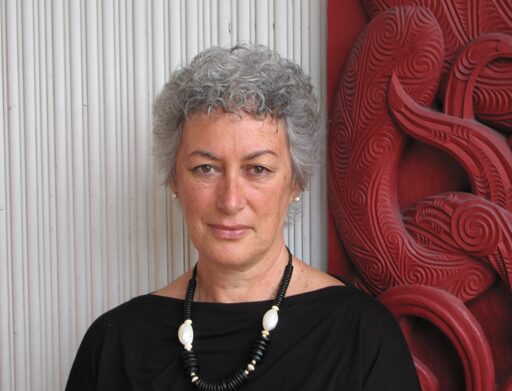

Professor Margaret Mutu has been charting significant events and changes for Māori for 30 years, published in the second edition of The State of Māori Rights. (Photo supplied)
Thirty years ago, Margaret Mutu, a professor of Māori Studies, was asked to write a review of the year in Māori rights for an academic journal in Hawai’i. She never thought that in 2026, she’d still be doing it, and that a book of those collected reviews, titled The State of Māori Rights*, would be into its second edition.*
Here, she tells Atakohu Middleton why, despite the frustrations the book records, she remains hopeful.
Way back in 1995, Margaret Mutu inherited a job from the late Ranginui Walker, a colleague at Waipapa Taumata Rau, the University of Auckland.
Ranginui had been writing annual reviews of issues affecting Māori for a journal called The Contemporary Pacific, a longstanding publication of the Center for Pacific Islands Studies, University of Hawai‘i, and wanted to pass on the job.
At the time, Margaret was a junior academic. She recalls the huge frustration she felt back then, watching the injustices Māori endured, and “feeling powerless in the face of a colonial behemoth that impacted every part of our lives.”
So, when Ranginui asked her to take over from him, she jumped in.
There was plenty to write about. Māori were battling the government over its controversial “fiscal envelope” policy for settling Tiriti o Waitangi claims — a take-it-or-leave-it plan that proposed a $1 billion cap on all historical settlements over the next 10 years. Margaret had been involved for two decades in the land and Tiriti battles of her own whānau and hapū, so she knew the issues inside out.
Writing the annual reviews was “cathartic, even though I doubted that it would really make any difference,” she recalls. “I was increasingly surprised when The Contemporary Pacific kept asking me to do it year after year, always expecting that each year would be my last. Then international colleagues asked me to publish what became the first edition, and even after that, the invitations kept coming.”
Did she ever imagine that she’d be doing the job so many years later? “Never!”
That first 2011 edition of The State of Māori Rights contained 15 chapters, and the book was promptly added to university reading lists.
This new edition will probably follow. With 29 chapters taking us up to mid-2023, it’s an accessible, illustrated and footnoted account that provides a Māori perspective on the challenges to Māori autonomy over the past three decades, covering political, social and cultural spheres.
It’s not all about struggle, though. Māori succeeding as Māori are celebrated, and the leaders lost during that time are remembered.
“The whole approach right from the beginning has been listening to what the people are saying and then trying to capture it,” Margaret says. “That means keeping a close eye on what Māori media are saying about things and listening at the hui you go to.”
It’s a book aimed at a wide readership, explaining the context and background of the issues traversed — and Margaret hopes that Pākehā, in particular, will read it.
“I want them to understand what the hell it is we keep going on about, and why,” she says. “I have a lovely example of this. My son came home one day — I think he might’ve been at university at the time — and said: ‘You know, Mum, one of my friends said to me that the word “Māori” and the word “protest” are synonymous.’”
She laughs. “I told him: ‘That ain’t right.’ Correcting that misconception was one of the things that drove me when I was writing the columns that have gone into this new book. I want to make sure that people understand why we protest. We’re saying: ‘You’re not listening to us! Listen, listen carefully. You need to understand what happened when we got dispossessed of everything, and the consequences of that.’”
For Māori, there’s increasing recognition that the path to self-determination in Aotearoa requires constitutional change, and the book charts progress in this area.
In short, in 2010, the National Iwi Chairs Forum set up Matike Mai Aotearoa, an independent working group to develop a constitution for Aotearoa based on He Whakaputanga o te Rangatiratanga o Nu Tireni and Te Tiriti o Waitangi. The group ran 252 hui across the country between 2012 and 2015, talking to thousands of Māori about what an inclusive constitution should look like.
The working party was convened by the late Moana Jackson. Margaret has chaired it since its inception and says it’s the visions of change contained in the working group’s report, written by Moana Jackson, that drive her.
The report lays out six indicative models that recognise three spheres of influence: the rangatiratanga sphere, where Māori make decisions for Māori, and the kāwanatanga sphere, where the Crown makes decisions for others. The relational sphere overlaps both and requires them to work together.
“The aim of constitutional transformation is to put the country back into a state of balance,” she says, pointing out that without constitutional power, iwi will continue to have decisions imposed on them.
“When we asked people: ‘If tomorrow you could make your own decisions for your own lives, what would it look like?,’ they said: ‘If you get the values right, the rest of it will fall into place.’”
Those values? People talked about mana (power and authority), tapu (sacred), manaakitanga (care for the other) whanaungatanga (kinship), whakapapa (genealogical history). “All those things that we talk about all the time.”

“I want to make sure that people do understand why we protest. We’re saying: ‘You’re not listening to us! Listen, listen carefully. You need to understand what happened when we got dispossessed of everything, and the consequences of that.’” — Professor Margaret Mutu, on the reason for ‘The State of Māori Rights Revised Edition’. State of Māori Rights Revised Edition by Professor Margaret Mutu, published by Huia. (Photo: Huia)
Looking at the three decades covered by the book, Margaret picks education as the area where there has been the most progress.
“That’s because we managed to get in place the kōhanga reo, the kura kaupapa, the wharekura,” she says. “Even though there’s only a relatively small percentage of our kids that go” — last year, about 10 percent of Māori students were in full immersion, numbering about 20,000 students — “it has had an impact on the rest of that generation. That kōhanga reo generation is a fundamentally different generation from my generation.”
Margaret says that’s because this generation has experienced education that affirms their identity. “Whether that has freed them to be able to excel, I don’t know. But I notice it as they come through to the university. They’re a different breed. They are very confident in who they are and where they’re from, and they live comfortably in their own skin.”
Ask Margaret what she wants to tell politicians of every stripe in a particularly fractious election year, and she has just one message.
“Constitutional transformation is needed in this country, and you need to get your head around that. Please tell us how you’re going to engage. Please read the report of Matike Mai Aotearoa. Then tell us how we’re all going to engage the country in that long conversation.”
She remains hopeful that Māori and non-Māori will find a way to live more harmoniously, and feels that optimism most strongly when she looks at her six mokopuna.
“My mokopuna will be what I had always hoped our people would be. Confident in both te ao Māori and te ao Pākehā, and there to make sure that we all get on and look after each other — you know, that we treat each other as well as possible.”
Margaret Mutu (Ngāti Kahu, Te Rarawa, Ngāti Whātua, Scottish) is Professor of Māori Studies at the University of Auckland, and is an internationally renowned researcher, author and lecturer who works on issues around the Treaty of Waitangi, te reo Māori and Māori rights.
She is the chair of her iwi parliament, Te Rūnanga-ā-Iwi o Ngāti Kahu, and of two of her marae. She is also a mandated representative of Ngāti Kahu nationally and internationally, including at United Nations Indigenous forums, and she is the chief negotiator for the settlement of Ngāti Kahu Tiriti o Waitangi claims. She is mum to three, has six mokopuna, and is “nan, whaea and cuzzie to hundreds”.
The State of Māori Rights Revised Edition by Margaret Mutu is published by Huia**, $55.
The post Thirty years of the state of Māori rights appeared first on E-Tangata.
From E-Tangata via This RSS Feed.