

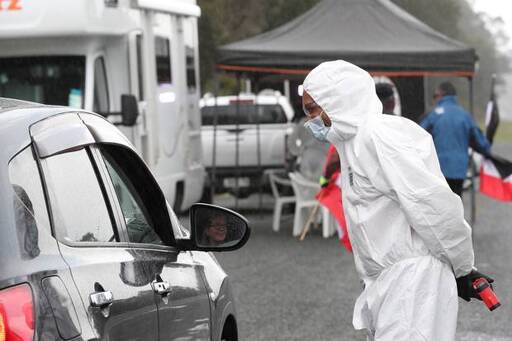

Māori acted quickly to stop the pandemic from reaching their communities, applying the lessons learned from the influenza pandemic of 1918. Pictured: A Tai Tokerau checkpoint in 2020. (Photo: Facebook/Hone Harawira)
In 2020, when Covid-19 hit our shores, Māori acted quickly to stop the pandemic from reaching their communities, applying the lessons learned from the influenza pandemic of 1918, which had so devastated Māori.
In this extract from her book, The State of Māori Rights Revised Edition*, Professor Margaret Mutu reviews the success of that response.*
For Māori, the Covid-19 pandemic brought into sharp relief horrific memories of the 1918 Spanish flu pandemic.
Oral traditions have preserved the histories of the disproportionate loss of life Māori suffered as we were denied information, resources, support and assistance.
The death rate for Māori was at least eight times greater than that of Europeans. Our cemeteries continue to remind us of the disastrous consequences of foreign diseases when we are unable to protect ourselves.
As soon as we realised that the Covid-19 pandemic was heading to Aotearoa New Zealand, Māori moved to stop it reaching our communities.
We called on our medical experts to keep us fully informed on the best steps we should take to protect ourselves. They had already come together to form Te Rōpū Whakakaupapa Urutā, the National Māori Pandemic Group. Its membership included many of the country’s leading Māori medical and health experts.
Te Rōpū set out to keep Māori communities as well-informed as possible. They set up a comprehensive website, issued press releases and gave numerous media interviews. In addition, their members attended many meetings convened online by whānau, marae and iwi and by the National Iwi Chairs Forum, providing advice and guidance and answering seemingly endless questions. They also advised those who were vulnerable to go into lockdown before the country officially did on March 25, to stop widespread outbreaks, community transmission and new clusters.
As restrictions were gradually and progressively lifted on April 27, May 13, and June 8, they advised the more vulnerable to maintain restrictions until the disease was contained.
As of the end of June, the threat continued to be uncontrolled overseas but was contained within Aotearoa New Zealand, with all new cases being identified and managed at the border. Measures in place at the border were stringent and included compulsory quarantine and ongoing testing and contact tracing to minimise the risk of importing the disease into Aotearoa New Zealand.
The steps Māori took to protect ourselves went beyond the already extensive effort the government undertook to eliminate the disease.
For example, for my Ngāti Kahu iwi, as soon as the danger became apparent, one of Te Rōpū who is Ngāti Kahu attended no fewer than a dozen online meetings, providing extensive, practical advice in a manner that made sense to us.
He contributed a video warning of the dangers and encouraging the use of face masks, demonstrating how to make and properly use them.
We then ran online seminars, used social media and had teams ringing people to make sure they were informed and taking all the necessary precautions.
We encouraged people to stay in their houses and worked with neighbouring iwi to organise the delivery of food, water, medicines and other urgent needs.
Our businesspeople arranged for surplus food from supermarkets and food that had been destined for export to be donated to our vulnerable members.
With other iwi, we called on our relations working in government departments and on hospital boards, asking them to free up resources and carry out flu vaccinations and Covid-19 testing in our communities so we would not have to travel to the Pākehā settlements to access them.
We were disappointed but not surprised that the government chose to ignore Te Rōpū, who could have reached even more of our people using government communications resources.
Within the communications industry, only Māori media took advantage of their contributions, and the rest of the country had little idea about the work Māori organisations were doing.
The only aspect of our work that they did encounter was the road-monitoring initiatives we set up to protect our communities from those breaking lockdown rules who could bring Covid-19 into our territories.
The disease was far more prevalent in Pākehā communities than ours, but their sense of entitlement to travel wherever they chose, despite rules forbidding it, posed a serious threat to Māori communities.
Some Pākehā, and their sense of entitlement and lack of consideration for the vulnerabilities of Māori communities, are emboldened by the knowledge that New Zealand society condones such basic lawlessness. Eventually, the police joined us to help with the road monitoring and to curb the racist abuse directed at our frontline workers.
Māori, particularly those of us in the north, where the largest Māori population lives, were far ahead of the rest of the country in terms of protecting ourselves from the pandemic. As a result, and in direct contrast to the 1918 pandemic, the infection and mortality rates of Māori are, to date, much lower than those of Pākehā. In 1918, the overall death rate for Māori was at least 50 per thousand people (with many Māori deaths unrecorded). For Europeans, it was 5.8 per thousand.
In 2020, Ministry of Health statistics record a total of 1,555 cases of Covid-19, with 22 deaths up until 22 July 2020. Of the total cases, 131, or 8 percent, were Māori (we are 17 percent of the population), while 1,073, or 69 percent, were New Zealand European (who are 72 percent of the population).
The rates of contraction per thousand people were 0.17 for Māori and 0.3 for Europeans. Three of those who died were Māori, while 18 were European. That is a rate of 0.003 deaths per thousand people for Māori and 0.005 for Europeans.
The contrast with the 1918 pandemic is stark. It is one of the rare times that Māori have been less impacted by a disease than Europeans and provides a clear example of how much better Māori do when we are able to exercise self-determination and control our own lives.
This is an extract from The State of Māori Rights Revised Edition*, written by Margaret Mutu and published by Huia.*
Margaret Mutu (Ngāti Kahu, Te Rarawa, Ngāti Whātua, Scottish) is Professor of Māori Studies at the University of Auckland, and is an internationally renowned researcher, author and lecturer who works on issues around the Treaty of Waitangi, te reo Māori and Māori rights. She is the chair of her iwi parliament, Te Rūnanga-ā-Iwi o Ngāti Kahu, and of two of her marae and is also a mandated representative of Ngāti Kahu nationally and internationally as well as the chief negotiator for the settlement of Ngāti Kahu Tiriti o Waitangi claims. Margaret is mum to three, has six mokopuna, and is “nan, whaea and cuzzie to hundreds”.
The post What happens when Māori have more control? appeared first on E-Tangata.
From E-Tangata via This RSS Feed.