


This story was originally published by Arizona Mirror.
Caitlin Sievers
Arizona Mirror
Arizona’s multibillion dollar mining industry wants Republicans in the state legislature to prod the Trump administration to make it easier for them to mine on federal and state land — including near the Grand Canyon.
Since former President Joe Biden officially designated the Baaj Nwaavjo I’tah Kukveni-Ancestral Footprints of the Grand Canyon National Monument in 2023, effectively barring mining on roughly a million acres of land near Grand Canyon National Park, Republicans have been trying to reverse that designation.
So far, they’ve been unsuccessful.
House Concurrent Memorial 2009 would ask Congress, President Donald Trump, the secretary of interior and the director of the Bureau of Land Management to repeal and rescind policies and rules that hinder mineral extraction in Arizona, especially the extraction of copper.
Sponsored by Rep. Pamela Carter, R-Scottdale, HCM2009 would ask Trump and Congress to amend the Antiquities Act of 1906 to ensure that no new national monuments are designated without approval from Congress and the Arizona Legislature.
“I love copper,” Carter said during a Tuesday hearing of the Arizona Senate Natural Resources Committee.
The senator’s grandfather came to Arizona to mine copper, she said, adding that it’s a vital mineral for use in items like electronics. Arizona provides about 70 percent of the copper produced within the United States, but proponents of the memorial say too much of the mineral is inaccessible because it is underneath protected state or federal lands.
HCM2009 is basically a postcard to the Trump administration that will carry no force of law, though it could spur those entities to take action.
It also asks Trump to “take all necessary policy steps to streamline the permitting process for new mines in the West to increase the ease, speed and ability of private parties to gain access to federal land for critical mineral exploration.”
Sen. Theresa Hatathlie, D-Coal Mine Mesa, a citizen of the Navajo Nation and the only Native American on the Senate Natural Resources Committee, had some blunt words for supporters of HCM2009.
“We continue to desecrate and rape the environment, constantly and consistently for profit,” she said. That focus on extracting minerals for wealth happens without considering the value the lands provide to communities beyond the money that can be made from them, she added.
During a Feb. 10 Arizona House of Representatives Natural Resources, Energy and Water Committee hearing, Steve Trussell, a lobbyist for the Arizona Mining Association and the Arizona Rock Products Association, said that the state and federal governments need to ensure access to copper and other important minerals.
“At its core, this memorial is about balance and respecting conservation while ensuring Arizona and the nation can responsibly access resources essential for our future,” he said.
Trussell said that mining in Arizona is a $21.4 billion industry and that the state provides 10 percent of the country’s non-fuel minerals.
“Federal agencies now recognize copper as a critical mineral, yet access to known and proven reserves in Arizona is increasingly restricted by federal land withdrawals and regulatory barriers,” Trussell said.
Near the start of Trump’s second term, he issued an executive order naming copper as a “critical” mineral and declaring that the nation’s overreliance on copper from China was a threat to national security.
Although he claimed that the aim of the memorial wasn’t to promote mining on protected federal lands, HCM2009 specifically mentions minerals that are inaccessible because they rest beneath the Baaj Nwaavjo I’tah Kukveni-Ancestral Footprints Ancestral Footprints Monument, the Ironwood Forest National Monument and the Petrified Forest National Park.
Trussell said that those protected areas were named specifically in the memorial because they were examples of “conservation land grabs.”
“We knew there were minerals there that were critical to our strategic defense, and those conservation areas were created anyway,” he said.
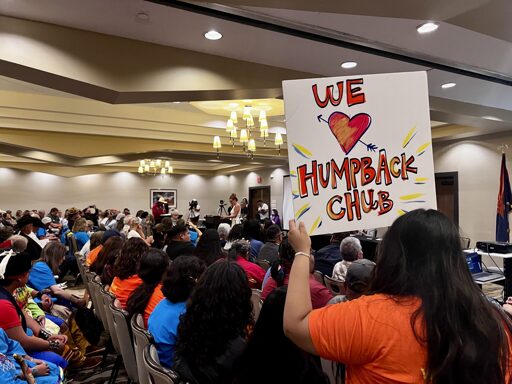
The Biden administration designated the Baaj Nwaavjo I’tah Kukveni monument at the urging of numerous Native American tribes whose ancestral homelands surround the Grand Canyon. Tribes still rely on the canyon for natural and cultural resources that are significant and sacred to their communities.
Hatathlie excoriated proponents of HCM2009 for their allegiance to money over people, and their characterization of the monument designations as “land grabs.”
“I think that the sense of entitlement is blatantly disrespectful, and it’s disgusting,” she said.
Hatathlie asked legislators to think about what kind of future Arizonans are leaving for the children and grandchildren.
“Money only takes you so far,” she said. “But you can’t take it with you when you die. And so, when we look at these capitalistic strategies, we need to find a balance to continue to preserve our environment.”
Last year, a judge dismissed a lawsuit filed by the Republicans who lead the Arizona Legislature that asked the court to set aside Biden’s creation of the Baaj Nwaavjo I’tah Kukveni Monument.
“We are confident this unconstitutional land grab will be reversed, either by the courts or by the Trump Administration,” Senate President Warren Petersen said in a statement to the Arizona Mirror after the suit was dismissed last year.
During the Senate Natural Resources Committee meeting, Sandy Bahr, the director of the Grand Canyon chapter of the Sierra Club, pointed out that if the state legislature had a say, the Baaj Nwaavjo I’tah Kukveni – Ancestral Footprints Monument likely never would have been designated.
“I just don’t think it would be appropriate for you all to be able to deny approval of that national monument, or to weaken it,” she said.
The lands of Baaj Nwaavjo I’tah Kukveni include cultural and sacred places of the Havasupai Tribe, Hopi Tribe, Hualapai Tribe, Kaibab Band of Paiute Indians, Las Vegas Paiute Tribe, Moapa Band of Paiutes, Paiute Indian Tribe of Utah, Navajo Nation, San Juan Southern Paiute Tribe, Yavapai-Apache Nation, Pueblo of Zuni, and the Colorado River Indian Tribes.
The post Mining industry rallies Republicans to urge Trump to let them open mines on protected land appeared first on ICT.
From ICT via This RSS Feed.