


On October 2, 2025, far-right influencer Nick Sortor was arrested by the Portland Police Bureau during an anti-ICE protest in Portland, Oregon. The charge: disorderly conduct.
The reality: he showed up, disrupted a flag burning, escalated tensions, and walked directly into the kind of confrontation he’s built a career on provoking.
Within days, Sortor flipped the script.
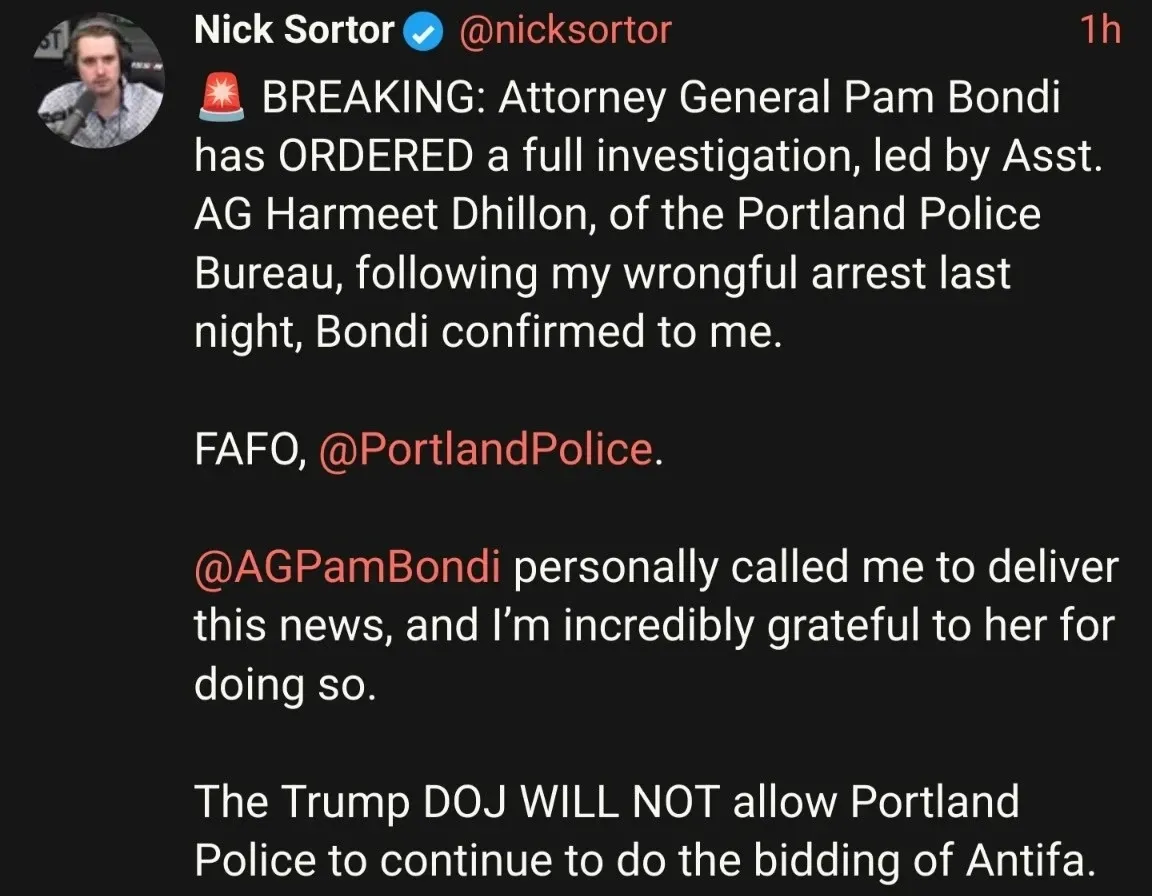
He took to social media claiming that Attorney General Pam Bondi had personally called him to announce a Department of Justice investigation into the Portland Police Bureau, one allegedly led by Assistant Attorney General Harmeet Dhillon (previously Andy Ngo’s lawyer). According to Sortor, his arrest wasn’t the result of his own actions, but proof that the police were “doing the bidding of antifa.”
There is no evidence for any of this. And anyone who has even been remotely paying attention to Portland, or has a basic understanding of policing knows how ridiculous this claim is. But that didn’t stop it from spreading like wildfire. Within days, accounts and MAGA influencers all over Twitter had been accusing PPB of being “antifa."
A Propaganda Pipeline, Not Journalism
Sortor isn’t a reporter. He’s a full-time escalation machine with over a million followers, known for pushing racist conspiracies and inserting himself into protests to generate viral content with manufactured conflict.
In New Orleans, Sortor was captured on camera striking what appears to be a de-escalator in the face at a protest. Surprisingly, even New Orleans Police said that Sortor was “creating a problem” and antagonizing protesters. In Minneapolis, Sortor was seen hitting a woman outside of the Whipple Federal Building after manufacturing content and rage-baiting protesters. Sortor also has an active warrant out for his arrest in Kentucky after he stole a woman’s dog and became violent with her after she turned down his sexual advances. Until today, Sortor continues to initiate physical altercations in Portland and at protests across the country.
As Nick Sortor continues to insert himself into the news cycle, read about why he is wanted by the state of Kentucky, for violating probation in a case where a woman said he stole her dog, then physically attacked her after she rebuffed his sexual advances.
Link: https://t.co/VeUmqbrFbb
— Jacqueline Sweet (@JSweetLI) January 12, 2026
He’s amplified white nationalist panic narratives—from false claims about Haitian migrants to fear mongering during natural disasters. His presence at protests follows a familiar pattern: provoke, escalate, film, and then repackage the chaos as persecution.
The night before his arrest, video shows Sortor getting into an argument with a woman and then shoving her.
I slowed down a video of Nick Sortor in Portland from Wed night to show he pushed this woman first in this altercation. Sortor claimed he was attacked last night (Thurs) and was unfairly arrested, and Pam Bondi has since called him to tell him the feds will investigate his “wrongful arrest.” /
— Jacqueline Sweet (@jsweetli.bsky.social) October 3, 2025 at 12:03 PM
The night of his arrest, he went after a burning flag and stole it, not to “protect public safety,” but for content. Days later, he brought that same flag to Washington D.C., presenting it during a chilling White House “Antifa Roundtable,” where he complained about Portland police.
At one point, Donald Trump reportedly told him: “At least that horrible night made you famous.”
That wasn’t an offhand comment. It was the point.
From Narrative to Policy
The fallout from Sortor’s “PPB is antifa” narrative didn’t just live online, it had material consequences on the ground. Not because it was true, but because it gave the Portland Police Bureau an excuse to perform neutrality while continuing to operate exactly as they always have. PPB has a well-documented pattern of policing that benefits far-right actors, through selective enforcement, uneven intervention, a consistent willingness to treat left-wing protesters as the primary problem, and even sharing information about antifascists in texts sent to right-wingers. What Sortor and his allies manufactured wasn’t a shift in allegiance, it was a crisis of optics.
Faced with viral accusations and federal attention, PPB didn’t suddenly turn against the far-right. They doubled down on targeting the left, more aggressively and more visibly, to counter the narrative. Sortor didn’t expose a bias. He handed them a justification to lean into it more aggressively, under the cover of disproving him.
In the weeks that followed, that pressure translated into intensified, highly visible crackdowns on anti-ICE protesters: a flood of low-level citations, targeted arrests, and constant surveillance aimed almost exclusively at one side. The pretense was “order.” The reality was political theater. That escalation culminated on October 25th, when officers moved in on protest infrastructure over so-called “sidewalk access” complaints, claims that were, in practice, trivial to navigate and selectively enforced. In pouring rain, police tore down supply tents distributing food, water, and basic aid, clearing the space as far-right agitators stepped in and looted what remained. The alignment didn’t need to be explicit. PPB enforced, the far-right benefited. What followed wasn’t a break from past patterns, it was their continuation, sharpened under national scrutiny.
From Street Theater to Courtroom
Fast forward to March 23, 2026.
Sortor returned to Portland, not as a defendant, but as a witness.
A local protester was on trial for disorderly conduct tied to the same incident. The allegation? That they contributed to harassment against Sortor as he backed into a bioswale during the confrontation.
In reality, video shown in court told a very different story.
Sortor, again, was the one initiating physical contact. Footage presented as evidence included him shoving people, striking individuals, and forcibly taking the flag. Property that did not belong to him.
The defendant? Never even touched him.
At most, they told Sortor to “get the fuck out of here.”
That was the case.
Guilt by Proximity
Prosecutors attempted to argue something broader: that being present near others who were pushing or shouting amounted to collaboration. That proximity itself was evidence of criminal coordination.
It’s a dangerous theory, and a familiar one.
When the state can’t prove individual wrongdoing, it starts building collective guilt. Anyone in the frame becomes suspect. Anyone identifiable becomes expendable.
In this case, the defendant appears to have been charged simply because they were the only person police could easily identify. And the state seemed compelled to carry out a prosecution after public outcry by the far-right and an ongoing campaign of accusations that PPB are antifa, or colluding with antifa.
A Witness Who Couldn’t Keep His Story Straight
Sortor’s testimony didn’t help.
On the stand, he claimed he traveled from Washington, D.C. because mainstream media “leaves at night,” positioning himself as the only one documenting what happens after dark.
But during the trial, he pointed out mainstream media reporters visible in the very footage being used as evidence.
The contradiction was obvious.
So was the broader pattern: exaggerate, distort, and rely on the assumption that no one will check.
The Verdict Everyone Saw Coming
The jury didn’t buy it.
The defendant was found not guilty.
Because there was nothing there.
No assault. No coordination. No crime beyond yelling at a man who had inserted himself into a volatile situation and escalated it for an audience thirsty for protestor blood.
The Real Story
This case was never about disorderly conduct.
It was about power, who gets to provoke, who gets protected, and who gets prosecuted.
Sortor walked away from his own charges. Then he showed up in court backed by political attention, federal connections, and a massive online platform, while someone else faced criminal penalties for simply being nearby.
This isn’t new. It’s a repeatable formula.
Agitators like Sortor embed themselves in protest movements they oppose, trigger confrontations, and then leverage the fallout—both online and through political channels—to bring state pressure down on their targets.
Five days after his arrest, Sortor was sitting in the White House, accusing Portland police of collaborating with “antifa,” while federal officials entertained his claims.
That’s not accountability.
That’s a pipeline.
Escalation as Strategy
When you repeatedly target communities already under surveillance and repression, eventually someone reacts.
That reaction becomes the product.
And then the state gets involved.
Figures like Sortor don’t just document conflict, they manufacture it, then weaponize it.
They are not neutral observers.
They are escalation agents operating in sync with a broader political project that blurs the line between propaganda, policing, and prosecution.
And if this case is any indication, the goal isn’t justice.
It’s finding someone, anyone, to punish.
This is how it works now.
They show up. They escalate. They lie.
The state steps in. The police enforce it. The courts legitimize it.
And somewhere in that chain, someone gets picked. Not because they did anything, but because they could be identified.
Not justice. Not public safety.
Just power, moving exactly how it’s supposed to.
From We Will Free Us via This RSS Feed.