

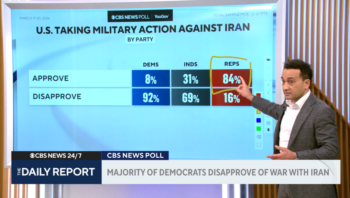
CBS polling director Anthony Salvanto (3/23/26) found that 92% of Democrats and 69% of independents disapproved of military action against Iran—a finding CBS summarized as “Majority of Democrats Disapprove of War With Iran.”
A recent CBS News poll (3/17–20/26) declared that a majority of Americans (53%) say it would be “unacceptable” if the United States were to end the conflict with Iran with that country’s current leadership still in power.
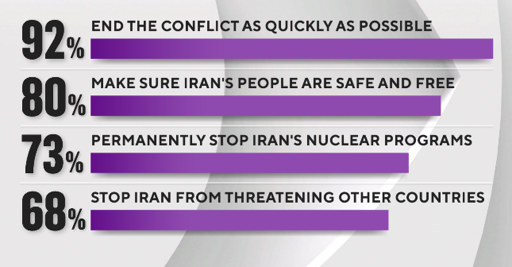
Moreover, the poll also found that large majorities of Americans say it is “important” to “make sure Iran’s people are safe and free,” to “permanently stop Iran’s nuclear programs,” and to “stop Iran from threatening other countries.”
These results seem to suggest that most Americans want the war to continue until those goals, including regime change in Iran, are actually achieved.
Much of the rest of the poll, however, suggests the public does not support the war with Iran, even when “conflict” instead of the touchy word “war” is used to describe what’s happening. According to the poll:
- 60% disapprove of the US taking military action against Iran.
- 62% disapprove of the way Donald Trump is handling the situation in Iran.
- 57% believe the “conflict in Iran” is going “very/somewhat badly.”
- 51% do not believe it is important to change Iran’s leaders to ones that are pro-US.
- 92% believe it is important to “end the conflict as quickly as possible.”
The report notes: “If those desires between goals and a fast end seem contradictory, it connects to the continued call for more explanation from the administration.”
Blaming the public instead of the poll
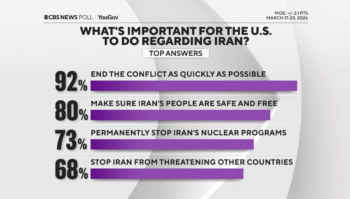
Is it more important to “end the conflict as quickly as possible” or to “make sure Iran’s people are safe and free”? CBS (3/17–20/26) didn’t ask.
The poll did ask if the Trump administration had clearly explained its goals, and only 32% said it had; 68% said no.
But that is not evidence of the public’s “continued call for more explanation.” There is nothing in the poll that suggests the public is demanding more information, and in the absence thereof, the public exhibits contradictions between its preferred goals and a quick end to the war. The explanation is a non sequitur.
One reason for the contradictions is that the poll asks each question as though it were free from any context. Respondents are not asked to evaluate each goal in light of possible cost. If, for example, regime change is a goal of the war, how long should the US continue to press for that change, given the likely cost in money and lives?
The poll lists several goals, and each one might seem pretty appealing—assuming it could be reached. Respondents hear a goal and say, sure, it’s important, without having to confront the inevitable trade-offs. Reporting such responses as though the public is actually demanding the US pay the costs to achieve regime change, or to make the Iranian people free and safe, is a wild distortion of what the poll has actually measured.
Measuring ‘non-opinion’
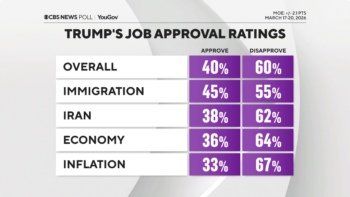
According to CBS‘s poll (3/17–20/26), 100% of American adults have a specific opinion on how well Trump is handling immigration, Iran, the economy and inflation.
Another reason for the contradictions is that much of the poll, by design, is measuring what pollsters call “non-opinion.” The truth that pollsters/media don’t want to acknowledge is that on any given issue, a significant portion of the public is simply not engaged. People have lives to live; financial, health and social challenges to face. Many people are so overwhelmed, they don’t have time to follow the news closely about every major issue.
So what do respondents do when confronted with questions about issues they haven’t followed? They make top-of-mind responses to satisfy their implied obligation to give an answer. Pollsters pressure them by asking forced-choice questions (questions that do not offer an option to say “don’t know”). That’s how CBS/YouGov got 100% of its respondents to give an opinion on:
- How well Trump is doing his overall job.
- How well he is handling inflation, the economy, immigration and the situation with Iran.
- How well the fighting is going in Iran.
- What are “important” goals for the “conflict” in Iran.
- Whether ICE operations in the US need to be increased, decreased or kept the same.
You might think that at least one person, or, more likely, some significant percentage of the population, might have such busy lives that they could not keep up with all the events happening in the world and—if asked questions about any of the above issues—would frankly admit they didn’t have an opinion.
Instead, the poll reports that every adult in the United States is allegedly engaged enough to express a meaningful opinion on every one of those issues.
Of course, that is ridiculous.
As I’ve indicated in a previous post (FAIR.org, 9/28/23), polls that ignore how unengaged the public is on any given issue, and instead report that 95% to 100% of the public has a meaningful opinion on that issue, are really performative polls. They’re designed explicitly to give the illusion of an attentive and informed public that is consistent with our general conception of how US democracy should work.
That such polls then produce contradictory results should not be blamed on the public itself. The fault, dear CBS, lies not in the public, but in yourself.
From FAIR via This RSS Feed.