

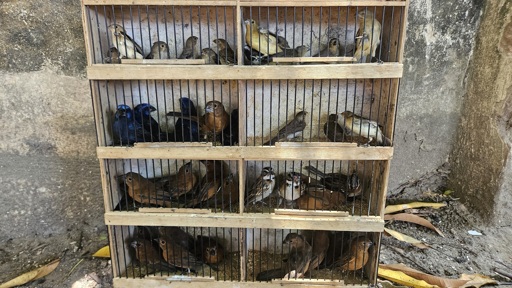
In October 2025, environmental officers arrived unannounced at the Parangaba Fair that takes place every Sunday in Fortaleza, in northeastern Brazil. The market, also known as the Bird Fair, had a reputation for illegally selling small birds, parrots and macaws. During that Sunday’s operation, agents seized 271 birds and transported them in groups to the Wildlife Screening Center (CETAS) in Fortaleza. There, confiscated wildlife is rehabilitated for possible reintroduction to the wild. These rescue and rehab centers are managed by Brazil’s federal environmental agency, IBAMA. Within days, some small, multicolored African lovebirds, from the genus Agapornis began to sicken — and die. Targeted by the pet trade, these parrots sometimes carry circovirus, a genus of viruses that afflict a wide range of birds. It was a growing crisis.“The [seized] birds kept arriving and tests were being conducted, and then they started coming back positive,” said Fernanda Gaia, IBAMA’s environmental analyst at the center. The diagnosis triggered a red alert: the hundreds of birds housed at CETAS were at risk. Staff isolated the sick birds. IBAMA agents seize birds sold illegally at the Parangaba Fair in Fortaleza. Image courtesy of Daiane Cortes/IBAMA. Then, in January 2026, there was another scare. Two turquoise-fronted Amazon parrots (Amazona aestiva) were diagnosed with avian polyomavirus. This disease, first discovered in Canada and the U.S. in the 1980s, acts much like circovirus. To prevent further infections, IBAMA closed the Fortaleza CETAS to new bird arrivals for 90 days. “With the detection in more species, both with…This article was originally published on Mongabay
From Conservation news via This RSS Feed.