

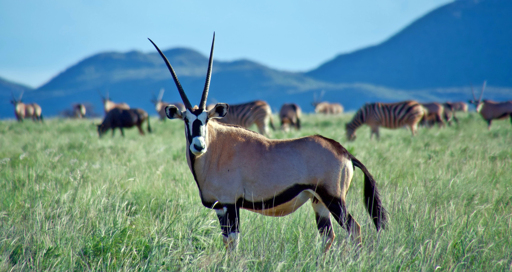
TSWALU KALAHARI RESERVE, South Africa — From high on a promontory in the Korannaberg Mountains, a mountain zebra (Equus zebra hartmannae) peers down to the west across the green-dappled plain below, the sun rising behind. In the distance, wild dogs (Lycaon pictus) hunt in the veld, verdant after early rains. And nearby, white rhinos (Ceratotherium simum) graze among thorny thickets. These species, and dozens more, persist here thanks to a decades-long effort to rewild a sliver of Southern Africa’s great desert and dry savanna. The Tswalu Kalahari Reserve has become a sanctuary for rare and threatened animals, drawing in a steady stream of well-heeled tourists from around the globe. More recently, the reserve’s managers have embarked on a quest to increase the carbon stored in its soils — a quest that relies heavily on the reserve’s animals. At first glance, places like Tswalu might not seem suited for stockpiling carbon. The Tswana people call this part of the world Kgalagadi — “the waterless place.” Fickle precipitation in the Kalahari averages a scant 10-50 centimeters (4-20 inches) annually, and much less in some years. That means the comparative lushness here in late 2025 could evaporate if the rains don’t carry on throughout the austral summer of the Southern Hemisphere. To date, most nature-based carbon storage efforts have focused on fast-growing tropical forests, expanding native or plantation tree cover that draws carbon out of the atmosphere. Soil carbon, by contrast, is slower to accumulate, and it’s more laborious and expensive to monitor.…This article was originally published on Mongabay
From Conservation news via This RSS Feed.