

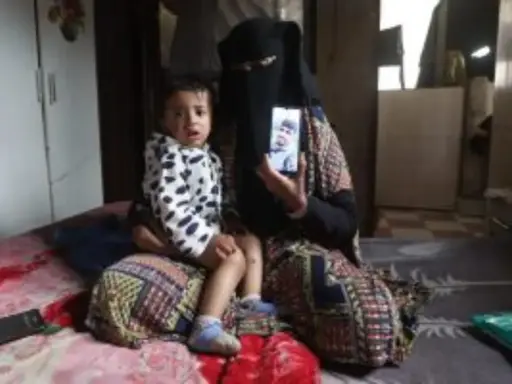

News that Israel have tortured a Palestinian baby has gone largely under-reported by a complicit Western media. It is a horror almost beyond comprehension; recent reports describe how a Palestinian father named Abu Nassar endured a 10-hour interrogation by the Israeli military, during which his one-year-old child was tortured in front of him. Salma Kaddoumi, a freelance video and photojournalist who interviewed Nasser’s family, later told the Canarythat Nasser has not been heard from since.
Despite photographic evidence of the baby’s injuries trending on social media, and alarming claims of forced disappearance raised by Nasser’s family, Western media outlets have broadly failed to report on the incident. Unfortunately, at this point, few would expect them to. Nasser’s story is one more crime ignored amidst the gravest crimes against humanity seen this century.
Israel’s torture of Palestinian baby met with deafening silence
When Nasser’s story first broke on 24 March 2026, it was impossible to ignore the images of his baby on social media. We are all too used to encountering images of injured Gazan children in this way, often bloodied and covered in debris. What is so disturbing about the injuries suffered by Nasser’s child, however – two burns or punctures on each leg, in roughly the same place — is how deliberate they appear to be.
This story is different, making its absence across Western media all the more stark. Bogus claims about children caught up in the ‘realities of war‘ cannot be made here. This is a story about the Israeli state abusing a baby to extract a confession from the child’s father.
Stories about children who suffer abuse at home and abroad usually occupy Western news cycles for days, weeks, even years — so long as the children are white. Almost twenty years later, the BBC continues to report on the harrowing case of ‘Baby P’. Nasser’s baby, to the contrary, is outright ignored. What is the media afraid of? Having an emotional reaction in response to the suffering of the wrong kind of child?
Institutional racism
The reasons why the media is failing to report on this story are, by now, no doubt obvious. Institutional bias in favour of the Zionist regime, if not outright capture by its representatives, has led to a culture of silence where the horrors experienced by Palestinians are persistently absent from the news cycle.
This bias is compounded by racism, which leads to more scrutiny being applied to Palestinian civilian testimony than the claims of the Zionist regime itself. Whereas the media was more than happy to report on unverified claims of ‘40 beheaded babies’ on 7 October 2023, verified reports of beheaded Palestinian children, backed up by video footage, are left to the side.
We can imagine the excuses made by editors. Is the testimony provided by Nasser’s family members deemed untrustworthy? Is it too difficult to verify their accounts to report on them? Are the reports produced by freelance journalists on the ground, who continue to risk their lives to break through Israel’s blockade, not good enough for them?
A manipulated grey area of plausible deniability quickly amounts to a new form of censorship.
Citizen journalism sidelined
What a difference fifteen years makes. In 2011, the Arab Spring heralded a new era of ‘citizen journalism’. Mainstream media outlets were quick to fill their reports with footage captured by everyday people, who uploaded their testimony to the internet via smartphones.
But even at that time, the role of Big Tech companies in manipulating stories was becoming apparent. Haythem Guesmi, writing for Al Jazeera in 2021, showed how social media has since revealed itself to be a double-edged sword:
Big Tech companies have been allowed to be the ultimate arbiters on free speech online and a haven for hate speech and disinformation. They have piggybacked on the idea that they helped trigger the Arab Spring and are therefore a force for freedom and democracy.
Social media is seen as both a threat to and the last bastion of free speech. One side-effect of this contradiction is that citizen journalism is typically now confined to social media platforms, which are deemed lawless zones of misinformation. The disinformation pumped out by governments, however, is subject to less scrutiny than ever before. With citizen journalism maligned, the mainstream media defers unquestioningly to state power.
No accountability
As a result, we live in a dissonant world where those responsible for a genocide live-streamed across our smartphones avoid scrutiny and accountability. Stories like Nasser’s, quarantined on deregulated platforms, are both inescapable and ignored.
The fact that social media platforms are drowning in disinformation is self-evident to anyone with an Internet connection. But by placing all emphasis on the responsibilities of Big Tech companies, we let our legacy media off the hook.
In the same article for Al Jazeera, Guesmi reported how international civil rights organisations were calling:
on Big Tech companies to cease their unfair discriminatory practices, to invest in regional expertise of content moderation and become more transparent about policies and procedures.
In 2026, it is long past due that our legacy media organisations did the same. Until they do, they will continue to fail those who are subject to horrifying abuse at the hands of rogue states, like Nasser and his baby.
This would require media organisations disentangle themselves from their cozy relationships with state power first. Until that happens, we can expect them to remain complicit in state violence and racism through their unwillingness to report on the stories that matter.
Featured image via the Canary
By Em Colquhoun
From Canary via This RSS Feed.
Mainstream media is captured by the people dropping the bombs. They are not going to cover their own atrocities, it is up to us to spread the word. Do not rely on “news” organizations, they are all compromised
