

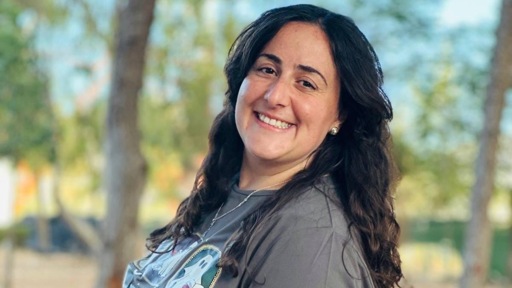
A young woman in her early thirties, energetic and composed. This is how Hadeel Shatara, a freed Palestinian prisoner, appeared while sharing her experience in Israeli detention with Peoples Dispatch.
Despite the conditions and treatment she suffered while being imprisoned, Shatara still believes in the inevitability of the struggle for the freedom of Palestinian prisoners and the liberation of Palestine.
Hadeel was arrested on June 30, 2024, during Israel’s genocidal aggression on the Gaza strip, a period that marked an unprecedented crackdown campaign on the Palestinian Prisoners’ Movement by the Shabas (Israel Prison Service).
The circumstances of her arrest were more like a kidnapping, as she was apprehended by the Israeli Occupation Forces (IOF) on the border crossing traveling back from Jordan to occupied Palestine.
She was taken from there to an unknown destination and placed under administrative detention for six months without charge, which was later extended for an additional four months.
Hadeel recounted the details of her detention, during which she and scores of other Palestinian women endured inhumane conditions.
Gender-based violence and sexual harassment
Hadeel reported being subjected to gender-based violence and sexual harassment by male Israeli guards multiple times in many ways.
“While being transferred from one prison to another, they were beating me. They hit me between my legs. I was strip searched in a very humiliating way in an open space, while the door was opened and male guards were able to see me. These male guards raided the prison cells and attacked us frequently,” she noted.
Shatara added that the privacy of female Hijabi prisoners was constantly breached, as male guards stormed the prison whenever they wanted.
The agony of mothers behind bars away from their infants
According to the latest statement released by the Palestinian Prisoner’s Society on March 21, on Mother’s Day, there are 39 Palestinian mothers among the 79 female prisoners currently detained in Israeli jails.
Witnessing the agony of many of her fellow inmates who were separated from their infants, Hadeel says the agony of detained mothers is the most difficult emotional experience for a female prisoner.
“The detained mothers were separated from their infants physically. The infants were not allowed to visit their mothers in prison at all. The lawyers were also prevented from bringing any photo of the infants to their mothers.”
Hadeel pointed out that in addition to the grave emotional distress, some of those mothers suffered physical implications, due to being forced by the Shabas to take medications that dried up their breast milk.
“They were left in isolated cells to deal with their physical pains alone, and without being provided with the needed medical care,” she said.
Starvation and deprivation of basic hygiene needs
Hadeel clarified that the Israeli authorities sought to starve the Palestinian female prisoners by providing them with a very minimal amount of food, which would only barely keep them alive, while leaving them hungry all the time.
Regarding their personal hygiene, each prisoner was given a small quantity of shampoo, which was the only cleaning substance provided for hair, body, and washing clothes. The quantity of menstrual pads they received was not sufficient either.
“We used plastic forks to comb our hair because the use of hair brushes or combs was not allowed,” Hadeel maintained.
Complete isolation from the outside world and deliberate emotional torture
Isolating Palestinian prisoners completely from the outside world has become another emotional torture technique of the Shabas in the last couple of years.
Palestinian political detainees have not only been deprived from family visits, but also from access to any media or information outlet that would allow them to know what is happening outside the prison.
The Shabas personnel are the only source of news for Palestinian prisoners. They intentionally inform Palestinian prisoners of tragic events related to Israel’s all-out aggression across the region, and the assassination of prominent resistance leaders in an attempt to break their morale.
Read more: Israel kills nine Palestinians across Gaza during Eid al-Fitr holiday
“The whole experience in the Zionist prisons in general is really hard. It is horrifying and horrible, but there were moments when we heard news about what was going on in the outside world, such as what was happening in Gaza and the West Bank, and how they were attacking Lebanon, Yemen and Iraq,” she stated.
“These moments were really hard moments for us inside the prison, because we were inside those slaughterhouses, isolated from our people. We did not even have the chance to express our sadness, as we had to remain steadfast in front of the Zionist administration,” the freed prisoner affirmed.
The plight of the more than 10,000 Palestinian prisoners being held in Israeli jails has gained increased visibility since Israel’s Minister of National Security, Itamar Ben-Gvir, unleashed a brutal crackdown against the Palestinian Prisoners’ Movement beginning in January 2023. Since then, the conditions in detention have further deteriorated, with noted increases of solitary confinement, severe torture, and deliberate medical neglect. Conditions for prisoners got even worse after October 7. Occupation authorities have denied Palestinian prisoners the fundamental right of visits with lawyers and family, basic sanitary conditions like showers and decent food, and reports of sexual violence against detained Palestinians have skyrocketed.
The campaign “End the Genocide Behind Bars: Freedom for Palestinian Prisoners” was launched in late February by a coalition of international human rights organizations and Palestinian groups calling for an end to torture and an improvement in conditions, the disclosure of names, identities, and conditions of Palestinian prisoners, and their immediate and unconditional release.
The post Hadeel Shatara: the Palestinian woman who defied her jailors appeared first on Peoples Dispatch.
From Peoples Dispatch via This RSS Feed.