


Day 28 of the U.S.-Israeli war with Iran. Trump again postpones the threatened U.S. attack on Iran’s energy infrastructure. The U.S. is running low on Tomahawk missiles. The Pentagon redirects $750 million in Ukraine weapons funds to replenish American stockpiles. Iran fires at least ten missile salvos at Israel, wounding nine. Bellingcat reports U.S.-made mines were scattered near an Iranian village. Iran threatens “special and unprecedented” measures against UAE and Bahrain over Gulf island security. Pentagon weighs deploying up to 10,000 additional troops to Middle East. Israel expands southern Lebanon ground invasion. Gaza disarmament plan ties reconstruction to weapons handover; Hamas official tells Drop Site it will reject the plan, denouncing it as “catastrophic.” Senate unanimously passes TSA funding at 2 a.m amid DHS shutdown. Sen. Lisa Murkowski is drafting authorization for the Iran war. State Department diverts $1.25 billion from disaster and peacekeeping funds to Trump’s Board of Peace. House delays Iran War Powers Resolution until after congressional recess. Israeli citizen arrested in Las Vegas after weapons and biological samples found at home linked to California biosecurity case. Judge declines to dismiss drug charges against Maduro so that he can pay for his defense. Wall Street has its worst day since the Iran war started. Colombia to withdraw from international investor-state arbitration system. Zelenskyy visits Saudi Arabia to trade Ukrainian drone expertise for Gulf air-defense missiles.
NEW from Drop Site: Palestinians in the West Bank Are Now Experiencing Multiple Settler Attacks Per Day. The Untold Story of Dario Amodei’s Antiwar Past, as His AI Tech is Used for a New Middle East War.
Drop Site is now live on WhatsApp. Get our latest reporting, podcasts, and breaking news, delivered directly. Join the channel here.
This is Drop Site Daily, our free daily news recap. We send it Monday through Friday.
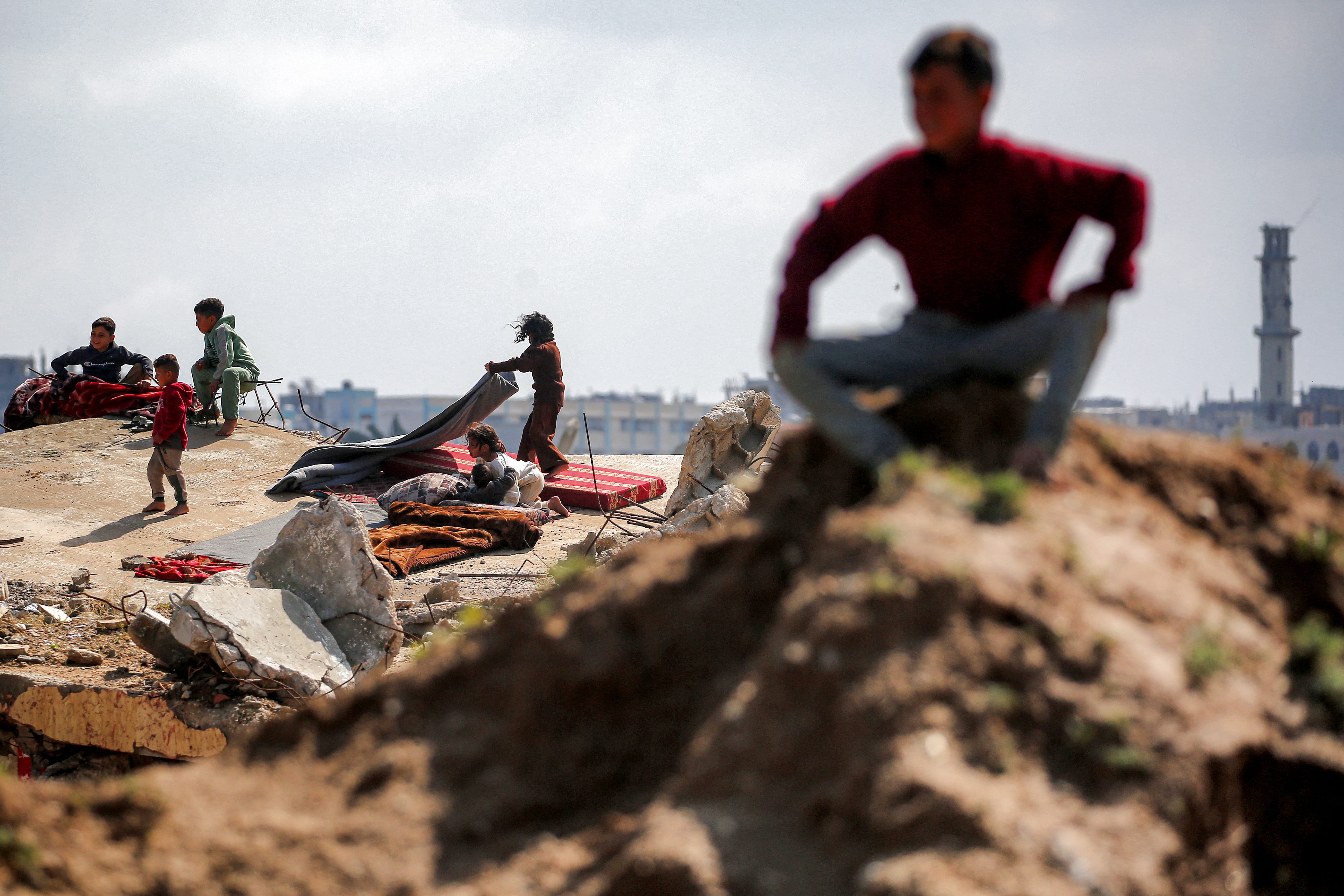
Children sit on the rubble of destroyed buildings at the Bureij camp in the central Gaza Strip on March 27, 2026. Photo by Eyad Baba / AFP via Getty Images.
Iran War
-
U.S. and Israel continue attacks on Iran:
- U.S.-Israeli airstrikes on a residential area in Isfahan in central Iran on Friday killed 26 people, including seven children, according to Press TV.
- The Israeli military announced a broad wave of attacks targeting government infrastructure in the heart of Tehran, with Iranian state media and residents reporting explosions across the capital, including the Chitgar neighborhood in northwest Tehran.
- At least seven people were killed in U.S.-Israeli strikes on residential units in the city of Urmia in northwestern Iran, near the borders with Turkey and Iraq, BBC reports.
- Early Friday, Iranian Red Crescent teams were deployed after an airstrike struck a residential area in Qom, a central Iranian city south of Tehran, with crews carrying out search and rescue operations at the scene.
- Israeli Defense Minister Israel Katz said on Friday that Israel will “escalate and expand” attacks on Iran. Iran “will pay heavy, increasing prices” for attacking Israeli civilians, Katz said in a televised statement.
-
Casualty counts: More than 1,900 people have been killed and at least 20,000 injured in Iran since the start of the U.S.-Israeli war on Iran, Maria Martinez of the International Federation of Red Cross and Red Crescent Societies told Reuters.
-
Trump again postpones attack on Iran’s energy infrastructure: President Donald Trump announced he would further delay attacks on Iran’s energy infrastructure by 10 days—until April 6—for Tehran to reopen the Strait of Hormuz. Trump claimed talks to end the war are “going very well.” Iran continues to staunchly deny it is in any negotiations with Washington.
-
U.S. running low on Tomahawk missiles: The U.S. military has fired over 850 Tomahawk cruise missiles since the start of the war on Iran, a rate that is prompting the internal discussions at the Pentagon about how to make more available, according to the Washington Post. One U.S. official cited by the Post characterized the number of Tomahawks left in the Middle East as “alarmingly low.”
-
Pentagon redirects $750 million in Ukraine weapons funds to replenish American stockpiles: The Pentagon notified Congress it plans to divert roughly $750 million from the Prioritized Ukraine Requirements List, a NATO-backed program funding American-made weapons for Kyiv, to restock its own depleted arsenal, the Washington Post reports. Officials cited shortages of critical air defense systems—including Patriot and THAAD missiles drawn down through heavy use in the Middle East. President Donald Trump publicly attacked NATO, calling it a “paper tiger” on Truth Social and warning the United States would “remember” which countries failed to step up.
-
Iran fires at least ten missile salvos at Israel, wounding nine: Iran launched at least ten missile salvos at Israel on Thursday, many carrying cluster warheads, wounding at least nine people across the country following a 14-hour pause in hostilities, according to the Times of Israel. Submunitions struck multiple locations in Kafr Qasim, injuring five, while two others were wounded by shrapnel and blast in Tel Aviv, one person was injured near Haifa in northern Israel, and a home in a West Bank settlement was struck, wounding one.
-
Iranian drone and missile attacks continue on day 28 of war: Saudi Arabia’s Defense Ministry announced Friday it intercepted four drones in the country’s eastern region, adding to multiple interceptions reported over the preceding 24 hours. Kuwait’s military separately warned residents of incoming missile and drone attacks.
-
Drones strike Kuwait ports: Two ports in Kuwait were struck on Friday by drones and cruise missiles. Mubarak Al Kabeer Port, jointly constructed with China as part of its Belt and Road initiative and located in Bubiyan Island in the Persian Gulf, suffered “material damage,” but no injuries. Drones also struck Shuwaikh port, according to the Kuwait Ports Authority. Shuwaikh serves as Kuwait’s primary commercial gateway and handles the bulk of the country’s non-oil imports, including food, consumer goods, vehicles, and construction materials.
-
Iran continues launching missiles from Yazd base despite repeated strikes: Missiles were launched overnight Friday from the Yazd region of central Iran, the same mountain area that has been struck multiple times in United States and Israeli operations, according to footage reviewed from March 9, March 22, and March 24 showing successive waves of attacks on the site including secondary explosions and sustained bombardment. Iran’s underground “missile city” is a network of deeply buried infrastructure that allows operations to persist even after surface entrances are targeted. The strikes may have damaged access points while leaving core launch systems largely intact.
-
Evidence points to U.S.-made mines scattered near Iranian village, Bellingcat reports: Air-dropped mines discovered in Kafari, a village near Shiraz in southern Iran, appear to be American-made Gator anti-tank munitions, according to an investigation by open-source intelligence outlet Bellingcat. Experts identified the devices as BLU-91/B mines delivered via cluster munitions, with debris consistent with aerial deployment. Bellingcat noted the United States is the only party in the conflict known to possess Gator Scatterable Mines, and analysts believe the weapons were placed to deny vehicle access to a nearby Iranian “missile city,” preventing repair or recovery operations at the site.
-
Iran petitions UN to intervene against reported U.S.-Israeli assassination plots targeting senior officials: Iran’s UN Ambassador Amir Saeid Iravani formally petitioned Secretary-General António Guterres and the Security Council Friday to intervene against reported Israeli intentions to assassinate Foreign Minister Abbas Araghchi and Parliament Speaker Mohammad Baqer Qalibaf, describing the threats as “state-sponsored terrorism” and a violation of international law. The petition cited a March 25 Wall Street Journal report revealing that both officials had been temporarily removed from assassination target lists and granted a four-to-five day reprieve to allow for potential peace negotiations. A March 26 Reuters report, citing a Pakistani source, stated that Israel had already identified coordinates for both men and intended to strike, but that Pakistan intervened, leading the US to ask Israel to stand down. Ambassador Iravani warned the Security Council that such actions establish a “dangerous heresy” in international relations and urged member states to compel the parties to cease all unlawful attacks.
-
Iran threatens “special and unprecedented” measures against UAE and Bahrain over Gulf island security: Tehran has prepared “special and unprecedented” measures targeting the UAE and Bahrain if any ground attack is launched against Iranian islands in the Persian Gulf, an informed military source told Fars News Agency on Friday. The warning follows United States threats of a ground operation and Tehran’s accusation that Gulf states have facilitated attacks by hosting American bases and providing infrastructure and advanced technologies. Iranian authorities said any retaliatory response would be “very damaging and instructive.”
-
France says UN draft resolution on Strait of Hormuz navigation is under discussion: French Foreign Minister Jean-Noël Barrot confirmed Friday that talks are underway at the United Nations on a draft resolution aimed at restoring free navigation through the Strait of Hormuz, according to the Associated Press. Barrot described the proposed mission as “strictly defensive” in nature—an international escort operation intended to resume maritime traffic once conditions on the ground stabilize—and said it is also aimed at relieving pressure on global energy prices.
-
UAE commits to joining proposed Hormuz Security Force to escort ships through strait: The UAE has informed Western allies it will participate in a proposed Hormuz Security Force to escort commercial vessels through the Strait of Hormuz, with Abu Dhabi potentially deploying its own naval assets, according to the Financial Times. Senior Emirati minister Sultan al-Jaber discussed the plan with United States Vice President JD Vance in Washington this week.
-
Pentagon weighs deploying up to 10,000 additional troops to Middle East: The Pentagon is considering sending as many as 10,000 additional ground troops to the Middle East, the Wall Street Journal reported Friday, with Fox News citing a senior defense official confirming similar details. The potential deployment would expand an already significant American buildup in the region that includes roughly 5,000 Marines and thousands of troops from the 82nd Airborne Division. The United States currently maintains approximately 50,000 service members stationed across nearly 20 sites and aboard warships in the countries and waters immediately surrounding Iran.
-
U.S. officials reviewing high-risk ground operation options inside Iran, CNN reports: United States officials are examining plans that could involve ground forces operating inside Iran, according to CNN, citing more than half a dozen people familiar with the discussions. Plans under review reportedly include seizing Kharg Island, Iran’s main oil export hub handling roughly 90 percent of the country’s crude exports, though holding it would expose American troops to sustained missile and drone counterattacks. Other options include capturing islands near the Strait of Hormuz to secure shipping lanes, sending forces into Iran to extract enriched uranium from fortified nuclear sites, and broadening strikes on Iranian energy infrastructure at the risk of wider regional retaliation and global market shocks. Officials warned the options carry significant risks, offer no clear path to ending the war, could dramatically escalate the conflict.
Lebanon
- Casualty count: The death toll from Israel’s assault on Lebanon has risen to at least 1,116—with 3,229 wounded—since March 2, according to Lebanon’s Health Ministry. Another 22 people were killed and 110 injured on Thursday.
- Israeli attacks kill at least nine and wound 18: A series of Israeli airstrikes across Lebanon, overnight and early Friday, killed at least nine people and wounded 18, according to Lebanon’s Health Ministry. The deadliest strikes were reported in Saksakiyeh where four people were killed and eight wounded, and in Kfarreman where two people were killed and eight wounded. Additional strikes killed two people in Tahweitat al-Ghadir and one person in Bazaliyeh in northern Baalbek while wounding two others. Artillery shelling and the use of phosphorus munitions were reported near Naqoura, Bayada, and Shamaa.
- UNICEF: Over 370,000 children displaced in Lebanon: At least 370,000 children have been displaced, with over 121 killed and 399 injured, amid ongoing Israeli strikes, according to UNICEF’s representative in Lebanon Marcoluigi Corsi, as reported by Reuters. More than 1.16 million people in total have been displaced since March 2, Lebanon’s Minister of Social Affairs said Monday. UNHCR representative Carolina Lindholm Billing noted that Israel’s destruction of bridges in the south has isolated tens of thousands of residents, preventing aid from reaching them.
- Israeli military orders all residents south of Zahrani River to displace: The Israeli military on Thursday issued a sweeping displacement order for all residents of Lebanon living south of the Zahrani River, which is roughly 20 kilometers further north of the Litani River—where Israel has destroyed several bridges and said it plans to invade and occupy.
- Hezbollah rocket barrage kills one and wounds dozens; Two IDF soldiers killed in clashes: A rocket strike on Israel from Lebanon killed a man in his 30s and wounded around 25 others in Nahariya, a coastal city near the Lebanese border, on Thursday, according to Israeli emergency services. The barrage caused damage across multiple sites. Separately, an Israeli soldier was killed in a Hezbollah missile strike in south Lebanon, the second killed Thursday, and at least the 4th by the resistance in Lebanon since March 2. The soldier was killed and four others were wounded when a Hezbollah anti-tank missile struck a Merkava tank in southern Lebanon, the military said, according to The Times of Israel.
- Israel expands southern Lebanon ground invasion: The Israeli military deployed additional troops from Division 162 into southern Lebanon on Thursday, joining two divisions already operating in the country following Prime Minister Benjamin Netanyahu’s announcement of plans for a “larger buffer zone” to neutralize Hezbollah’s missile threat. Lebanese Prime Minister Nawaf Salam warned UN Secretary-General António Guterres that Israel’s actions “constitute a matter of utmost gravity that threatens Lebanon’s sovereignty,” and said Beirut would file a formal complaint with the Security Council. France, the United Kingdom, Germany, Italy, and Canada have also warned that an expanded ground offensive “would have devastating humanitarian consequences.” Hezbollah chief Naim Qassem vowed the group would continue fighting “without limits.”
- Netanyahu urges northern mayors to keep residents in place as Hezbollah rocket fire empties border communities: Israeli Prime Minister Benjamin Netanyahu asked northern Israeli mayors via Zoom on Friday to do everything possible to prevent residents from fleeing their communities, even as Hezbollah rocket fire continues without early warning, according to the Times of Israel. Netanyahu acknowledged that elderly and disabled residents often cannot reach shelters in the seconds available between a strike and impact. Kiryat Shmona Mayor Avichai Stern told the call his city’s population has collapsed from around 24,000 to roughly 10,000, warning that if conditions persist another month, only those physically unable to leave will remain.
The Gaza Genocide, Israel and the West Bank
- Attacks on Gaza: Two children were injured by Israeli army gunfire on Friday in the eastern area of Al-Maghazi refugee camp in central Gaza. Local sources reported that Israeli soldiers fired live bullets toward civilians east of the camp. Parts of the Al-Shawa and Al-Hasri towers in the Rimal neighborhood, which house displaced families, collapsed due to ongoing Israeli attacks, causing damage to surrounding sheltering families. Israeli artillery intensified strikes on eastern Gaza City, with an explosion heard in central Khan Younis.
- Gaza disarmament plan ties reconstruction to weapons handover, Al Jazeera documents show: A phased disarmament plan has been presented to Hamas by Nikolay Mladenov, President Donald Trump’s High Representative for Gaza and envoy of his “Board of Peace,” according to documents obtained by Al Jazeera. The framework operates on a strict step-for-step basis, conditioning the entry of aid and rebuilding materials on areas being verified as weapons-free. Under a “one authority, one law, and one weapon” model, Hamas and other Palestinian resistance groups would be required early in the process to catalog their weapons and a transitional national committee would gradually assume administrative and security responsibilities as the process advances.
- Senior Hamas official tells Drop Site movement will reject “catastrophic” Gaza disarmament plan: A senior Hamas official confirmed the authenticity of the disarmament documents published by Al Jazeera, telling Drop Site News the plan was “catastrophic” and that the movement would oppose it. The official added that Palestinians as an occupied people retain the right to resist and that the core of the conflict cannot be resolved through security arrangements alone. While Hamas has previously expressed willingness to transfer governance and security control in Gaza to a Palestinian national committee, the movement has repeatedly stressed that disarmament of the Palestinian people is not a matter it can negotiate on its own. Hamas’s Basem Naim charged on Wednesday that Mladenov was “threatening Palestinians with a return to war on behalf of Netanyahu and his fascist government” rather than acting as a neutral peace envoy.
- Settler attacks escalate in the West Bank: Violence by Israeli settlers and soldiers against Palestinians in the West Bank, that had already reached record levels in 2025 alongside the genocide in Gaza, has escalated further since the U.S. and Israel launched a war on Iran last month. Reporter Naqaa Hamed documents a wave of violence last weekend, with marauding settlers attacking over two dozen villages and towns across the West Bank, burning cars and homes and assaulting residents. Read her dispatch for Drop Site here.
United States
By Julian Andreone, with Ryan Grim. Have a tip on Capitol Hill? Email Andreone at Julian@dropsitenews.com.
-
House delays War Powers Resolution until after congressional recess: Democratic leaders plan to delay a vote on their War Powers Resolution until the House returns in mid-April. Privately and publicly, Rep. Greg Meeks, the top Democrat on the House Foreign Affairs Committee, has been arguing that while Democrats are on board, he needs more Republican support. Yet Thomas Massie and Warren Davidson are solid backers (Davidson confirmed his support to Drop Site on Thursday) and Nancy Mace has made the case for it, too. Mace told Drop Site that she had not heard from Democrats about her position. With those three Republicans voting yes, if Democrats hold their caucus they could pass the resolution, and yet they’re declining to put it on the floor. A rather testy Meekstold our Hill intern Lillian Franks that he is not bringing the Iran War Powers vote on to the floor this week because he is confident it would lose. He won’t force a vote today or tomorrow “because we can’t win. When you see me put the bill on the floor, that means we’re gonna win. I know how to count,” he said. “I know how to do my job.” (Watch here.)
-
Senate unanimously passes DHS funding bill at 2 a.m., excluding ICE and border enforcement amid shutdown crisis: The Senate approved a Department of Homeland Security funding package by voice vote at 2:20 a.m. Friday, The 42-day funding lapse has left TSA officers without pay and caused widespread airport disruptions, with call-out rates exceeding 11 percent nationally and surpassing 40% at some airports. The legislation funds all of DHS except Immigration and Customs Enforcement and Customs and Border Protection, which Democrats refused to support without reforms to immigration raid and deportation practices. The bill now goes to the Republican-controlled House, which is aiming to go on recess for two weeks starting this afternoon. Republicans plan to pursue separate ICE and CBP funding through a party-line bill that could also carry Iran war funding and elements of the Trump-backed SAVE America Act.
-
Republican Senator Lisa Murkowski drafts war authorization legislation: Sen. Lisa Murkowski (R-Alaska) is working with a group of colleagues on a formal authorization for the use of military force against Iran, nearly a month into the conflict, The New York Times reports, after growing frustrated with the Trump administration’s refusal to share details about the war’s objectives, cost, or timeline with Congress, a spokesman confirmed Thursday. Murkowski described the effort as an act of desperation to impose some parameters on a conflict that lawmakers have largely been shut out of, and raised pointed questions about the administration’s direction. “This president came into office saying he was going to be the peace president,” she said. “People are asking me, ‘Is that what we’re moving into?’ And I can’t honestly tell them the answer, because I don’t know that answer.” Congress is departing for a two-week recess Friday, pushing any vote to after the break.
-
State Department diverts $1.25 billion from disaster and peacekeeping funds to Trump’s Board of Peace: The State Department transferred $1.25 billion to President Donald Trump’s Board of Peace by drawing on funds designated for international disasters and peacekeeping operations, according to a new report from Semafor. Officials pulled $1 billion from international disaster assistance, $200 million from peacekeeping operations, and $50 million from international organizations and programs to make up the total. Trump has said the United States will contribute $10 billion to the board overall, which he says will fund the rebuilding of Gaza. The transfer prompted Sen. Catherine Cortez Masto (D-Nev.) to introduce a bill that would redirect $1 billion of those funds to the Low-Income Home Energy Assistance Program amid rising energy costs driven by the Iran war. “Instead of giving President Trump a $1 billion blank check to fund a ‘Board of Peace’ that has offered no transparency about how it is investing its money, let’s focus on helping American families afford their monthly power bill,” Cortez Masto said.
-
Israeli citizen arrested in Las Vegas after weapons and biological samples found at home linked to California biosecurity case: Ori Solomon, 55, an Israeli citizen, was arrested in Las Vegas after officers in protective gear discovered a cache of firearms, lab equipment, and more than 1,000 samples of unknown liquids at a home on Sugar Springs Drive, according to the Los Angeles Times. Solomon faces charges of illegally possessing firearms and improperly disposing of hazardous waste. Authorities said the materials were consistent with evidence from a separate investigation in Reedley, California, where a foul smell led officials to a hidden warehouse lab containing thousands of biological samples, 1,000 lab mice, and traces of at least 20 infectious agents including SARS, hepatitis, and dengue. Chinese national Jia Bei Zhu is accused of running that operation—importing COVID tests from China and selling them as American-made—with a congressional report flagging more than $1.3 million in unexplained payments from Chinese banks tied to the scheme. Investigators linked the Las Vegas property to Zhu after finding he had listed it as bail collateral and called it hundreds of times over the past year, with Solomon identified as the property manager.
-
Judge declines to dismiss drug charges against Maduro so that he can pay for his defense: Federal Judge Alvin K. Hellerstein ruled Friday he would not dismiss drug conspiracy charges against Venezuelan President Nicolás Maduro, at least for now, over a dispute about whether Maduro can access funds to pay for his defense. Maduro, who has pleaded not guilty, is accused of helping traffic large quantities of cocaine into the United States and faces the possibility of decades in prison. His lawyers argue that sanctions are blocking access to Venezuelan state funds needed to retain counsel.
-
Tennessee Senate committee approves bill to replace “West Bank” with “Judea and Samaria”: A Tennessee Senate committee approved legislation Tuesday that would prohibit state agencies from using the term “West Bank” in official government materials, requiring instead the use of the biblical designations Judea and Samaria. The bill, which already passed the Tennessee House, advances to the full Senate for a final vote and is scheduled to take effect July 1, 2026, if enacted. Arkansas passed similar legislation in 2025, and comparable bills have been proposed in other states. Tennessee state Sen. Paul Rose, a Republican, threatened to physically attack journalist and activist Jonathan Kanew after Kanew asked who sponsored the West Bank terminology bill and whether Rose was concerned it could push the United States toward war. “If I was at home I’d bust your face right now,” Rose told Kanew during the exchange.
-
Wall Street has its worst day since the Iran war started: The stock market tumbled on Thursday amid doubts on Wall Street about a possible end to the war with Iran. Rising oil prices fueled inflation fears, leading to a spike in 10-year Treasury yields to 4.415% as investors bet the Federal Reserve may delay interest rate cuts. The S&P 500 fell 1.7%—its worst day since January and is back on track for a fifth straight losing week, making it the longest losing streak in nearly four years.
Other International News
- Colombia to withdraw from international investor-state arbitration system: President Gustavo Petro announced Thursday that Colombia will exit the Investor-State Dispute Settlement system, a mechanism that allows foreign corporations to sue governments in international tribunals over policies affecting their profits, often bypassing domestic courts. Petro cited roughly $14 billion in claims currently at risk under the system, arguing that states frequently lose such disputes. The decision follows a call from more than 220 economists and legal scholars—including Nobel laureate Joseph Stiglitz and economist Thomas Piketty—urging countries to abandon the regime. The withdrawal aligns Colombia with South Africa, India, and Indonesia, which have also terminated such agreements, and comes ahead of the first-ever Global Conference on Transitioning Away from Fossil Fuels, set to be hosted by Colombia in April.
- Zelenskyy visits Saudi Arabia to trade Ukrainian drone expertise for Gulf air-defense missiles: Ukrainian President Volodymyr Zelenskyy arrived in Saudi Arabia on Thursday for an unannounced visit centered on a proposed strategic exchange, offering Ukrainian battlefield expertise in countering Iranian drones in return for advanced air-defense missiles held by Gulf nations. Zelenskyy revealed that more than 200 Ukrainian anti-drone specialists have already been deployed across the Middle East—including in Saudi Arabia, the UAE, and Qatar—to help defend against Iranian-designed Shahed drones. Kyiv is offering to share its experience with low-cost drone interceptors and electronic jamming systems in exchange for the high-end air-defense missiles Ukraine needs to counter Russian ballistic missile threats.
If you want to continue getting this newsletter, you don’t have to do anything. But if this is too much—we do try to be mindful of your inbox—you can unsubscribe from this newsletter while continuing to get the rest of our reporting. Just go into your account here at this link, scroll down, and toggle the button next to “Drop Site Daily” to the off setting. It looks like this:

From Drop Site News via This RSS Feed.