

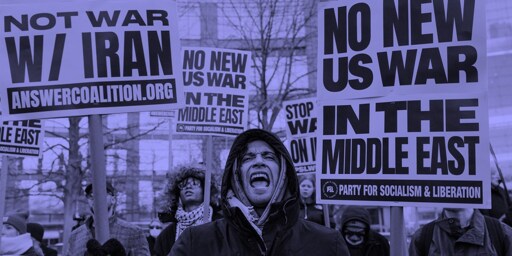
Donald Trump’s second term has been broadly defined by an overwhelming sense of chaos. Every week the U.S. finds itself in a new crisis of the president’s making. The war in Iran and the broader Middle East is stretching into its fourth week, as the administration prepares to send thousands of troops to the region for a possible ground invasion. The U.S. oil blockade on Cuba has plunged the country deeper into a humanitarian crisis. The Department of Homeland Security sent ICE to airports across the country on Monday to allegedly assist TSA agents who have gone without pay due to a partial government shutdown over congressional efforts to apply the most minimal of reforms to ICE. Meanwhile, Trump’s sons are backing a new drone company vying for a Pentagon contract as the president and his family have amassed about $4 billion in wealth this term, according to the Wall Street Journal.
“It’s a constant stream of violence, corruption, spectacle,” Nikhil Pal Singh tells The Intercept Briefing. “They smash, grab, move on. But I think now they’ve actually broken something.” The professor of social and cultural analysis at New York University and the author of several books, including “Race and America’s Long War” joins host Akela Lacy in a conversation about protests and movement-building in the latest Trump era.
Trump “said the real enemy — the real threat — was within. He reversed the Bush priority, which said, we fight the terrorists over there so we don’t have to fight them at home. And instead said, no, we actually have to bring the fight home. And he brought the fight home,” says Singh. “The idea there then also is that Americans themselves — that is us — we need to be governed violently first and foremost.”
“What we saw in Minneapolis and in Chicago and other places is almost like a really spontaneous emergence of that civic energy where people are basically like, ‘No, this is not OK in my city,’” says Singh. With the upcoming nationwide No Kings protests on Saturday, Lacy brings up the challenges of protesting under the second iteration of the Trump administration, and whether it’s fair to question the efficacy of protests at a time when they’re being met with paramilitary forces.
“We’ve lived through a period where the protests against the war in Gaza were pretty brutally suppressed by the Democratic Party and by the very institutions that the Trump administration is trying to destroy,” notes Singh. For there to be long-term meaningful change during this increasingly hostile environment to dissent or opposition, big alliances are needed, including with parts of the Trump coalition, he says. “Those kinds of cross-class alliances that cross the parties that are oriented around what we might call left economic populist politics and anti-war politics are going to have to be built.”
Listen to the full conversation of The Intercept Briefing on Apple Podcasts, Spotify, YouTube, or wherever you listen.
Transcript
Akela Lacy: Welcome to The Intercept Briefing, I’m Akela Lacy, senior politics reporter at The Intercept.
Jessica Washington: And I’m Jessica Washington, politics reporter at the Intercept and co-host of the Intercept Briefing with Akela.
AL: I don’t know about you, Jessie, but I honestly feel like I’ve had constant whiplash the past few months. Maybe it would be helpful for our listeners if we start with just breaking down exactly where we are right now in the world. I’ll do a quick recap.
We are, as many people know, in a full-blown war with Iran after being told for years that that would effectively mean the beginning of the end. The U.S. has killed more than 150 people in boat strikes around the world and successfully kidnapped the Venezuelan president and his wife. Trump has consolidated the nation’s largest paramilitary police force and unleashed it on U.S. cities and now airports. The number of people being detained by ICE is at an all-time high. Federal agents have killed two protesters, and more than a dozen other people have died this year alone at the hands of ICE.
At the same time, prices are soaring. The Treasury just declared the U.S. insolvent, in case you missed that, which I certainly did. The government is still partially shut down, and Trump and his allies are still withholding documents from the public on Jeffrey Epstein.
And in case anyone forgot, we’re knee-deep in a midterm cycle that’s seen unprecedented levels of dark money and efforts by corporate lobbies to influence elections. So how are you feeling about all of this? How are you processing all of this?
JW: Yeah, it’s a lot to process as a journalist and a person in the country.
The way that I’m thinking about this is really in the context of protests, and whether or not we’re going to see a real resistance to the Trump administration emerge. Obviously, what we’ve seen in Minneapolis has been a real resistance to their efforts from everyday people. What I’m thinking about now is just how can we exist in this society and push back against some of these really awful things, when there’s so much repression of protests and of activism in general, and of journalism?
AL: The conventional wisdom for moments like this is that this is when the opposition should theoretically be at its strongest. Is that the case right now? What is the opposition right now, and how are regular people responding to this, and is it having any effect?
JW: Yeah, we can talk about poll numbers. Certainly Donald Trump is historically unpopular, so we are seeing people react in that way. But I think we have to take into account the real ways in which the Trump administration, but also the Biden administration — and if we’re going to talk about college protests — university administrators really clamped down on college campus protesters, on protest in general. And we’ve seen the indictment of protesters in the Cop City case; we’ve seen the indictment of protesters in the case in Chicago, where we saw Kat Abughazaleh indicted. So there’s a real risk to protest.
[
Related
Google Secretly Handed ICE Data About Pro-Palestine Student Activist](https://theintercept.com/2025/09/16/google-facebook-subpoena-ice-students-gaza/)
I mean, we interviewed Momodou Taal on this very podcast, a Cornell student who had to flee the country in order to escape being detained by the Trump administration because of his actions on college campuses. So there’s real fear.
I think there’s also real movement organizing. We’ve seen it in Minneapolis, we’ve seen it in even deep-red places like Hagerstown, Maryland, which I’m interested in talking a little more about.
There’s certainly still activity, but there’s a lot of fear and a lot of that fear is understandable.
AL: Jessie, you mentioned the Cop City case, and I think those indictments were obviously an effort to intimidate those protestors. I will just note that a judge dismissed most of the charges against them, but the Georgia attorney general is trying to appeal that dismissal. So the intimidation tactic continues, whether or not the charges were dismissed.
JW: No, I think that’s a really good point that a lot of the early intimidation we’ve seen of protesters has been unsuccessful in terms of actually getting them detained and locked up. We’ve also seen many of the students who were detained by the Trump administration for protesting have since been released or have fled the country and are no longer within the administration’s grasp. But nonetheless, it still has this chilling effect on protest on college campuses, but obviously across the country when people have to worry about whether or not they’re going to end up in prison for trying to protect their neighbors, I think that becomes a really difficult decision for a lot of people.
[
Read our complete coverage
Chilling Dissent ----------------](https://theintercept.com/collections/chilling-dissent/)
AL: Specifically on this question of protest or how communities are responding to the increasing state violence that we’re seeing, you’ve been doing some reporting on a rapid response ICE watch group in a red county in Maryland. Is that right?
JW: Yes. I have been covering the potential development of an ICE facility in technically Williamsport, Maryland, but the closest, largest city would be Hagerstown. But what’s been really fascinating about this story — the ins-and-outs of how this warehouse is going to become habitable for human beings is a large part of what I’m focused on. But we’ve seen in this county, which is Washington County, where the warehouse ICE facility would exist — it’s this deep red county where they’re trying to build this ICE warehouse, and you’ve actually seen massive resistance.
So first, I would really point to this Hagerstown Rapid Response group. There’s this group that emerged really in the wake of what they watched in Minneapolis. They saw the successful ICE observers and ICE watches that were going on in communities in the Twin Cities, and they wanted to build something similar to that. So they developed the Hagerstown Rapid Response.
[
Related
Can Trump’s Plan for Warehouse Immigrant Detention Camps Be Stopped?](https://theintercept.com/2026/02/17/warehouses-immigration-detention-camp-prisons-immigrants/)
But over the course of developing their group, they realized that there was this ICE detention facility that was going to be potentially built in their community. So they really organized these pinpoint protests against the county commissioners where they live. So they’ve held weekly protests outside of the county commissioner’s office, but they’ve also worked to surveil the warehouse. They have drones they have used to get images to send out to the press, to the public, to really raise public awareness about this issue.
So we are seeing people in communities, even in conservative communities, really coming together and finding ways to protest and organize against ICE and against the Trump administration.
AL: We touch on all of this and more with our guest today, Nikhil Pal Singh, a professor of social and cultural analysis at New York University and the author of several books, including “Race and America’s Long War.”
Nikhil, welcome to The Intercept Briefing
Nikhil Pal Singh: Thanks for having me.
AL: Trump’s second term has been broadly defined by this overwhelming sense of chaos. As we speak, the war in Iran and the broader Middle East stretches into its fourth week. The U.S. oil blockade on Cuba has plunged the country deeper into a humanitarian crisis. The Department of Homeland Security sent ICE to airports across the country on Monday to — it’s unclear exactly how — assist TSA agents who have gone without pay due to a partial government shutdown over congressional efforts to apply even the most minimal of reforms to ICE.
Meanwhile, Trump is minting a new coin with his face on it, continuing to renovate the White House, and his sons are backing a new drone company vying for a Pentagon contract as the president and his family have amassed about $4 billion in wealth this term, according to the Wall Street Journal.
It’s a lot to keep up with. You’ve written that the question facing the American public today is less about whether what we’re seeing is unprecedented and more about what purpose the chaos serves, and how we respond to it. But what effect has this constant whiplash had on the public and its ability to organize or to respond?
NS: It’s a good question, and it’s where I began the piece that I wrote. You didn’t even mention “Operation Total Extermination” in Latin America and Ecuador, which Nick Turse wrote about this week. And of course, the signs that insiders have been trading on information in Trump’s tweets, making directional trades against them in the oil market and in the futures markets.
AL: Right.
NS: It’s a constant stream of violence, corruption, spectacle. The term that the Trump administration likes to use, and Pete Hegseth’s favorite term, is “kinetic action”: We’re moving fast and breaking things all the time and showing and asserting our dominance over every situation. Those of us who try to comment upon this, report on it, analyze it, are always trailing behind it, trying to keep up, trying to make sense of the next thing — it does induce a state of whiplash. It does induce a state of paralysis by design.
One of the things I’ve been trying to do is to try to think about: How do we create a broader framework to understand what’s happening? Not a framework that tries to say this all makes sense, or it has some rationality, because there is a substantive irrationality to all of this, but I do think there is a method in their madness. And that method is really about keeping us off balance.
“Everything they do has a short-term calculus associated with it.”
It’s about allowing them to continue to raid the Treasury. It’s about destabilizing the institutions that create a sense of organization, order, coherence within our society that then allows them to have more room to maneuver, at least within the short term. It’s hard to say what the long term’s going to look like, because everything they do has a short-term calculus associated with it.
I think the long term looks quite grim for them and for us, especially if we can’t get a handle on this. I think that’s part of what we need to try to understand. We need to almost not take a step back, but balance ourselves against the impulse to constantly be shaken and reactive in relationship to everything that they do and the next thing that they do and the next thing that they do.
I will say, as a last point in this opening, that I think in the Iran war they might really have met their match. That smash and grab, which has essentially been the mode right? “We’ll seize Maduro. We’ll send an ICE team into Minneapolis.” Of course, they met their match in Minneapolis too, and we can come back to that.
AL: Yeah, we will.
NS: But they smash, grab, move on. But I think now they’ve actually broken something. That is going to have long-term consequences for many, many, many of us, and political consequences for them that they’re not going to be so easily left behind.
“We need to … balance ourselves against the impulse to constantly be shaken and reactive in relationship to everything that they do and the next thing that they do and the next thing that they do.”
AL: This is a great segue into what I wanted to ask you about.
So for our listeners, we’re talking about this essay you wrote for Equator magazine in January, really central to which is the idea of “Homeland Empire” that you write about. This notion — which is linked with your last point about the long-term ripple effects in Iran and beyond that we can’t necessarily account for yet — this notion that you cannot understand Trump’s project if you separate the realms of the domestic and the foreign.
That what we’ve heard for years about the U.S. turning its global wars back on its own citizens is happening now. That it’s more than a disturbing phenomenon. It’s a symptom of this broader rot at the core of U.S. institutions, which Trump is an outgrowth of.
You write, “Trump’s real innovation has been to marry the archaic geopolitics of a settler empire to the modern legal frameworks devised by his liberal predecessors. What distinguishes his latest regime is its effort to reimagine and remake the borders of American state power, collapsing the foreign and the domestic in a single domain of impunity: Call it ‘Homeland Empire.’”
What is the utility of that specific framing, and what does it tell us that we don’t already know or understand about Trump?
NS: I do think that the concept of the “homeland,” which really comes into focus in the global war on terror. And there’s a great book by Richard Beck called “Homeland,” which has been really important for me. It’s suggested that national security and the security complex needed to be in some ways reshored.
You have the development of the Department of Homeland Security, which is a massive government reorganization, creating a whole new government department that you might even think of as being on par with the creation of the Department of Defense after World War II. So there’s the beginning of a reorientation institutionally in terms of policy. Of course, [George W.] Bush frames it in a very telling way. He says, we have to be able to fight the terrorists over there so we don’t have to fight them here. That’s still within the old model, even though the model is shifting.
It’s the old model which tells us Americans are going to be safe as long as we keep our power projection and fighting the enemies and the bad guys all around us. That idea that there are threats everywhere, and that the United States has this global mandate and remit to fight them — that really does go back to the end of World War II and the Cold War. So there’s a long arc of that thinking. But what begins to shift in the global war on terror, and partly because of the attacks of 9/11, is this sense that the homeland is actually under a real threat. That it actually can be attacked. It can be destabilized.
[
Related
“Terrorist”: How ICE Weaponized 9/11’s Scarlet Letter](https://theintercept.com/2026/02/06/spencer-ackerman-9-11-terrorists-ice/)
Now, that doesn’t just come out of 9/11. If you think about the period since the end of the Cold War, the search for new enemies dissipates. If you’re as old as I am, you remember when they were promising a huge peace dividend. Of course, the wars in the Middle East immediately begin to ratchet up. But the other thing that begins to ratchet up is the war on crime and the war on migrants. If you track the government spending — that precedes the origins of the Department of Homeland Security — on the prison complex and on the border–control complex, those are also going through the roof. They’re being imagined, again, in terms of this primary sense that Americans are being rendered insecure by street criminals, by migrants coming across the border, and now also by terrorists who might infiltrate.
If you remember back to the war on terror period when Bush was fighting in Iraq, some Republican congressmen then were already running ads saying terrorists and migrants were essentially the same thing — that brown people coming across the border wanting to do us harm. So the idea that the terrorists, the migrant, the criminal represent this new nemesis that is actually now much more proximate, that has been building up for a long period of time. It’s been helping to produce spending streams, funding streams, institutions. And Trump has cemented it into a single ideological complex.
“The idea that the terrorists, the migrant, the criminal represent this new nemesis … has been building up for a long period of time. It’s been helping to produce spending streams, funding streams, institutions. And Trump has cemented it into a single ideological complex.”
One of the things Trump was very, very clear about, even though he promised that he was going to be a peace president and wind down the wars and the forever wars, not be involved in overextension of American power overseas, et cetera, et cetera, which he numerously described as foolish, reckless — even though he did support the Iraq War, let’s not forget that.
He also said the real enemy — the real threat — was within. He reversed the Bush priority, which said, we fight the terrorists over there so we don’t have to fight them at home. And instead said, no, we actually have to bring the fight home. And he brought the fight home. He began to imagine bringing the fight home through the framework of a mass deportation campaign through the idea of making what was already a paramilitary organization in a sense — Customs and Border Protection, but more or less confined to the border — bringing that into the interior of the country. Adding huge amounts of funding to DHS to build up an immigration police with paramilitary characteristics.
We’ve seen the results of that over the last year. The idea is that it’s only the illegals who are being governed violently or the only the criminals. They’re always careful to say that, but that’s actually not how it’s played out at all. The idea there then also is that Americans themselves — that is us — we need to be governed violently first and foremost.
AL: Right. The end result is the expansion of state power and state violence.
NS: Right.
AL: So this brings us to Minneapolis. We’re seeing this massive escalation of state violence at home and abroad, while the public is also weathering increasingly difficult economic hardship, which is being exacerbated again by the war in Iran.
That is the same issue that many people argued posed such an obstacle to former President Joe Biden and Kamala Harris’s 2024 campaign, and what brought us a second Trump term, right?
NS: Yeah.
AL: This economic hardship issue, this is the time that you would expect the height of mobilization by the opposition. While we’ve seen massive public opposition to ICE raids. We have “No Kings” protests; there’s another one planned for this weekend. But we’ve also seen the state deploy intense violence in response to that opposition, obviously killing two protesters in Minneapolis.
Do you think that the state’s response has effectively crushed whatever opposition has come up? Whether the answer to that is yes or no, where does the opposition go in this increasingly hostile environment?
NS: I think it’s a good question, and it’s definitely one that I’ve been mulling over. We would all like to see the streets filled with people again like 2020. I do think Americans have proved more attuned to violence at home and violence against their own neighbors and in their own neighborhoods. I think that’s been amazing and inspiring.
[
Related
Federal Agents Are Intimidating Legal Observers at Their Homes: “They Know Where You Live”](https://theintercept.com/2026/03/05/ice-cbp-minnesota-surveillance-intimidation-observers/)
It really gives the lie to what the Trump administration professes when JD Vance says something like, anybody would be uncomfortable, having someone next door to them who speaks another language. It’s actually not true. Actually Americans, even in small towns, even in rural spaces, have grown accustomed to living alongside people who are very different and figuring out how to either live and let live, or sometimes even more affirmatively, to cooperate, to play soccer together, to be in civic organizations, to go to church.
I’m not saying the United States isn’t still a segregated country, or that there isn’t racial animus or distrust or any of those things. But I think we really underestimate the degree of ordinary comity among people.
Obviously what we saw in Minneapolis and in Chicago and other places is almost like a really spontaneous emergence of that civic energy where people are basically like, “No, this is not OK in my city.” These might even be people who have sensitivities and anxieties about unauthorized migration, which is a legitimate issue to debate. But the violence and impunity and lack of due process and disruption is offensive to people. We’ve seen the results of that in public polling data. We see it in the ways in which people act on the streets.
I think wars overseas are more difficult for people in the United States. They feel more distant. The propaganda is so thick. You’ve been told for decades that Iran is some alien power that is irrational and in search of a nuclear bomb that might be eventually fired at like New York or something. It’s absolutely worthless propaganda, but it does its work. It’s very, very tied into the protection and safety of Israel, which is the most heavily propagandized topic in the U.S. foreign policy realm. People don’t really know what to think. And it doesn’t seem to affect them in the immediate sense — especially when you’re bombing from the sky and using remote warfare.
But now they’re really at a crossroads. They are amassing troops in the region. If American troops start going into combat situations and getting killed, you’re going to see people start to pay a lot more attention as gas prices rise, as the cost of everything increases.
“It’s very, very tied into the protection and safety of Israel, which is the most heavily propagandized topic in the U.S. foreign policy realm. People don’t really know what to think.”
Trump is going to be bedeviled with all the problems that Biden faced because people are going to feel that very profoundly. People who, as you say, are living paycheck to paycheck who are struggling to make rent, for whom a $1 increase in the price of gas when they have to commute two hours each day is actually a huge amount of money on a weekly basis. Trump owns that.
So they’re extremely reckless people, and I have to think that politically they will pay a huge price. They already are. As long as we — that is, those of us who are opposed to this — are able to exercise our civil and political rights both in the streets and at the ballot box. That obviously is going to be a real question. Is repression going to ramp up? Is there going to be chicanery around the elections? I think we can expect both of those things. Then we’re going to see where the balance of forces are. But I don’t think we should interpret the current quietness around the anti-war stuff necessarily as evidence that civic energies and oppositions has been beaten.
AL: To that point, these No Kings protests are taking place around the country on Saturday. Co-founder of the group, Indivisible, which organizes the protest, Leah Greenberg, told The Guardian, “Every No Kings is going to be about the issues that are driving people most at that moment and it’s also going to be about the collective ways in which they begin to harm our democracy.”
I want to talk a little bit more about the challenges. We touched on this a little bit, but I want to go a little bit deeper in the challenges of protesting under the second iteration of the Trump administration, and whether it’s fair for us as journalists and analysts to question the efficacy of protests at a time when they’re being met with paramilitary forces. I’ve seen some questions about the specific demands of the No Kings protests or lack thereof. I’m curious, what do you make of that?
NS: I tend to be a little bit on the side of, let a thousand flowers bloom. Anybody who wants to organize something and signal their opposition, that’s great. But I do think the opposition has to be sharpened and has to become more pointed around what the issues are.
I think, by necessity, the anti-ICE protests have become that way. There’s obviously synergies between these different things. People find their ways into different kinds of organization and different senses of action that may not always be strictly compatible with each other.
Again, the anti-war stuff is very specific. We’ve lived through a period where the protests against the war in Gaza were pretty brutally suppressed by the Democratic Party and by the very institutions that the Trump administration is trying to destroy. So the ways universities responded, the ways nonprofits and civic organizations often remained very silent on Gaza, the way the Democratic Party was obviously complicit fully with the genocide in Gaza — all of these things have left a mark on some of the most militant people who were out there in front and who were right, and who were correct in the positions that they were taking after October 7 about the Israeli response and the disproportionality of it, and the mass killing of civilians and the way in which it had the potential to unleash a regional war. And of course, Israel started this regional war three years ago.
That’s a huge problem for some of these big-tent protest projects, which are very tied into the Democratic Party — a Democratic Party that in some ways we are now engaged in a huge battle over. Israel has split the Democratic Party. We have one side, which is the side I would say that I’m on, that really thinks that there has to be an extremely hard red line around future funding for Israel, around AIPAC and the use of PAC money that is flowing into candidates and races on behalf of Israeli interests.
This is very divisive because of the way in which it pricks this whole set of arguments about whether it’s antisemitic and so forth, and it’s a real dilemma. But I think we have to be able to win this battle in the Democratic Party. Otherwise, we’re going to find ourselves in just another situation where even if the Democratic Party is back in power, it is still like the controlled opposition.
[Break]
AL: I wanted to touch on the same thing basically that happened with Gaza protests, we can map that back onto BLM protests in 2020, which is that Democrats were nominally supportive of this. But when it came down to brass tacks, they were still sending police to crush these protests. Then when it was time to actually pass legislation, at least at the federal level, there was basically like a do nothing bill that Democrats calculated would pacify this movement for the long term.
Now we’ve seen that so much of that momentum was basically co-opted or diluted and that all the things that people were calling for in terms of police reform, the evidence that none of that happened is the paramilitary police that we’re seeing respond to all these protests today.
NS: For sure.
AL: People still have a bit of that taste in their mouth of OK, even when Democrats were in control or even when these protests seem to be taking off, what was the legislative payoff? I’m curious today, whether we need to be thinking differently about what we are going to count as a positive result of a protest or as an effective protest, whereas we could argue that community resistance in Minneapolis and backlash to the agents killing Renee Good and Alex Pretti led to in some ways DHS Secretary Kristi Noem and Border Patrol Officer Greg Bovino losing their jobs, while there’s still been very little change to DHS policy. So I wonder how we value those outcomes — those cosmetic outcomes versus long-term legislative change and knowing that the Democratic Party that we have is the one that we have? Does that alter the calculus with these protests or should it?
NS: When you think back to BLM, you could say they helped Biden win 2020, even as then, it not only translated into the very anemic policy wins, but then also there was a belated or delayed backlash, which exploited some of the weaknesses of the movement itself, of course. The ways in which it had already had some of these problems internal to it around leadership, around nonprofit funding, around internal corruption and so forth, and the sidelining of grassroots protests — that really going back to Ferguson — really emerged out of direct community action and need based upon the experience of being under police occupation.
We have to be able to learn from these cycles. I don’t think the lesson necessarily is that protest is ineffective or irrelevant. Protests are going to happen. We live in what my dear old friend who passed away last year, Joshua Clover called the “age of riots.” People are under stress. A lot of this emerges very spontaneously. There’s obviously a viral environment that allows people to gather in outrage — the outrage is palpable throughout the society. It crosses left and right.
Public opinion is what they like to call thermostatic. It can change and switch very quickly. We haven’t really been able to figure out on the left how to harness that and develop that for a more ambitious and large scale transformation. To harness it for a larger scale transformation, we really have to be able to start thinking across different kinds of divides. That would be my view.
The modalities of certain kinds of identity politics have not served us well, ultimately. The hierarchies of oppression have not served us well, especially when they’re advanced by people who are not actually interested in economic redistribution or anti-war politics. It’s quite easy and we’ve all encountered this, someone who will talk about priorities of anti-racism or anti-sexism or homophobia or whatever else. But actually basically just has mainstream Democratic Party politics at this point. So the Democratic Party succeeded in harnessing and appropriating protest energies that legitimately came out of the experience of people who are being racially brutalized. But people being racially brutalized — and this is something that, someone like even [Martin Luther] King, understood very well at the end of his life — need a big alliance to be able to make any real change in this country.
That big alliance is actually going to involve an alliance with poor white people, many of which who have been part of the Trump coalition, and have been hailed by a certain Trumpian politics. I’m not saying all poor white people. But those coalitions, those kinds of cross class alliances that cross the parties that are oriented around what we might call left economic populist politics and anti-war politics are going to have to be built.
In my view, there’s really not much hope for us without building those without some root through mass politics that allows us to change the dispensations of the political reality we live under, which, for all the ways in which people talk about polarization, there’s a lot of bipartisan consensus between the Republicans and the Democrats around war, around economic policy, around taxes around monopolies, around feeding donor interests and around a willingness on both sides to use a culture war polarization discourse to keep their own base close while not really doing much for them. Unless we can really demystify that and really think about solidarity and alliances even with people we don’t necessarily agree with on everything or even like very much.
AL: This is something we’ve been talking about in our newsroom as well, like this bipartisan consensus on these issues, even when it’s coming from the conservative movement, like with people like Candace Owens or Tucker Carlson or Marjorie Taylor Greene, or even Megyn Kelly particularly criticizing the war in Iran and Israel’s influence. Sure, you can say that’s interesting, but I think the more instructive approach to thinking about something like that is OK, what do we take from this? Are people doing that because it’s politically expedient for them or because they’re trying to appeal to their base, or because they’re actually looking for a way to advance some counter policy at the national level? I feel like every other day I see news about the fact that these Republicans are breaking, but it’s like OK, does that actually matter?
NS: I want to be really, really, really clear about this. I think it’s a really important point to be clear about.
AL: Yeah.
NS: Tucker Carlson, Megyn Kelly, Kelly, Candace Owens. I’ll leave Marjorie Taylor Greene on the side. I’m not sure, something about the sincerity of her conversion convinces me a little bit more for whatever reason.
AL: Interesting. OK. Yeah.
NS: These are odious people. These are reactionaries. These are people who actually would want to advance many of the same policies that Trump is advancing, particularly around deportation and mass incarceration. But who knows? President Tucker Carlson might preside over the final war against Iran.
Trump was anti-war until he was pro-war. Once these guys get hold of the machinery of state, which is what interests them, they’re absolutely interested in prosecuting a vision of the country that does not include people like us. That is deeply and profoundly hostile to democracy. That’s deeply and profoundly hostile to the poor. That’s deeply and profoundly hostile to immigrants and people of color. That’s deeply and profoundly hostile to women. There’s no question in my mind that that’s true and that we shouldn’t be paying much attention to their antagonisms towards Trump and the splits within MAGA, except in so far as those become tactically useful.
What I’m talking about when I say, public opinion is thermostatic, people who voted for Trump, who are working class and poor and stressed, don’t necessarily have an absolutely ideologically sealed and impenetrable view of the world, that those are the people that have to be admitted as possible parts of a bigger coalition.
My model there would be Zohran Mamdani going out into Queens, the day after Trump was elected, and talking to people who voted for Trump and trying to figure out why and trying to say that he could offer something different. That to me is really different than saying that the Megyn Kellys of the world, these cynical influencers, are people that like we should take any sucker from.
AL: That we need in our coalition.
NS: Or that we need in our coalition. No, I think and I’m absolutely not saying that we don’t continue to draw really hard red lines around certain things. You’re not allowed to be racist, you’re not allowed to be sexist. Like these are not acceptable positions.
I don’t want to get back into an argument about whatever cancel culture and all of that, but that has been not useful ultimately, for our side, like we have to be able to be people who can allow an internal differences in dialogue, even over issues that are really contentious and painful to people and allow people to move forward and grow. That’s how you develop solidarity. That’s how you build it.
AL: I’ve spoken to people on the left who think that it’s a good idea to go on Tucker Carlson’s show because he reaches all of these people and I think we have to be able to differentiate between having an inclusive tent and allow for growth and allow for change. The difference between that and enabling people who will betray you when it’s convenient for them. And I think that’s difficult in some ways. I don’t think there’s a hard and fast rule, but I do think it’s frustrating to me that I see so many people like, “You gotta hand it to these people for coming out against the Iran war.” Do we? I don’t know that we really have to do that.
NS: It’s a super tough question, and I don’t think anybody has a single clear program for how to deal with it. I remember back to when people on the left were condemning Bernie Sanders for going on Joe Rogan. I remember thinking at that time Bernie should go on Joe Rogan.
Joe Rogan has some terrible attitudes and some terrible views and some very misinformed conceptions of the world. Maybe in an ordinary sense too, as a reactionary, the reactionary guys I like grew up with in New Jersey who I played soccer with or whatever. Just normal reactionary opinions that you encounter, if you talk to ordinary people. He’s like that and that’s why he’s popular. So should Bernie go on there and talk to him? I thought so, and a lot of people really condemned Bernie back then. I think that was when we were in a much more stringent cancel culture mode.
[
Related
Tucker Carlson Outdid the Mainstream Media — But Still Missed This Crucial Point](https://theintercept.com/2025/06/18/tucker-carlson-ted-cruz-iran-israel/)
Now would I say the same thing about Tucker Carlson? No, because I think Tucker Carlson has serious political ambitions and is actually like a master manipulator of media. That’s my call, that’s how I would judge it. Somebody else might judge it differently.
I don’t think it’s super easy. I feel like we have to believe in the possibility of building bigger coalitions through dialogue, through change, through struggle sometimes. Yet I think the questions you’re asking and the way that we will pose these questions in public, we should be very clear about what we think.
AL: I’ll close with this question. I’m going to quote your wonderful essay one more time. For Equator, you write that the future is really up to the leadership of the opposition that Trump has turned America toward, “the vulgar, predatory, racist, great-power conflicts of old. He does not transcend history, but affirms what [Stephen] Miller calls its ‘iron laws.’ Reversing this will require something more than a return to normalcy, particularly as the American security state tends to be accretive – recent history suggests that it only metastasises. A more profound and comprehensive democratic renewal and reconstruction is needed.”
What does that mean? What does the democratic renewal and reconstruction entail? Who is involved and what are they doing?
NS: I think we’ve been talking about it. It’s clearly going to have to be at multiple scales. There’s a civic scale to all of this, a local scale to all of this, that I’m seeing in New York City where I live, and extremely, heartened by it. It also has its limits.
There’s a national electoral scale. Our government, which accesses billions and billions of dollars of our tax money to do all kinds of terrible things with it. We have to be able to transform and change that. A lot of people I know have given up on electoral politics altogether, but I don’t see any way to not work also at that scale.
So to me it’s always we’re all always thinking about something like a dual power struggle, like a struggle within civil society and civil society organizations, and a struggle to actually affect the dispensations of our government. For me, primarily right now, that is the struggle inside the Democratic Party to change what it is to make it a true opposition party in the current moment, to make it a party that will really actually try, actually, not try, but succeed in constructing a real majority for the kinds of policies that we would support, which would