

Caracas, March 26, 2026 (venezuelanalysis.com) – US Judge Alvin Hellerstein ruled out dismissing the case against Venezuelan President Nicolás Maduro and First Lady Cilia Flores in a hearing on Thursday in Brooklyn.
The defense team for Maduro and Flores—who face charges including drug trafficking conspiracy and weapons possession—requested that the case be thrown out after the US Treasury’s Office of Foreign Assets Control (OFAC) denied them authorization to use Venezuelan state funds to pay for legal counsel. OFAC had initially granted the license on February 9 but revoked it three hours later.
New York Southern District Judge Hellerstein declined to throw out the charges due to the blockaded funds, calling it “a serious step based on hypotheticals.” However, he did not formally rule and left the door open to revisit the decision in the future.
US Justice Department prosecutor Kyle Wirshba argued that allowing access to Venezuelan state funds would undermine existing sanctions policy, adding that if the defendants are unable to hire private attorneys, court-appointed counsel could be assigned. Maduro attorney Barry Pollack countered that such a measure would violate their Sixth Amendment right to choose their own legal representation.
During the hearing, Hellerstein challenged the prosecutors’ arguments, adding that OFAC’s personal sanctions against Maduro and Flores would also block them from using personal funds. The judge likewise disagreed with the prosecution’s claims that the blocking of funding for the defense was a matter of national security, stating that Maduro and Flores “no longer represent a threat.”
He further remarked that “things have changed” and that the United States is already “doing business” with Venezuela.
According to observers in the courthouse, Maduro and Flores, both in beige prison uniforms and handcuffed, appeared calm throughout the hearing, using headphones for simultaneous translation. Neither spoke. Observers noted that Maduro appeared thinner. Flores’ attorney, Mark Donnelly, made an urgent request for a medical evaluation, specifically an electrocardiogram, citing a pre-existing condition. The judge approved the request.
Hellerstein will set a new court date in the coming days. Maduro and Flores have not requested bail and were returned to the Metropolitan Detention Center in Brooklyn after the hearing.
Maduro and Flores, who is also a lawmaker, were kidnapped by US special forces during a military attack against Caracas on January 3. They pleaded not guilty at their arraignment two days later. Despite recurring “narcoterrorism” accusations over the years, US officials have not presented evidence tying high-ranking Venezuelan leaders to narcotics activities. Specialized agencies have consistently found Venezuela to play a marginal role in global drug trafficking.
Trump calls for additional ‘charges’
Prior to the hearing, US President Donald Trump argued before reporters that additional charges should be brought against the Venezuelan president.
“He emptied his prisons into our country, and I expect that at some point he will be charged for that,” he said. Trump has repeatedly raised unfounded claims that the Venezuelan government “emptied” prisons and mental institutions into US territory.
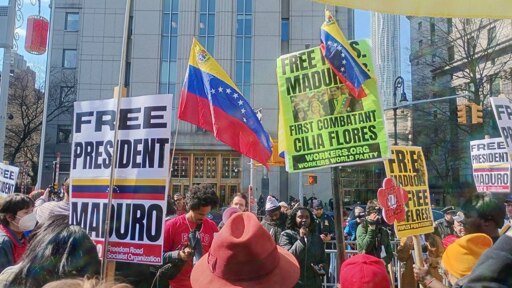
Outside the courthouse, a heavy police presence separated Venezuelan opposition supporters from solidarity activists demanding the release of Maduro and Flores and an end to US attacks against the Caribbean nation.
In Caracas, social movements gathered at Plaza Bolívar to express support for the president and first lady. The demonstration followed another mobilization earlier in the week demanding the lifting of US economic sanctions against Venezuela.
Speaking at the rally, lawmaker Nicolás Maduro Guerra—the president’s son and also facing US Justice Department charges—described his father as “a worker” who identifies “as a son of God above any political office.” Days earlier, in a social media post, Maduro Guerra had said his father would appear “in high spirits” and “in good shape” due to regular exercise.
He was joined by Caracas Mayor Carmen Meléndez, while the ruling United Socialist Party of Venezuela (PSUV) also called for Maduro’s release in a public statement.
For her part, Acting President Delcy Rodríguez has yet to comment on Thursday’s hearing. Venezuelan authorities have also not publicly addressed US efforts to block the funding of Maduro and Flores’ legal expenses.
Since January 3, the Rodríguez administration has led a diplomatic rapprochement with Washington, with several White House officials visiting Venezuela in recent weeks. A Venezuelan government delegation arrived in the US capital on Thursday, led by Vice Minister Oliver Blanco, who reported meetings with State Department officials to boost “mutually beneficial” relations.
Edited by Ricardo Vaz in Caracas.
The post Venezuela: Judge Refuses to Dismiss Maduro Case, Challenges US Blocking of Defense Funding appeared first on Venezuelanalysis.
From Venezuelanalysis via This RSS Feed.