



Creative Commons // UCO Medical Clinic
Erin In The Morning is a reader-supported publication. To receive new posts and support my work, consider becoming a subscriber.
The American Medical Association (AMA) has reaffirmed that gender-affirming care for trans minors, including surgeries, is medically sound—and that access to this life-saving care should not be impeded.
In a March newsletter, the nation’s largest physician organization stated its position unequivocally. “The AMA supports gender-affirming care as medically necessary per our policy,” wrote Board Chair Dr. David H. Aizuss.
The letter further clarified that the board does not endorse the controversial “position statement” from the American Society of Plastic Surgeons (ASPS) issued this past February. The document was created after meeting with Trump officials and repeatedly cited by anti-trans acolytes grasping for a “scientific” reason to support transphobia.
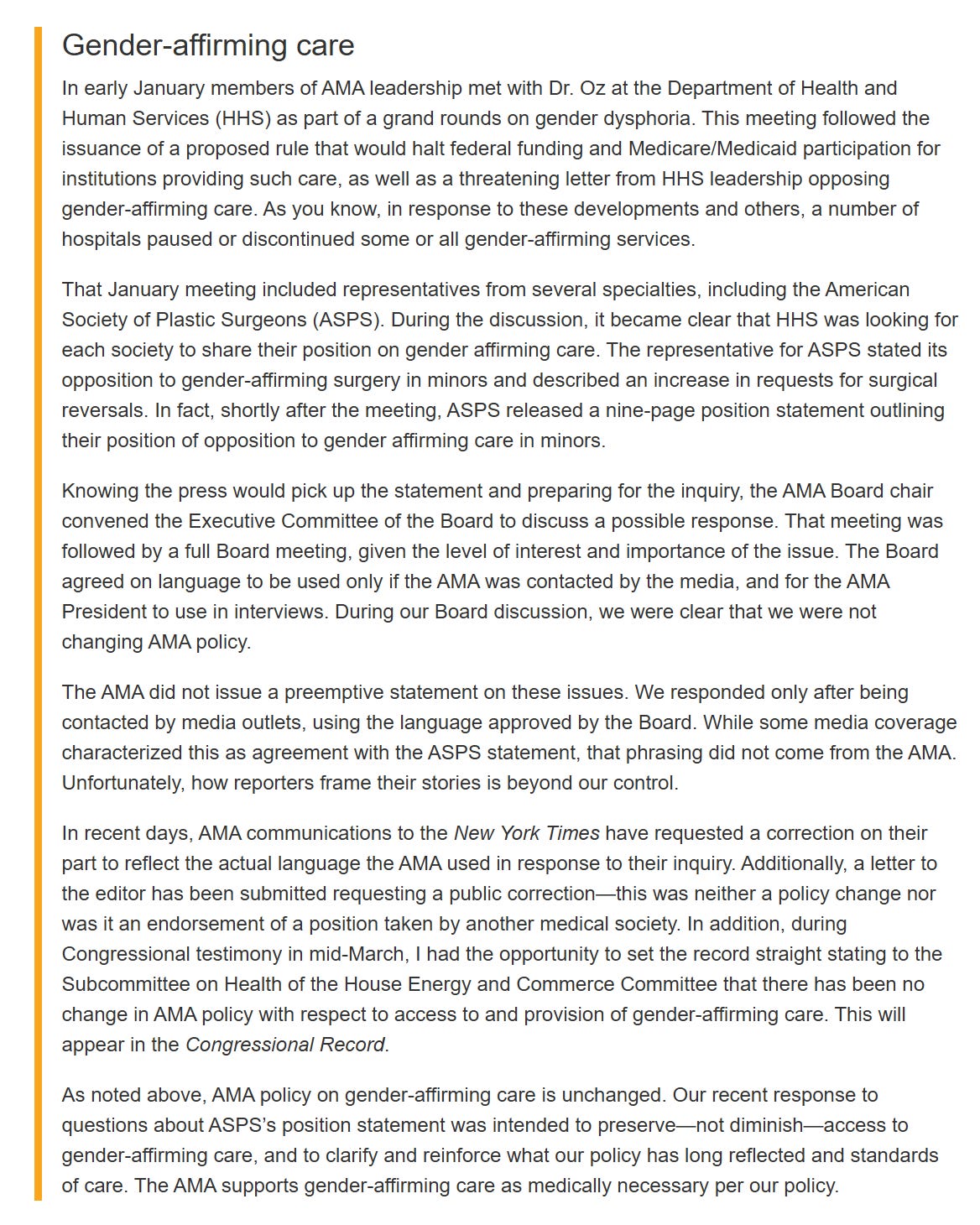
Full update from the American Medical Association
“Our recent response to questions about ASPS’s position statement was intended to preserve—not diminish—access to gender-affirming care, and to clarify and reinforce what our policy has long reflected and standards of care,” Aizuss wrote.
Statements from the organization—notably without any names attached—appeared in the New York Times and conservative publications like the National Review. Outlets reported the AMA “agreed” with the ASPS document, which was created behind closed doors and “recommends that surgeons delay gender-related breast/chest, genital, and facial surgery until a patient is at least 19 years old.”
Pundits branded it as some sort of turning point, but the newsletter rejects this characterization. Andrew Jacobs from the Times reported that the AMA had issued a “statement” saying that the “AMA agrees with ASPS that surgical interventions in minors should be generally deferred to adulthood.” Anti-trans activist Jesse Singal further seized on this in a subsequent op-ed for the Times where he triumphantly declared that “cracks have appeared in the supposed wall of consensus” around the efficacy of gender-affirming care.
“There has been no change in AMA policy with respect to access to and provision of gender-affirming care,” Aizuss wrote
Meanwhile, the countdown towards a proposed CMS rule to cut off medical institutions providing trans minors with GAC from accessing federal funds looms large. Hospitals providing these services have continued to drop patients out of fear; the position statement became more ammo for an already loaded gun, aimed squarely at providers.
The anti-trans movement has been building up a sprawling apparatus of anti-trans pseudoscience for years. It’s invested millions of dollars to combat an inconvenient truth: scientific consensus overwhelmingly supports the benefits of gender-affirming care for trans people of all ages. But the ASPS statement gave anti-trans politics a platform cloaked in the language of academia.
What this episode reveals is a dangerous conflation between formal policy, which goes through rigorous academic and democratic processes, and reactive media statements, which may not. And when confusion or discord between the two arises, it has real-life and immediate consequences for the trans community, whose care is heavily exceptionalized, politicized, and litigated both in the court of law and the court of public opinion.
Meanwhile, New York’s Dr. Scot Glasberg—one of the only names that was publicly attached to the statement—is using the ASPS statement and reporting on the AMA as fodder to push a similar resolution to the Medical Society of the State of New York (MSSNY). The ASPS represents more than 11,000 physician members nationwide. MSSNY, which is composed of licensed physicians, medical residents, and medical students across the Empire State, is 30,000 members strong.
Glasberg’s MSSNY proposal to endorse the ASPS position statement cites the very same aforementioned National Review article. It does not, however, cite formal AMA policy. A vote this week will determine whether that resolution passes through MSSNY’s House of Delegates.
Erin In The Morning is a reader-supported publication. To receive new posts and support my work, consider becoming a subscriber.
From Erin In The Morning via This RSS Feed.