

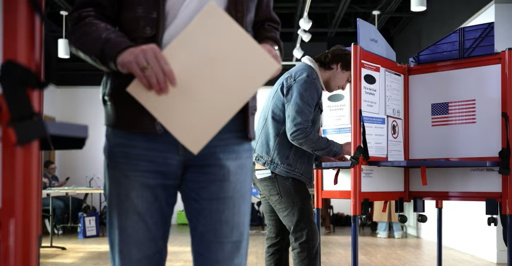

The SAVE Act is a solution to an imaginary problem that would cause real harm (Brennan Center, 10/10/24).
President Donald Trump wants his “SAVE America Act” (officially the Safeguard American Voter Eligibility Act) to become law so badly that he is demanding Senate Republicans eliminate the filibuster in order to pass it. Enough Republicans are resisting that the issue has become a drawn-out battle within the GOP, grinding work in Congress to a halt and garnering much media attention.
The bill, which passed the House in early February:
- Requires proof of citizenship to register to vote, like a passport or birth certificate—forms of identification that an estimated 21 million voting-age Americans lack. If your legal name is different than the name on your birth certificate—as with most married women—you would have additional hoops to jump through.</li
- Mandates that photo ID be presented before voting. Some 49 million voting-age Americans lack a valid driver’s license with their current name and address.
- Greatly restricts voting by mail. In 2024, 29% of voters mailed in their ballots—including many disabled people whose polling places are inaccessible.
- Forces states to turn over their voter rolls to the Department of Homeland Security, raising concerns around privacy, surveillance and false claims of election fraud.
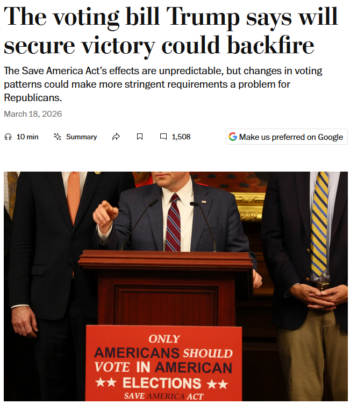
Washington Post (3/18/26): “Requiring Americans to prove they are citizens when they register to vote, in an effort to root out the extremely rare cases of noncitizen voting, would throw up roadblocks to the polls for millions of eligible voters across the political spectrum.”
And the law wouldn’t fund any of this, putting a huge financial burden on states with just months to go before the midterms. In recent weeks, Trump even tried (and failed) to convince his GOP allies to add provisions barring trans women from women’s sports and banning gender-affirming surgery for youth.
As the Washington Post (3/18/26) pointed out, a wide range of people—not only those who traditionally vote for one party or the other—would be disproportionately affected by the changes, including people of color, older people, rural residents, low-income people and women who changed their name after marriage.
In other words, though Trump has claimed that the SAVE Act would “guarantee the midterms” to Republicans, it’s not a fine-tuned bill to disenfranchise Democratic voters. Rather, it’s a blunt instrument that would further restrict the right to vote in the United States more broadly. The SAVE Act would throw up obstacles for all voters, making it more difficult for them to access their rights. (For Trump, it does have the side benefit of allowing him to paint Democrats as being opposed to voting “safeguards,” and giving him fodder for false narratives about election fraud.)
In news coverage of the SAVE Act, while many outlets have rightly debunked the GOP’s myriad false claims about voter fraud, some fell back on standard framing of “Republicans say X, Democrats say Y”—or, worse, of “Democrats vs. the public.”
‘Support among Americans’
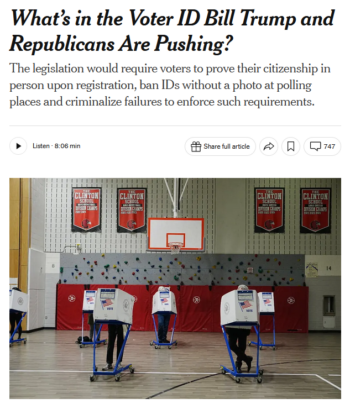
As Republicans push a bill that would block tens of millions of American citizens from voting, the New York Times (3/17/26) makes sure to point out that “Republicans say no reasonable lawmaker should oppose taking basic steps to ensure that only citizens can vote.”
A New York Times explainer (3/17/26) by Minho Kim started off by acknowledging that “fraudulent voting by noncitizens is already illegal and extremely rare.” But then it framed the probable effects of the legislation in “Republicans say/Democrats say” terms:
Democrats who oppose the legislation argue that it would suppress and discourage legal voting…. But Republicans say no reasonable lawmaker should oppose taking basic steps to ensure that only citizens can vote.
At Newsweek (3/23/26), the only critics of the bill reporter Joe Edwards named were Democrats, who he portrayed as standing in the way of what the public wants: “The bill has drawn criticism from Democrats, who argue it would restrict Americans’ access to voting, though polling indicates support for the move among Americans.”
Edwards cited a Harvard/Harris poll conducted in late February (2/25–26/26) that, he wrote, found
85% of voters believe only US citizens should be allowed to vote, with broad bipartisan support. Overall backing for the SAVE America Act stood at 71%—including majorities of Republicans and Independents—with 54% prioritizing voter fraud prevention over access concerns.
NBC (3/17/26) similarly cited polling to make the SAVE Act appear popular and Democrats’ opposition to it out of step, under the headline: “Most Americans Support Requiring Photo ID to Vote. Democrats in Congress Reject It.”
NBC senior national political reporter Sahil Kapur wrote that regarding photo ID, Democrats’ “message is increasingly falling flat with the American public,” citing a Pew poll that showed 83% of respondents supported requiring photo ID to vote.
Kapur dedicated the first nine paragraphs to only that side of the argument, including two quotes attacking Democrats’ opposition, before finally mentioning “other provisions in the sprawling bill” that might not be as popular, and allowing for quotes from those against the bill.
Another ‘major problem’
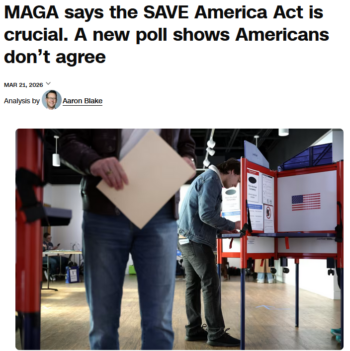
CNN (3/21/26) points out that a majority of those surveyed say the SAVE Act’s citizenship rules “would either mostly prevent legal citizens from voting (29%) or would prevent both about equally (28%).” In fact, evidence suggests illegal noncitizen voters are outnumbered by citizens who would be blocked from voting by the law by roughly a million to 1.
As FAIR (e.g., 9/26/24, 2/18/15) has repeatedly pointed out, polling is easily manipulated to create the illusion of public opinion, through—among other tricks—word choice and limited answer options. In the Harris poll, for instance, respondents are forced into support/oppose responses, with no option for those unsure or with no real opinion. They’re also primed with a question that explains that the SAVE Act includes “ending sanctuary protections for criminal illegal immigrants”—both false and incredibly loaded language.
In contrast, CNN‘s Aaron Blake (3/21/26) pointed out that a poll specifically on the SAVE Act—conducted more recently than the Harris or Pew polls, and allowing for “not sure” responses—showed something quite different:
The poll shows 42% of Americans regard ineligible voting as a “major problem.” But about the same amount—44%—say preventing eligible citizens from voting is also a “major problem.”
That’s a CBS/YouGov poll conducted March 16–19, well after the SAVE Act passed the House . The poll also found that the legislation itself was opposed 31-28%, with a whopping 41% “not sure.”
Part of that could be due to the fact that the details of the bill have been continually changing. But the poll also shows that—as on many public policy issues—the public is ill-informed. When asked, before offering any information beyond its name, if they knew what was in the SAVE Act, 36% of respondents didn’t even “have a general sense,” and fewer than half said they knew at least “some specifics.”
Empirical questions with factual answers
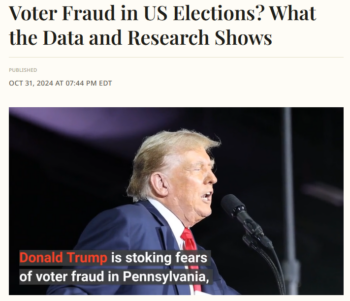
Brookings election expert Darrell West (Newsweek, 10/31/24): “Republican and Democratic judges…all reached the conclusion there was not widespread ballot fraud.”
The poll also found that a plurality of GOP voters believe noncitizens vote in federal elections “a lot,” 35% think “sometimes” and only 16% “very little/not at all.” They also think voter fraud in national elections is “widespread” rather than in “a few isolated incidents” 54% to 39%. (Democrats poll 17% to 71% on that question.)
These are empirical questions about voter fraud with factual answers, but in its own write-up of the poll, CBS (3/19/26) didn’t bother to tell readers which party’s voters are more aligned with reality. Spoiler alert: It’s not Republicans.
When Newsweek itself (10/31/24) covered a detailed report released less than two years ago, it noted an extensive historical record showing that instances of voter fraud “remain incredibly scarce.”
Even the Trump administration, which is desperately pushing the narrative of noncitizen voting, found after going through nearly 50 million voter registrations only 10,000 (0.02%) that were flagged for further investigation as possible noncitizens. In other words, 0.02% would be the ceiling, not the floor, for noncitizen voting, and even that is almost certainly highly inflated, given errors in voter rolls (New York Times, 1/14/26).
When news outlets cover the SAVE Act without that context, they only serve to further mislead the already poorly informed public.
From FAIR via This RSS Feed.