

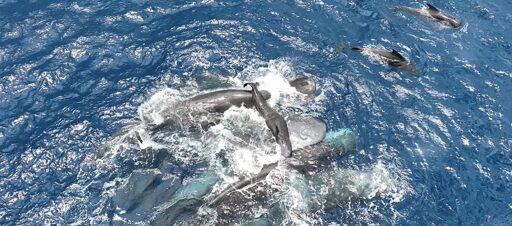
With the notable exception of humans, most mammals give birth alone. But in July 2023, researchers in the Caribbean witnessed something extraordinary: sperm whales not only attending a birth but actively helping both mother and newborn. Some of the whales present were not even related to the mother, known as Rounder. “Kinship barriers dissolved,” notes one of two studies published on the observation. A team from the Cetacean Translation Initiative (CETI) was in the area to record sperm whale sounds for their ongoing work to decode whale communication. Equipped with underwater microphones, drones and cameras, Project CETI president and founder David Gruber said it was “a moment of pure serendipity and luck.” The team noticed something unusual. Sperm whales are one of the deepest-diving whales; they spend much of their lives diving up to 2,000 meters (6,500 feet) deep hunting giant squid. But on that day, all 11 whales in a group known as unit A gathered near the surface, only taking very shallow dives and communicating so frequently, “it sounded like being in a popcorn machine,” Gruber said. “Did Rounder communicate that she was about to go into labor and call the unit together? We don’t know. We just know that they were ready and they were prepared.” What followed is the only known example of marine mammals helping in the birth of a non-kin. The calf emerged, tail first, and after 34 minutes was delivered to a waiting circle of whales who took turns supporting and lifting the newborn to…This article was originally published on Mongabay
From Conservation news via This RSS Feed.