

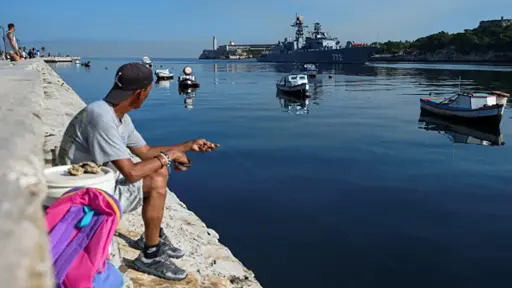
The total oil blockade of Cuba is pushing 11 million people living on the island to a catastrophic situation where not even food production and distribution is secured. An estimated 11,000 children are awaiting surgery, and countless other health-related procedures have been cancelled. Barely any vehicles move through the streets.
As the Trump administration moves from rhetorical bluster to concrete aggression, the message to the international working class is clear: the United States will do anything in its power to crush an example of defiance to imperialism and the market economy. We must be unequivocal: the defense of Cuba against U.S. imperialism is a primary duty for every socialist today.
From Sanctions to “Takeover”
Trump’s recent threats of a “takeover” of Cuba acquire an ominous meaning in the current political situation. Following the brazen U.S. military raid and abduction of Venezuelan President Nicolás Maduro in early 2026, the boundaries of what we can expect from this government have shifted. Trump and rabid anti-communist Secretary of State, Marco Rubio have demonstrated they are willing to use direct force, illegal aggression, and increased coercion over other countries to accomplish their goals. Yet this possibility seems unlikely in the short term, given the increasingly complicated scenario in Iran and the statements by Southcom Commander in a Senate hearing denying any short term plan to invade Cuba. Things can rapidly change, needless to say.
Soon after the Cuban government expropriated American companies, in 1960, President Eisenhower established sanctions and an economic blockade, which was tightened by John F. Kennedy in 1962, and then again by Bill Clinton in 1996. The U.S. embargo, upheld by both Republican and Democratic administrations, has cost the Cuban economy an estimated $1.1 trillion over the last six decades, amounting to a calculated, decades-long aggression on the Cuban people. It has been associated with poor nutrition, rising incidence and mortality from tuberculosis, and increase in death due to infectious and non-communicable diseases.
The current escalation in the form of a total energy blockade is aimed at pushing Cuba over the cliff and forcing the Cuban government into a “negotiated surrender.” By threatening massive tariffs on any nation — including Mexico — that dares ship oil to the island, the U.S. is effectively choking 11 million people, depriving them of a vital energy source. These measures have resulted in nation-wide blackouts, causing the interruption of hospital ventilators, food refrigeration, and the other basic needs, and has virtually paralyzed the economy.
The ultimate goal is capitalist restoration, allowing foreign capital to penetrate the island, and to roll back every social conquest of the 1959 Revolution. In fact, one of the main concessions from the Cuban government first reported by the New York Times has been to allow Cubans abroad to make investments in the island. The government also announced that it would soon release 51 political prisoners.
On Monday, March 16 Vice Prime Minister Óscar Pérez-Oliva Fraga made an official announcement in Mesa Redonda, the country’s main news show. He clarified that the new measures places no cap on the amount of investment and no sector of the economy where Cubans abroad can invest, including the financial and strategic sectors. It also enables them to build partnerships with local investors. In the same breath, Pérez-Oliva declared that Cuba was open to any investment from the United States.
In addition, Drop Site News reported more recently that the Cuban government is open to discussing “compensation” for the expropriations made after the 1959 revolution. This concession is allegedly an attempt to sweeten the deal for Cuban Americans, a constituency dominated by anti-Castro émigrés who are most likely to boycott any agreement with the Cuban government.
Attacking the Legacy of the 1959 Revolution
To Washington, Cuba remains a dangerous “bad example.” As the cost of living in the U.S. increases, the quality of public education deteriorates, and tens of millions still lack access to increasingly expensive health care, the alternative to the free market, even after decades of blockade and isolation, still has its appeal. It is living proof that even a small, resource-starved island can achieve universal healthcare — boasting health indicators that rival or surpass the U.S. despite a GDP that is a fraction of its size — extraordinarily high levels of education, and other social rights such as housing and a minimal monthly food ration.
These accomplishments were only possible because national resources, factories, sugar mills, energy companies, and land were socialized. It is a feat that could never be accomplished in a society where the profit motive drives all major decisions — such as where to invest, what to produce, how to distribute goods and services.
The current siege of Cuba also exposes the bankruptcy of Latin American “progressive” governments. While leaders like Claudia Sheinbaum in Mexico and Lula in Brazil talk a big game about sovereignty, publicly declare their solidarity with Cuba, and bemoan the blockade, they have not dared challenge the U.S.-imposed “oil asphyxiation.” The Mexican government has effectively joined the blockade by halting the vital oil shipments that previously kept the island’s power grid from total collapse. Under pressure from the Trump administration, Sheinbaum is, in fact, actively collaborating with the U.S. to starve the Cuban people. Lula has similarly ignored the request from the two largest oil workers unions in Brazil (Federação Única dos Petroleiros and Federação Nacional dos Petroleiros) to send oil shipments to Cuba.
We must remember that the Cuban Revolution began as a struggle for national liberation against the U.S.-backed Batista dictatorship. It was only after the revolution faced the sabotage of the national elite and foreign capital, and the first wave of U.S. sanctions that it took a socialist character. And it was not until the mid-1960s that the Castro government undertook a major wave of nationalizations of U.S.-owned assets, including oil refineries (after they refused to process Soviet oil), sugar mills, banks, and utilities. And only in 1962, three years after the victory of the revolutionary army, did Fidel Castro proclaim the “socialist character” of the revolution.
In other words, the expropriation of national and foreign capital happened only after the revolutionary government faced a capital boycott preventing it from rolling out their program — which included freezing utilities, expanding housing for working-class people, and more. These revolutionary advances were won by the workers and masses of Cuba who pushed the revolution further than Castro’s government had intended. Now, as U.S. imperialism demands Cuba’s bureaucratic government, headed by Diaz-Canal, concede the gains of the revolution, it is once again the Cuban workers and masses who must lead the defense of the revolution.
It is this legacy of anti-imperialist defiance and the socialization of private property that Trump and Rubio want to erase. It is an example of heroic resistance and a proof that organizing the economy around the needs of the population will always yield better social outcomes.
Against Imperialist Aggression and Capitalist Restoration
To defend Cuba from Trump’s asphyxiating strategy, we need first and foremost to break the oil blockade. A solidarity movement with Cuba could lead mobilizations across Latin America. A mass movement of workers and students could force the hands of Sheinbaum and Lula to ship the urgently needed oil to the island. There is widespread international solidarity for Cuba. The “Nuestra America” convoy carrying humanitarian aid, solar panels, and more is the most salient expression of this. Yet the most urgent task today is to restore the country’s access to oil.
In the United States, we need a movement against the blockade that demands clearly and loudly “oil for Cuba” right now. An anti-imperialist movement that draws on the networks of organized activists in defense of Palestine and against ICE can make the connection between the unprovoked war on Iran, the illegal kidnapping of Maduro and the aggression against Cuba, with the terrorizing of immigrants and protesters by ICE in U.S. soil.
We must demand that labor leaders publicly reject the “oil blockade” as an act of war and engage in active solidarity with the Cuban people, taking action through strikes, mobilizations, and boycotts. The recent general strike in Italy to stop the genocide in Gaza can serve as inspiration and guidance. Rank-and-file union members can push for resolutions along these lines at union chapters across the country.
The No Kings protests have been a flashpoint of popular discontent with the Trump administration. Organized by a broad coalition of over 200 organizations, the call advances a minimum program of rejection to Trump’s authoritarian and repressive policies. The Left must build a strong anti-imperialist contingent at these mobilizations that clearly denounces the illegal chokehold on Cuba, along with the unprovoked war on Iran, and the defense of Palestine. Let thousands of Cuban and Palestinian flags wave this Saturday.
End the blockade on Cuba! Oil for Cuba now! The struggle of the Cuban people is the struggle of the global working class.
The post As Trump Further Strangles Cuba, We Need an Anti-Imperialist Movement to Defend the Conquests of the Revolution appeared first on Left Voice.
From Left Voice via This RSS Feed.