

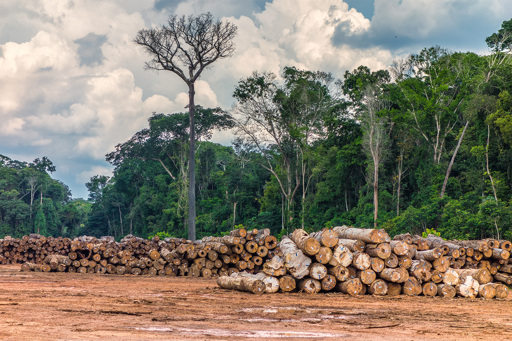
Forest loss, along with climate change, is changing the resilience of the Amazon Rainforest. By disrupting the movement of moisture through the atmosphere, deforestation is reducing rainfall and extending the dry season, especially in the southern Amazon Basin. But according to recent research, the impacts of large-scale deforestation could be much bigger than climate models have estimated for the region. A study published in Nature Communications found that between 52% and 72% of the rainfall decline in the southern Amazon Basin over the last four decades can be attributed to deforestation. Between 1980 and 2019, annual precipitation in the area has dropped by 8-11%. Additionally, researchers determined that rainfall decline was not just attributed to local forest loss, but to deforestation in upwind regions across South America. “Many studies only focus on the local scale, and local land-atmosphere feedback,” Jiangpeng Cui, associate professor at the Institute of Tibetan Plateau Research and lead author of the study, told Mongabay in an interview. “We combined observational data, like precipitation and evapotranspiration, with moisture tracking across South America. … This way we can know how [deforestation] changes vapor movement from one place to another.” Since 1985, natural forest cover in South America has declined by 16%, largely due to human-caused deforestation. In the Brazilian Amazon, which lost one-fifth of its forest cover between 1970 and 2019, primary forest is frequently converted to agricultural land or destroyed by wildfires. According to the study, cutting down large swaths of forest reduces the available evapotranspiration that…This article was originally published on Mongabay
From Conservation news via This RSS Feed.