

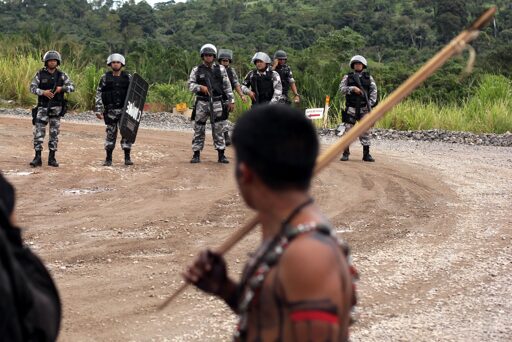
In October 2023, a delegation of La Gente de Centro — the Andoke (Pɵɵsiɵhɵ), Nonuya (Nonova), Muinane (Féénemɨnaa) and Uitoto (Nɨpode) peoples of the Middle Caquetá River Basin — traveled from the Colombian Amazon to Bogotá. They came not as petitioners but as authorities of living territories, demanding the implementation of Supreme Court Ruling 4360 of 2018, which recognized the Amazon as a subject of rights. Seven years after the ruling, however, the forest continues to burn, rivers silt up, and the agricultural frontier advances. Their visit raised a simple but unsettling question: what does it mean to recognize the rights of the Amazon if the peoples who have governed these forests for millennia remain outside the decisions that shape their future? In the territories they inhabit, authority is not concentrated in a single institution but woven through relationships among peoples, forests, rivers and other living beings. Protecting the Amazon, their presence suggested, requires forms of governance able to move across these interconnected scales of life and authority. Recognizing the Amazon as a subject of rights is therefore an important step but it is not enough. Judicial recognition must be accompanied by genuine co-governance with Indigenous authorities and by treating Indigenous life plans and governance systems as binding frameworks for territorial decision-making, rather than merely consultative inputs to state policy. This requires joint decision-making across several levels of government. National ministries responsible for climate and forest policy must work directly with Indigenous authorities, while regional environmental agencies, departmental governments, and…This article was originally published on Mongabay
From Conservation news via This RSS Feed.