

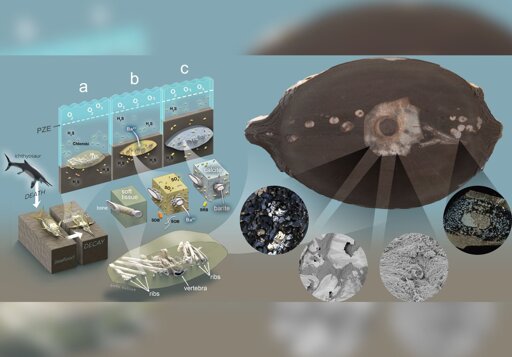
Scientists at Curtin University have solved a long-standing mystery about how some of the world’s best-preserved fossils formed in ancient oxygen-free ocean floor settings. The research, published in Communications Earth & Environment, focuses on a 183-million-year-old ichthyosaur—a dolphin-like marine reptile, preserved three dimensionally inside a carbonate concretion from Germany’s Posidonia Shale.
From Biology News - Evolution, Cell theory, Gene theory, Microbiology, Biotechnology via This RSS Feed.
You must log in or # to comment.