

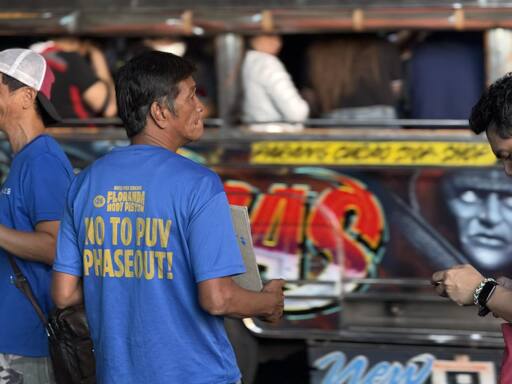
“Without price controls and the repeal of deregulation policies, these measures merely create an illusion of control.”
MANILA – Two days after Ferdinand Marcos Jr. declared an energy emergency, transport groups, commuters and other sectors launched a nationwide strike calling for policy changes beyond short-term economic aid.
The No to Oil Price Hike Coalition – composed of drivers and operators of jeepney, bus, utility vehicle, motorcycle, and transport network vehicle service, and multi-sectoral organizations – launched the first day of their nationwide strike today, March 26, 2026.
The coalition urged the government to address the reeling impacts of oil price shocks on the vulnerable sectors and ordinary Filipinos.
Jeepney driver and operator Tony Prado lamented in Filipino, “Every day, we are losing P750 (US$12.46), amounting to P22,500 (US$373.84) a month with multiple taxes.”
Prado, who joined the protest in Cubao, Quezon City, told Bulatlat he earns only P150 a day since the oil price hikes, far from his previous P1,000 (US$16.62) take-home pay. The amount is not enough to cover the needs of his family.
Prado and his group Piston maintained that Marcos Jr.’s Executive Order No. 110 declaring an energy emergency and creating the Unified Package for Livelihoods. Industry, Food, and Transport (UPLIFT) package and Committee, offers only stopgap measures.
Even the P5,000 cash assistance for the affected drivers is not enough to cover the estimated losses of the transport sector for a month alone. Even platform riders lose P500 (US$8.31) – P750 (US$12.46) daily due to the price of petroleum products, according to Laban TNVS.
“With the ayuda, many operators and drivers are burdened with numerous requirements,” Prado said in Filipino. “The government previously stated that only a license was needed. However, when it comes to the claiming process, many of us complained that they were suddenly asked for an OR/CR (official receipt/certificate of registration), preventing some from receiving the assistance.”
Piston dubbed the executive order as “a toothless gesture” since it still operates under the framework of Oil Deregulation Law. “Without price controls and the repeal of deregulation policies, these measures merely create an illusion of control.”
Read: Solons, transport workers slam ‘useless’ energy emergency declaration
The No to Oil Price Hike Coalition presented six major demands for the Philippine government: to remove the value-added tax and excise tax in the petroleum products, junk the Oil Deregulation Law, roll back the price of oil to P55 (US$0.91), implement a farehike together with P1,200 (US$19.94) family living wage, nationalize the oil industry, and oppose the war of aggression of United States and Israel on Iran.
Hundreds of commuters joined today’s protests in different parts of Metro Manila.
On March 25, a day before the nationwide transport strike, thousands of commuters waited for hours with fewer jeepney drivers on the road.
“We are not only supporters. We are part of this protest,” said Nanoy Rafael of PARA Commuters’ Network in an interview with Bulatlat. “The transport crisis is unfolding, and yesterday, many of us were stranded.”
Rafael said there is a failure of governance in this crisis as the government “prioritizes profit” of the big companies.
Amid the oil price shocks, Petron released their 2025 record-high net income of P15.6 billion, their strongest financial performance to date.
To cushion the impacts of the oil price hikes, Gabriela Women’s Party Rep. Sarah Elago, Kabataan Party-list Rep. Renee Co, and ACT Teachers Party-list Rep. Antonio Tinio filed twin bills – House Bills 8765 and 8766.
The House Bill 8765 seeks to amend the Price Act and classify gasoline, diesel, and other petroleum products as prime commodities to empower the government to impose price ceilings and activate price controls during calamities, emergencies, and clear cases of illegal price manipulation.
The House Bill 8766 seeks to repeal the Oil Deregulation Law, stating that it has allowed unchecked price hikes, weak transparency, and near-total impunity for cartel-like behavior.
“These proposed bills will prevent the situation where oil companies have greater control on oil prices,” the lawmakers said in a statement. “These twin bills provide urgent tools for relief and accountability while advancing the larger goal of breaking cartel power that has been entrenched by decades of deregulation and import dependence.”
As of this writing, more than 25 transport strike centers have been established in Metro Manila alone. The previous nationwide strike organized by Piston last week paralyzed 90 percent of the major routes in the capital. (RVO)
The post Aid, other government measures not enough to cushion impacts of oil price hikes – groups appeared first on Bulatlat.
From Bulatlat via This RSS Feed.