

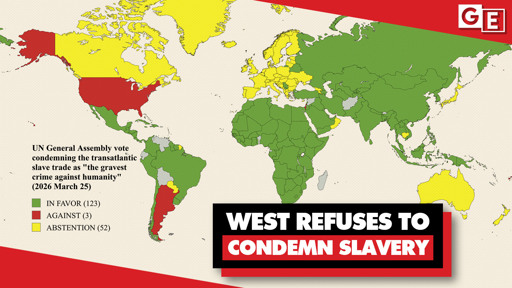
The United Nations General Assembly held a vote on a resolution denouncing the transatlantic slave trade as “the gravest crime against humanity”.
The countries of the political West refused to formally condemn the mass enslavement and trafficking of Africans.
The vast majority of UN member states, which are in the Global South, supported the resolution, with 123 votes in favor.
All of Europe abstained, except for Serbia. There were 52 abstentions in total.
Just three countries voted against the resolution: the United States, Israel, and Argentina’s right-wing regime of Javier Milei.

Paraguay’s conservative, pro-US government abstained. The right-wing, Trump-allied regimes in Bolivia and Ecuador did not vote. (Venezuela lost its right to vote, because it is unable to pay UN membership fees, due to the illegal US sanctions against it.)
Even Ireland and Spain — which in the past have broken with the pro-Israel European Union and supported Palestine — abstained in the vote.
The resolution stated:
The trafficking of enslaved Africans and racialised chattel enslavement of Africans [was] the gravest crime against humanity by reason of the definitive break in world history, scale, duration, systemic nature, brutality and enduring consequences that continue to structure the lives of all people through racialized regimes of labour, property and capital.
The capitalist nations of the West developed their economies through the enslavement and extreme exploitation of Africans.
The UN News agency wrote:
For more than 400 years, millions of people were stolen from Africa, put in shackles and shipped to the New World to toil in cotton fields and sugar and coffee plantations under scorching heat and the crack of the whip.
Denied their basic humanity and even their own names, they were forced to endure generations of exploitation with repercussions that reverberate today including persistent anti-Black racism and discrimination.
The resolution was sponsored by Ghana, whose President John Mahama said Africa wanted “reparative justice”.
West opposes reparations for Africans, arguing slavery was supposedly not a crime when it was committed
What especially angered the West about the UN General Assembly resolution was its call for reparations for the African descendants of the victims of slavery.
Western governments argued that they do not owe reparations, because international law did not exist during the mass enslavement and trafficking of Africans, therefore it was supposedly not a crime.
The US representative, Dan Negrea, claimed that the resolution was “highly problematic in countless respects”, the UN News agency reported.
The US government stressed that it “does not recognize a legal right to reparations for historical wrongs that were not illegal under international law at the time they occurred”.
The representative of the European Union made the same argument on the floor of the UN.
The EU criticized the resolution for implying “suggestions of a retroactive application of international rules which was non-existent at the time and claims for reparations, which is incompatible with established principles of international law”.
“References to claims for reparations also lack a sound legal basis”, the EU argued, stressing that the “principle of non-retroactivity, a fundamental cornerstone of the international legal order, must be strictly upheld”.
The UK Foreign, Commonwealth & Development Office said the same, in a statement explaining its decision to abstain.
The British representative argued that there is “no duty to provide reparation for historical acts that were not, at the time those acts were committed, violations of international law”.
The UK insisted “that the prohibitions on slavery, the slave trade, and what are now considered crimes against humanity had not yet been established in international law at the time of the transatlantic slave trade”.
The post West refuses to condemn slavery in UN General Assembly vote appeared first on Geopolitical Economy Report.
From Geopolitical Economy Report via This RSS Feed.