

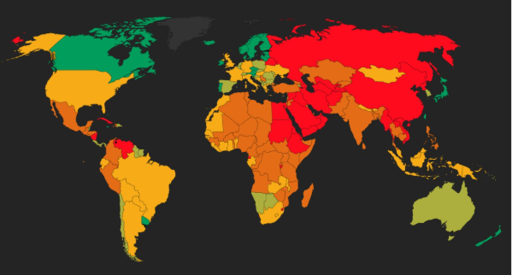
MANILA — The Philippines faces greater scrutiny as global human rights watchdog CIVICUS added the country to the Monitor Watchlist flagging serious concerns about its crackdown on dissent, criminalizing protesters and targeting activists.
“There is a deeply troubling pattern of state actions against protests that is restricting the democratic space and stifling fundamental freedoms,” said Josef Benedict, CIVICUS Monitor Asia researcher on the watchlist released March 25, 2026. “It is creating a chilling effect for many in the Philippines who seek to speak out and organise.”
The Philippines has been rated “Repressed” for five consecutive years, the second worst rating a country can receive, indicating severe restrictions to the freedoms of expression, peaceful assembly, and association.
Benedict told Bulatlat that it started in December 2020, during the presidency of Rodrigo Duterte, and has not changed ever since.
The recent crackdown on protests and protesters in the Philippines is the reason the country has been added to the human rights watchlist. It serves to send signals to the international community about the countries where civic space has come under increasing attack.
CIVICUS enumerated the reasons for the inclusion of the Philippines in the watchlist.
On September 21, 2025, the major anti-corruption protest in the Philippines resulted with widespread police violence and arbitrary arrest.
More than 215 people, among them 91 children, were detained and denied access to lawyers and their families.
Read: 91 children arrested in protest is a ‘large-scale children’s rights violation’ – Salinlahi
Numerous protesters reported inhumane treatment that may amount to torture or ill-treatment during the arrest and their detention.
These cases were confirmed by first responder lawyers from the National Union of People’s Lawyers (NUPL), Public Interest Law Center (PILC), Karapatan, and Sentro para sa Tunay na Repormang Agraryo (Sentra).
A separate report from the Philippine chapter of Amnesty International also corroborated the incidents.
“My whole body had been subjected to beating by three police officers while dragging me from a tent,” victim Luke Malimban told Bulatlat in a separate story. “Not a single person arrived in the blue tent without a bloody face and wounds. We were not fighting back, but the police were persistent.”
Malimban also exposed the dire conditions inside the detention facilities. He recalled being forced to sleep in a standing position because of the congestion, on an uncemented and mossy floor in a room without sunlight.
It took three days for him to even get to change his clothes, which had been soaked with sweat and still had traces of water cannons and tear gas.
He was sleep deprived and had no food to eat until a visitor brought some.
“The conditions were inhumane. It is not even suitable for animals,” he added.
Read: Police violence, torture cases surface as new anti-corruption protest looms
But that was not enough for the Philippine government.
After being freed from their unlawful detention, many activists have also been criminalized.
In November 2025, the Department of Justice initiated criminal proceedings against 97 protesters for sedition and inciting to sedition under the Cybercrime Prevention Act of 2012.
“Telling the truth is not sedition; it is the people’s right,” said Aldrin Kitsune, secretary general of anti-corruption group Kalayaan Kontra Korapsyon (KKK), after filing his counter-affidavit before the DOJ…
Read: Anti-corruption activists fight back against sedition complaints
Subpoenas related to sedition were also issued for movement leaders such as Bagong Alyansang Makabayan (Bayan) president Renato Reyes Jr., as well as several student leaders: Jacob Baluyot, national chairperson of Alyansa ng Kabataang Mamamahayag and associate editor of The Catalyst; Tiffany Faith Brillante, president of the Polytechnic University of the Philippines (PUP) Sentral na Konseho ng Mag-aaral; Joaquin Buenaflor, chairperson of the University of the Philippines Diliman University Student Council.
Read: Activists face sedition charges from DOJ
The repression did not stop at the anti-corruption protests either.
During the commemoration of the 40th year since the People Power Uprising on February 25, the police arrested human rights defenders Edel Parducho and Three Odeña.
The watchlist also took note of the arrest of seven anti-mining protesters in Dupax del Norte, Nueva Vizcaya on January 23, who were continuously defending their community from the mining exploration of British-owned Woggle Corp.
The cases against the seven individuals — resistance and disobedience against persons in authority — were later junked by the prosecutors and the Department of Environment and Natural Resources (DENR) has since suspended the company’s permit for mining exploration.
CIVICUS also flagged the escalated use of fabricated terrorism-financing charges against human rights defenders, land rights advocates, labor organizers, and journalists.
In January 2026, community journalist Frenchie Mae Cumpio and church worker Marielle Domequil were convicted of terrorism-financing charges after nearly six years of pre-trial detention.
The court denied their petition for bail the following month, raising further concerns about the misuse of counter-terrorism laws.
The same law was used against activist Carmilo Tabada and Cordillera labor leader Michael Cabangon last December 2025. They were freed in the same month after posting bail but prosecution continues.
“During a period when public accountability is urgently needed, authorities are choosing to use restrictive laws to criminalise activists and journalists rather than address legitimate public concerns,” said Benedict.
The resistance of Filipino people to human rights violations is also included in the global report of the organization released earlier this month. Particularly, it spotlighted the clamor against anomalous flood control projects and the drug war families’ quest for justice on Rodrigo Duterte’s case before the International Criminal Court (ICC).
Read: Global report highlights Filipino resistance to rights violations
“The international community must not remain silent but call on the Philippines government to adhere to their international human rights obligations to ensure the right to freedom of expression and peaceful assembly and to drop all charges against activists,” Benedict added.
For human rights group Karapatan, the Philippines’ inclusion in the global watchlist confirms their assessment on the dire human rights situation in the country.
“CIVICUS confirms our view that the climate of impunity persists through the infrastructure of impunity,” Karapatan Secretary General Cristina Palabay told Bulatlat, referring to the government policies that disallow the full exercise of dissent, freedoms of expression, assembly and association, and the people’s right to information.
She further affirmed that the situation on the ground exposes that laws are used to criminalize human rights defenders, dubbing the penal system as cruel and punitive for imprisoning innocent and democracy fighters.
The Philippines is a state party to the International Covenant on Civil and Political Rights, having ratified the convention in October 1986. This makes them accountable to violations of civil and political rights in the international community. CIVICUS and Karapatan have been persistent in sending reports of violations before the United Nations Human Rights Council.
“We call on Filipinos to persist in denouncing the draconian policies of Marcos Jr. and his regime’s fascist attacks against the people,” Palabay said. “We enjoin the international community to stand in solidarity with Filipinos in demanding justice and accountability.” (JDS, RVO)
The post Philippines on human rights watchlist due to crackdown on dissent appeared first on Bulatlat.
From Bulatlat via This RSS Feed.