

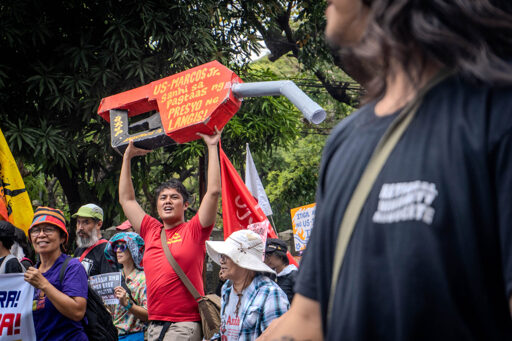
Absence of concrete price control mechanisms leaves transport workers, farmers, fisherfolk, and low-income households vulnerable to what it described as “war-driven oil shock.”
By Shan Kenshin EcaldreBulatlat.com
CABUYAO, Laguna — Transport group Pagkakaisa ng mga Samahan ng Tsuper at Operator Nationwide (Piston) and members of the Makabayan bloc criticized the Marcos Jr. administration’s latest policy responses to the oil crisis.
They said that these measures protect corporate interests as workers and commuters bear the brunt of rising costs.
In a statement released March 25, Piston criticized Executive Order No. 110, which declares a state of national energy emergency, as a “superficial band-aid” that fails to confront the structural roots of the fuel crisis.
The group said that the order operates within the framework of the oil deregulation law, allowing oil companies to continue dictating pump prices with minimal state intervention.
‘Illusion of control’
According to PISTON, the government’s reliance on monitoring mechanisms, particularly assigning the Department of Energy to track profiteering, amounts to a “toothless gesture” in a deregulated industry dominated by multinational oil firms.
“Without price controls and the repeal of deregulation policies, these measures merely create an illusion of control,” the group said.
Instead of decisive intervention, EO 110 emphasizes fuel conservation and “optimization” strategies which transport groups argue shift the burden of adjustment to ordinary Filipinos. For jeepney drivers already struggling with daily boundary systems and volatile fuel prices, such policies translate to reduced income and heightened uncertainty.
PISTON said that immediate suspension of excise taxes and the 12-percent value-added tax on petroleum products would significantly lower fuel prices overnight—something the administration has so far refused to consider.
Burdening the working class
The group warned that the absence of concrete price control mechanisms leaves transport workers, farmers, fisherfolk, and low-income households vulnerable to what it described as “war-driven oil shock,” linking the crisis to geopolitical tensions involving the United States, Israel, and Iran.
“EO 110 treats the symptoms while protecting the disease,” PISTON said, referring to neoliberal energy policies that prioritize privatization and market-driven pricing.
It also raised concerns over the proposed UPLIFT Committee tasked to facilitate assistance to affected sectors. Piston said that the mechanism risks delaying urgently needed aid through “layers of exclusionary bureaucracy.”
The group called for direct, unconditional fuel subsidies for all public utility vehicle (PUV) drivers and operators, stressing that assistance must not be tied to the government’s modernization program which many drivers oppose for its high costs and corporatization tendencies.
Lessons
Transport advocates cautioned against the broad powers granted under emergency declarations based on past experience.
During the COVID-19 pandemic, emergency powers under the Bayanihan to Heal as One Act were criticized for enabling a militarized response and uneven aid distribution. Similarly, energy crisis measures in the 1990s under the Ramos administration led to long-term financial burdens through contracts with independent power producers.
“These experiences show how emergency powers can be used to push policies that ultimately disadvantage consumers,” the group said.
Corporate bias
Separate statements from Makabayan bloc lawmakers echoed similar criticisms, this time targeting aviation policies.
Reps. Antonio Tinio, Sarah Elago, and Renee Louise Co slammed the government for selectively reducing airport fees.
They stressed that the Department of Transportation’s directive to lower passenger service charges applies only to airports regulated by the Civil Aviation Authority of the Philippines, and excludes the country’s main gateway, Ninoy Aquino International Airport (NAIA).
NAIA is operated by the NAIA Infrastructure Corp., a private concessionaire under San Miguel Corp.
They said that this exclusion undermines claims of providing relief, noting that the majority of air passengers pass through NAIA, where terminal fees remain significantly higher.
“Why limit relief to a minority of passengers while leaving the majority to shoulder increased costs?” they asked.
They challenged government claims regarding revenue distribution, pointing out that a substantial portion of terminal fees, particularly passenger service charges, goes directly to the private operator.
Systemic change
Both transport groups and lawmakers stressed the need for structural reforms rather than temporary mitigation.
Among the measures pushed are the repeal of the oil deregulation law, removal of fuel taxes, imposition of price controls on basic goods and services, and the provision of unconditional subsidies to affected sectors.
They also called for the suspension of airport and seaport terminal fees nationwide, stressing that this would provide immediate relief to travelers and tourism-dependent workers amid rising fuel costs. (JDS, DAA)
The post Solons, transport workers slam ‘useless’ energy emergency declaration appeared first on Bulatlat.
From Bulatlat via This RSS Feed.